







The title for Moriah Evans’s newest dance is an unsayable sign: […/+*^%<>€£¥$&@!!!!^^^]. Perhaps some sort of experimental grawlix used in place of an unknown profanity, it sprouts shards of meaning when broken into parts: unfinishedness and ongoingness (“…”); mathematical operations (“/+*^%<>”); competing regimes of value, international exchange rates (“€£¥$”); connectors and conjunctions (“&@”); excitement (“!!!!”); exponentials and insertions (“^^^”).
Titles for contemporary dance tend to provide some sort of linguistic frame, some sort of regime of about-ness. Sometimes they point toward a motivating concept or an implied narrative world. Sometimes they place a dance within a numbered sequence, or pin it to a quirky non sequitur or cheeky joke. In a performance economy marked by an endless stream of social media promotions (“Come to my show! Ticket link in bio!” etc.), titles are the linguistic material through which buzz spreads, creating a social weave of meaning that preempts the event of performance.
With […/+*^%<>€£¥$&@!!!!^^^], Evans sidesteps these conventions while also refusing to leave the dance untitled. Audience members have to improvise linguistically just to say they plan to see Evans’s dance. “Are you going to that dance with all the random symbols in the title?” “Do you have a ticket yet for that performance with the title I can’t say?” Even before the dance begins, the title creates a miniature crisis in the relationship between dance and language, dance and world. How can a dance be talked about? How does a dance get separated from the movement of the world?
^*%}
Over the past fifteen years, Evans has made dances, led collective research projects, taught workshops, and edited dance publications. She is one of the leading choreographic minds of her generation, consistently creating works that challenge how we think about dance as a social and aesthetic practice. Sometimes she calls herself a dance artist who “positions choreography as an expansive social process”; other times she says she is “an artist working in and on the form of dance.”
In addition to her dances and choreographic projects, Evans is a prolific writer and theorist. She often thinks in an interrogative mode, proliferating questions inside her paragraphs. As I read her printed essays and interviews researching this piece, I kept a document on my laptop where I notated all her questions, a swirling account of the stakes and scope of her thinking and writing:
Who and what choreographs the way that society functions?
When does the system choreograph us and when do we choreograph the system?
Can a dancing body or person supersede the choreography so that choreography enters a state of dance?
How do you dance?
Why do you dance?
How do you dance with desire?
How do you dance without desire?
Can we act without will?
How does agency operate?
Why meet?
Why come together?
How do we come together as groups — in solidarity yet with difference?
How do we work collectively?
Who is the “we”?
How actually is knowledge transferred?
How can artists come together outside of normal models of production?
What are your urgencies?
What are you working on now?
What should the dance community gather around?
Do we even want to do something together?
What do infrastructures of colleagueship and friendship offer?
What do they limit? Is trust inherent, granted, earned?
How much time do we need before we can trust each other?
How are consent, instrumentalization, and power operating?
Who is the author of what?
What is a post-subject-driven, anti-heroic art practice?
Why do people dance in front of others instead of dancing with each other?
Do we need to be looked at?
Do we need to look at each other?
How do I sustain other people’s creative practices in the structures I create?
Why would I try?
How do we bring people together in a sustained and committed manner?
Why are we dancing and who cares and what does this really have to do with life, with the world?
:&;*!>
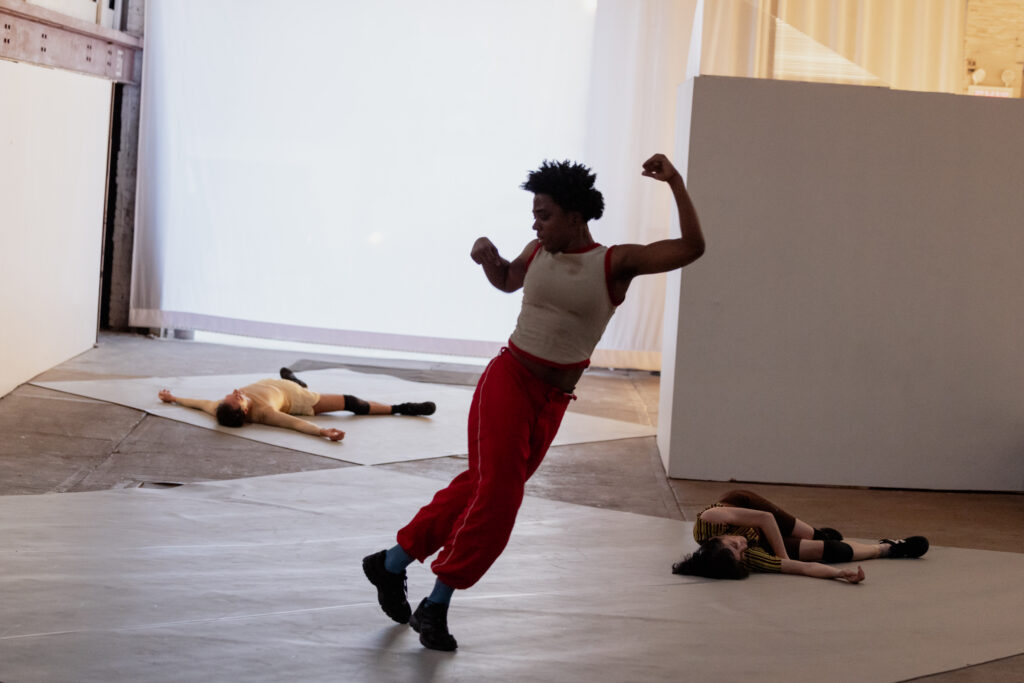
In June 2026, Evans presented an iteration of […/+*^%<>€£¥$&@!!!!^^^] at the Chocolate Factory Theater in Queens, New York. The Chocolate Factory Theater is an open warehouse on an industrial street surrounded by autobody shops and metal fabrication workshops. It has white walls and a concrete floor, with a slightly raised white rectangular platform at the far end. While this platform implies a stage, for […/+*^%<>€£¥$&@!!!!^^^], Evans seated the audience around the perimeter of the building so that sight lines traversed the entire warehouse. In addition, a large garage door, which typically remains closed to separate the theater from the street, was left open for the performance, covered by only a thin veil of translucent fabric. Throughout the dance, the theater remained permeable to the street, with shifts in sound, light, and temperature outside affecting what happened inside. People who happened to be walking by on the sidewalk became unwitting performers, visible and audible to the people gathering to watch the dance.
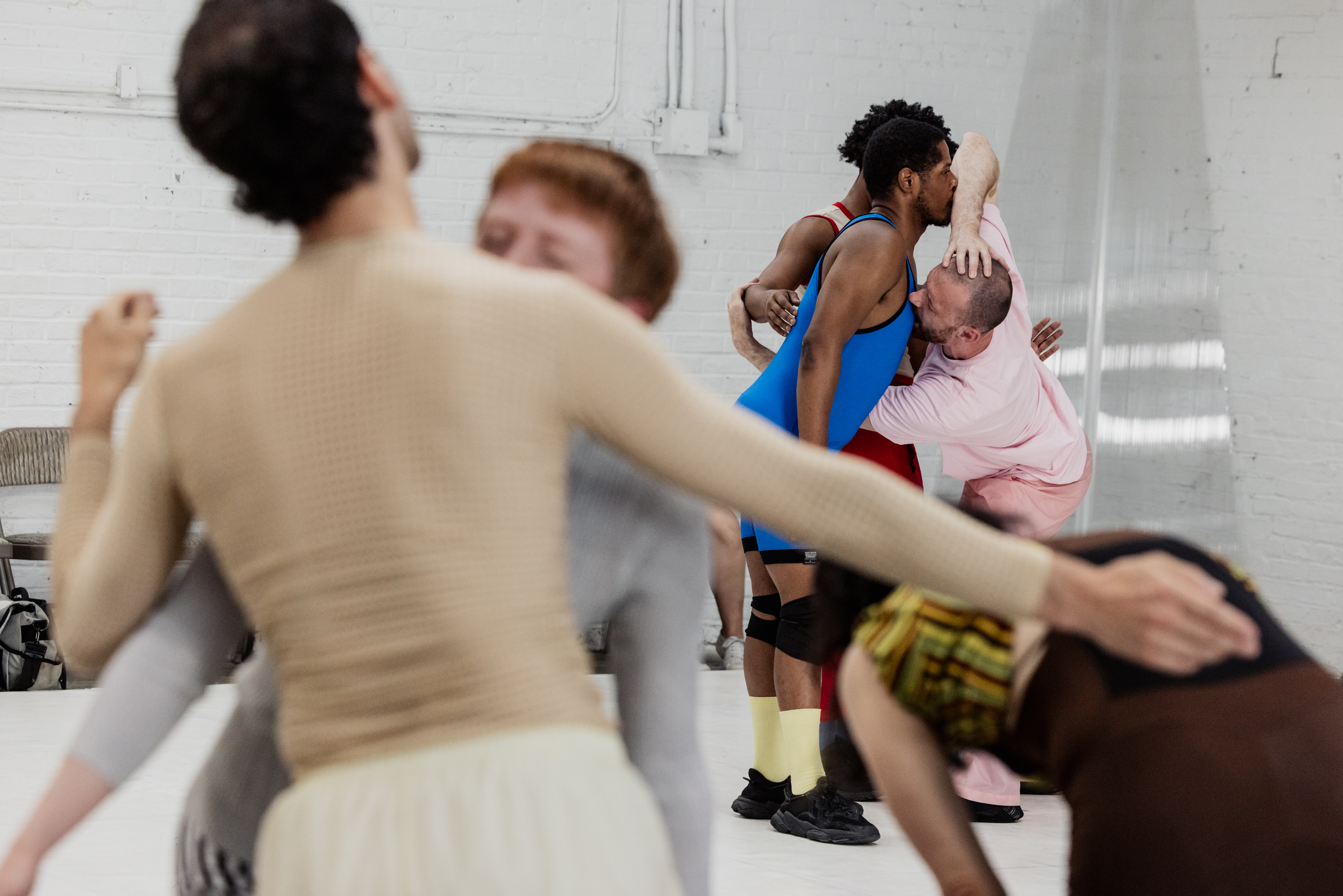
[…/+*^%<>€£¥$&@!!!!^^^] began with a series of deaths. Evans’s dancer-collaborators—Cyril Baldy, Malcolm-x Betts, Chloë Engel, Kris Lee, João dos Santos Martins, and Varinia Canto Vila—entered the space in bright costumes that conjured both sports and clubbing (singlets, shorts, kneepads, sneakers, translucent materials, a shirt with a large round hole in the center of it). One by one, they walked to a location—a corner, a seemingly random spot on the concrete floor—and melodramatically feigned death, collapsing to the ground. Once a dancer “died,” the remaining members of the ensemble would gather household objects and construction materials from around the room—hardly visible before, scattered at the edges—and assemble a precarious sculpture on and near the body of the fallen dancer, like an abstract three-dimensional crime scene outline, or a haphazard mourning altar, before then stepping back and taking a moment to look at the body-sculpture together.
When I asked Evans about these opening deaths and the position of death and dying in her work more broadly, she replied, “Well, as I always say, ‘Life is dance, dance is death.’”
*!!$%^
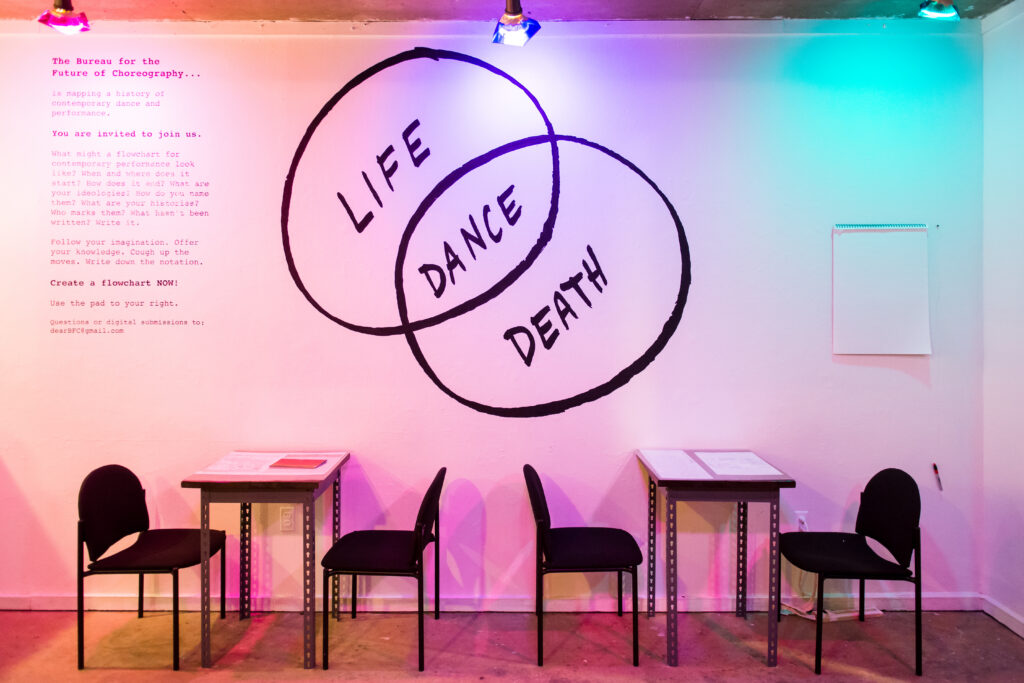
This isn’t just something Evans says. “Life is dance, dance is death” refers to a Venn diagram that has reappeared across her work over the last 15 years. In it, two circles overlap: One circle contains the word “life,” and the other contains the word “death,” with the word “dance” hovering inside the overlap. The diagram implies a few immediate readings: Life and death overlap, and dance is what happens at that convergence; dancing can be of life and dancing can be of death; life and death dance with each other; dancing is what we do in the interval between life and death; life is dance with death. The diagram has become something like a memento mori for Evans, a spare schematic update of the early modern danse macabre motif in which skeletons dance with the living.
The story of the diagram begins with the Bureau for the Future of Choreography, an experiment in shared authorship and group choreographic inquiry that held its first meetings in 2011. Evans has described the Bureau as a “fantasy of mine to make a collective sharing of practices amongst practitioners as well as to stage problems of collaboration in the field.” As Evans tells it, the diagram first emerged during a collaborative session at Asad Raza’s apartment. The visual artist Evelyn Donnelly drew the overlapping circles, and Evans wrote the words. From there, the “Life is dance, dance is death” diagram played a central role in the Bureau’s The Flowchart Project (2012–14), a research endeavor that set out to “map different histories of contemporary dance and performance from 1950 to the present and to postulate the future,” but became about how artists and theorists work with visual forms like diagrams, schemas, maps, and timelines to visualize not-necessarily-visual concepts (like dance and history).
Now, “Life is dance, dance is death” appears on costumes worn by Evans’s collaborators and is silk-screened onto T-shirts that circulate like bootleg merch around the dance and performance scenes. You can be at a bar in New York and see someone wearing a “Life is dance, dance is death” T-shirt, bringing the unholdable thought of death’s overlap with life to the dance floor.
(*&$}}
At the Chocolate Factory, […/+*^%<>€£¥$&@!!!!^^^] lasted two and a half hours. It was an early summer heat wave, and there was no air conditioning in the venue. Sweat poured off the performers and beaded the brows of spectators. Sometimes dancers moved anarchically, seemingly from internal energetic impulses completely independent of one another; other times they performed extended coordinated and unison sequences that were immediately legible as dance steps or physical exercises. Often the dancers moved at the edge of what seemed possible, creating gestures that exceeded what I thought a body could do, and then doing those gestures for longer than I imagined bearable (twisting falls that stretched out with abandon, repeated jumps as if trying to get beyond the vertical confines of one’s own body). They would reach a limit and go past it, finding endurance within exhaustion.
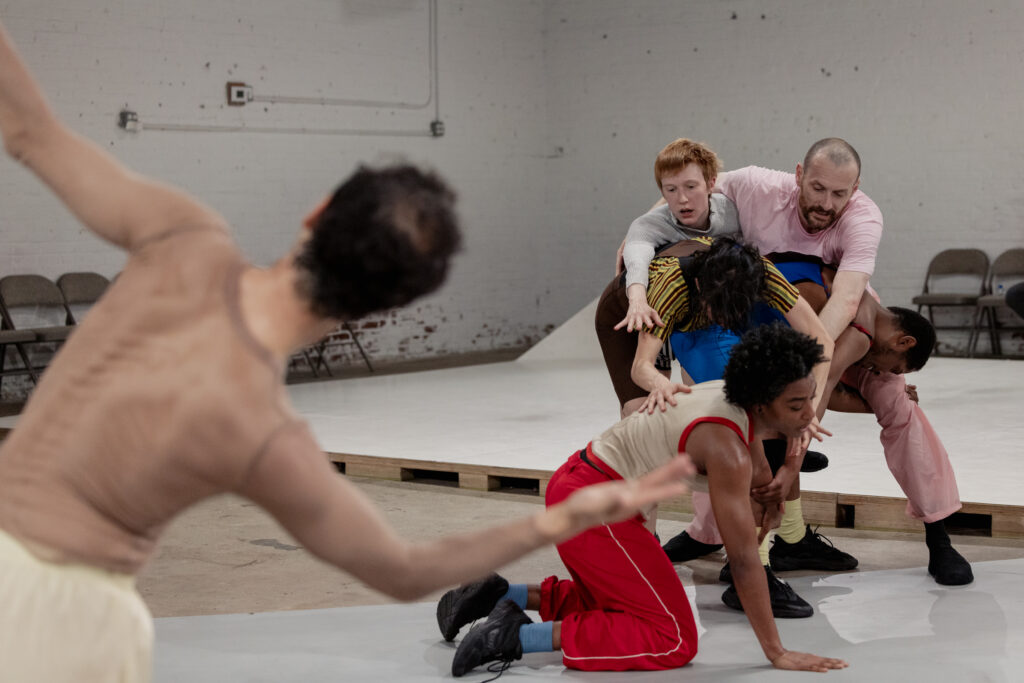
When I attended a rehearsal in preparation for the Chocolate Factory performance, I heard Evans talking to her dancers about a section of the dance that she referred to as “organ transplants.”After the rehearsal, I asked her what she meant by this. She laughed and only half-jokingly said, “We’re actually doing organ transplants. It’s real to us.” Dancers used heightened proximity and touch to imaginatively and yet materially give one another their organs without surgical intervention, engaging in the impossible and yet real task of taking another person’s interiority into oneself: the uncanny embrace of two dancers pressing into each other, spleen to spleen. For the philosopher Jean-Luc Nancy, who wrote the essay “L’Intrus” (“The Intruder”) about his experience receiving an actual heart transplant, organ transplantation makes a series of universally experienced, existential conditions more explicit, namely: (1) the absolute entwinement of life and death, what Nancy calls “life/death,” and (2) the ways that we are constituted by internal exteriorities, or, in other words, the things that make us up are often radically beyond our knowledge and control, what Nancy calls “the elsewhere ‘in’ me.” For Nancy, as for Evans, organ transplantation makes clear the ways that we are fundamentally constituted by what is not us, and life is constantly imbricated with death.
*&%(#)
During the rehearsal I witnessed for […/+*^%<>€£¥$&@!!!!^^^], Evans reminded her dancers of the prompt for the final sequence of the performance, instructing them:
You are always touching and being touched in two places. You are engaged in an act of connection and desperation. Try to know what organ you are working with and move through space. You are pushing and pulling, climbing over and through. You are a moving pile, a moving chain. If you get disconnected, you scream. Think, The Raft of [the] Medusa. It should be extreme. It should also be kind of fun.
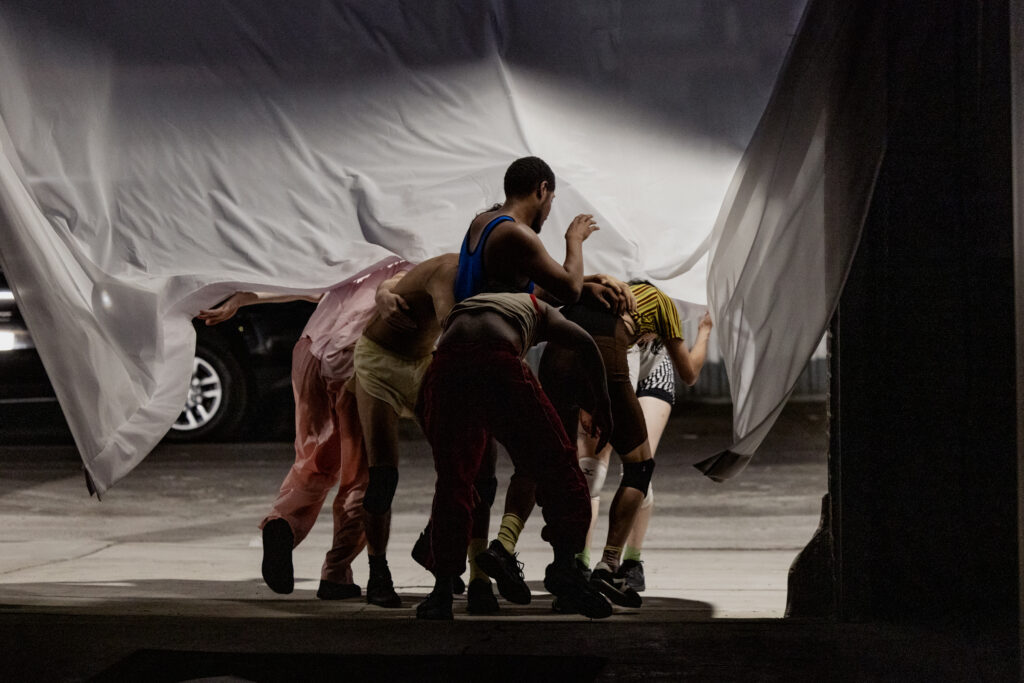
In the performance, this final sequence was thrilling. Evans’s six dancers, out of breath and dripping, clinging to one another in a constantly unraveling collective knot, crying out at any moment of disconnection while attempting to move together from one end of the theater to the other, eventually passing through the translucent garage door curtain and moving onto the street outside. It was a collective shape with all the ecstasy, pain, and wreckage of our shared antagonisms. How do we get somewhere else together? Life is dance and dance is death, but how do we dance together through the uneven distribution of life and death? Whose life? Whose death? Whose dance?
Evans and her collaborators will debut another iteration of the performance, }[…/+*^%<>€£¥$&@!!!!^^^]{, at the Walker Art Center on October 9 and 10, 2026.






Contribute your thoughts by leaving a reply