






When I arrived at the Montreal Museum of Fine Arts (MMFA) to see contemporary Canadian artist Keerat Kaur’s exhibition Sweet Speech, I mistakenly went to the second floor, home to the museum’s contemporary art galleries. The show was instead on the fourth floor, installed among one of North America’s largest collections of Sikh art. My wrong turn was telling: I’d assumed the very division between the contemporary and historical that curator Laura Vigo was upending by situating Kaur’s work in this wing.
Recently renamed The Arts of One World, after Édouard Glissant, these galleries—which combine historic art from Africa, Asia, Oceania, the Middle East, the Mediterranean, and the Americas—were substantially expanded by the Kapany family’s 2022 donation of Sikh artworks. Vigo, the MMFA’s curator of Asian arts and archaeology, has advocated for bringing contemporary artists into this space. In 2024, she began working with Kaur, an artist of Sikh-Panjabi heritage, on what would become Sweet Speech.
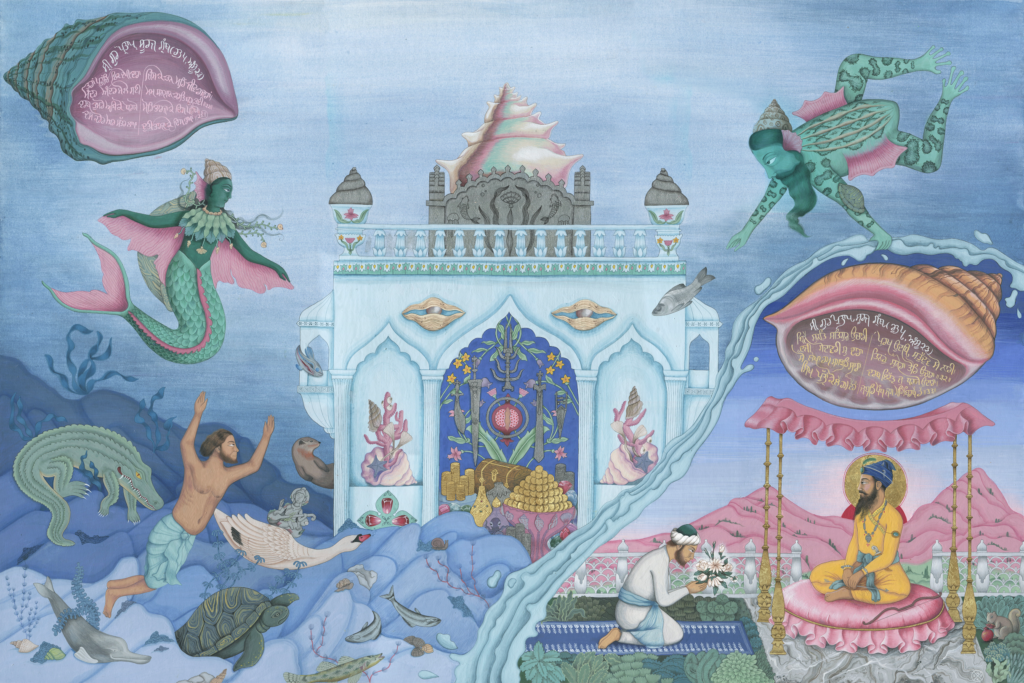
The solo exhibition, Kaur’s first at a Canadian fine arts institution, features sculpture and paintings in gouache, acrylic, and oil, with most draped across the walls of the fourth-floor galleries alongside Sikh artworks from the nineteenth and twentieth centuries. The show’s title is Kaur’s translation of the Sikh tenet of Mithī Bolī, described in an introductory wall label as “being shaped by humility, love and truth,” and, as the label also specifies, Kaur’s art draws on her upbringing in the gurdwara. But beyond the obvious connections between Kaur’s identity and the Kapany Collection’s dedication to Sikh arts, the artist’s works defy the rigid categories and linearity that often characterize Asian art shows and collections at Western museums, channeling her own, dreamlike interpretations of the divine and the mythological, all while dis/orienting the audience through hypnotic, immersive strategies.
One of the first works in the exhibition is a quadriptych of gouache paintings titled Nīlā’s Birth Story. The works, vibrant and ethereal, depict the imagined birth story of Sikh Guru Gobind Singh’s blue horse, Nīlā, along with Nīlā’s friendship with a white hawk named Bāz. Nīlã travels through air, water, and land before curling around the moon, which Bāz has just fetched for her. She goes to sleep surrounded by foliage with the hawk on her back. Kaur studies traditional Pahari painting, and the bright palette, the narrative approach, and her treatment of Nīlā—clean-lined, luminous, and caught in lyrical motion—extend the visual language of the historical gouaches into the present.
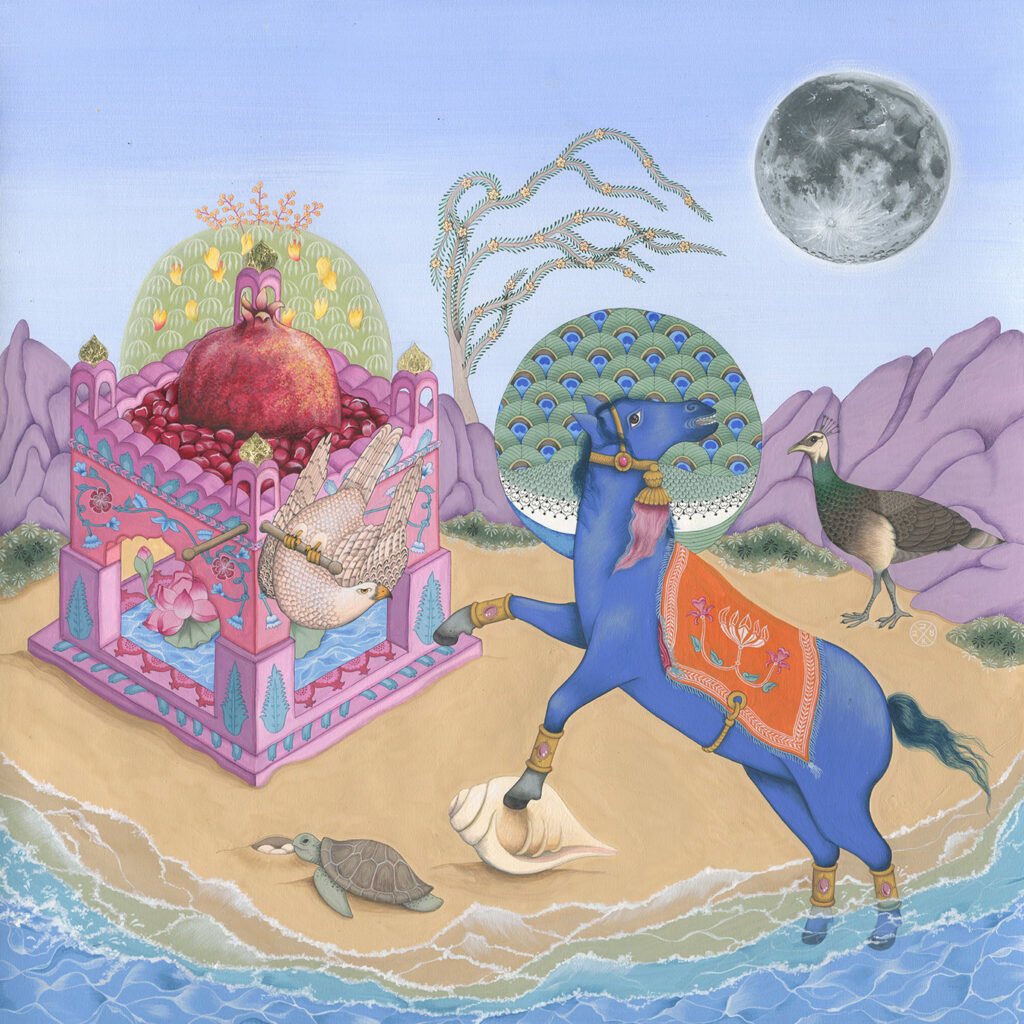
Directly across from the quadriptych, installed in a vitrine, are two Sikh knives, nineteenth-century objects from the Kapany donation, cleverly placed so that they feel almost part of Kaur’s work. Nīlā’s Birth Story is spiritual, inviting the viewer close to the artist’s relationship to her faith. The knives, religious artifacts that could have easily appeared in one of Kaur’s paintings, underscore the extent to which her art and these objects belong to a living material history.
Kaur also authored the wall texts accompanying each work, giving her interpretive voice an unusual prominence within one of Canada’s most traditional institutions. Writing about Origin Story (2020), among the exhibition’s largest works, she explains that the painting “contributes another layer to an inherited symbolic language, rather than inventing a new one.” The acrylic self-portrait literalizes this claim: Kaur emerges from a pomegranate at the top of the canvas, her face turned downward and one hand reaching out into the world. Around her, large roses and thornless green leaves fill an expansive ethereal landscape while an oversize seashell floats in the foreground. Its saturated color, natural setting, and poetic compression place the work in visual conversation with the richly illustrated Janamsakhis folios nearby, without collapsing the distance between them. Kaur inhabits an inherited symbolic field and stretches it to accommodate her own arrival.
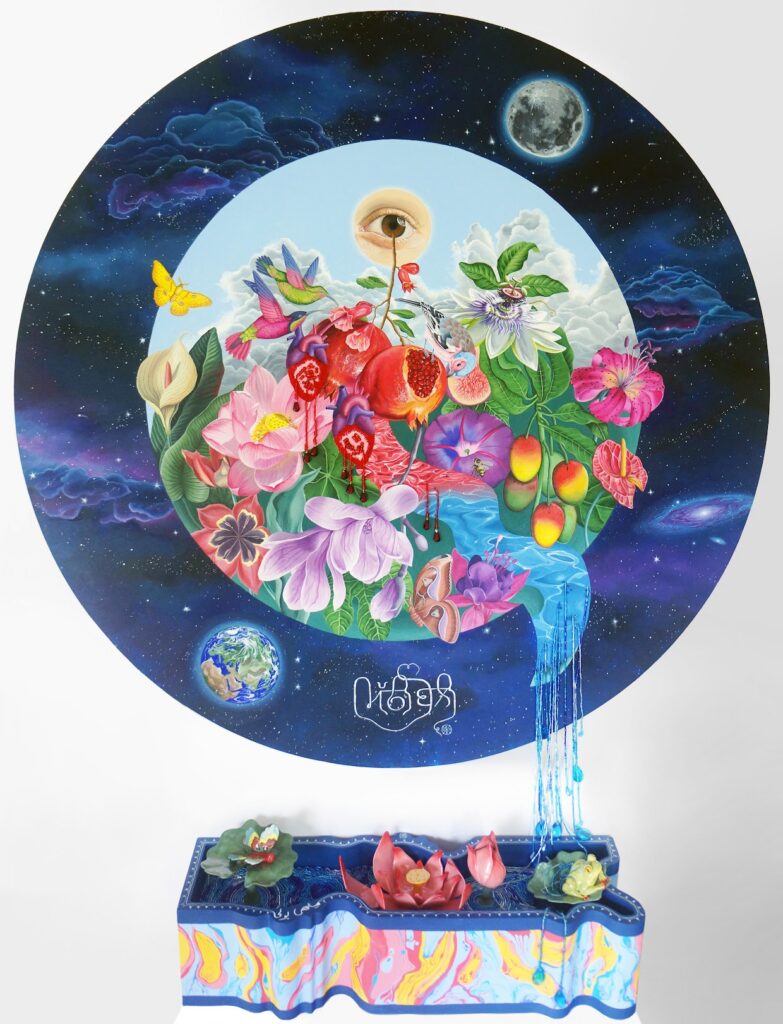
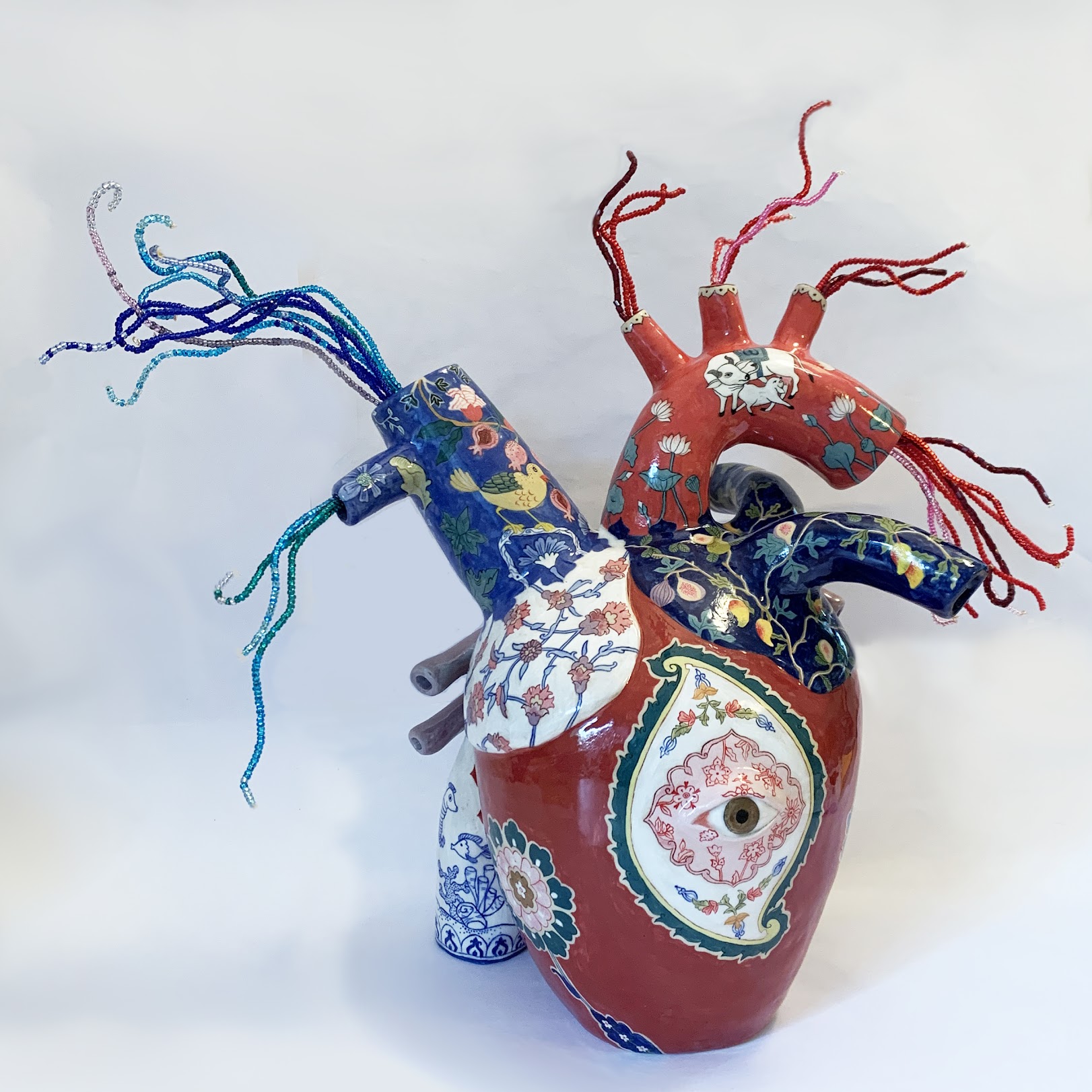
A recording of Kaur’s own singing in Punjabi plays throughout the galleries. The hypnotic melody links one work to the next. Further into the exhibit is Heart Cleanse, a 2020 ceramic sculpture of a large red and blue heart with beaded veins and arteries spilling out of the valves into a splay of organic tendrils. Delicate patterns cover the organ—flowers, beads, creatures—and a large open eye looks out from one side. The presence of the eye turns the heart into something conscious and watchful: an organ steeped in inherited knowledge, yet acutely perceptive.
Shortly before I visited Sweet Speech, anti-Sikh unrest erupted in my home, the United Kingdom, amid increasing anti-Sikh racism across Canada. At the same time, twentieth-century South Asian works were becoming increasingly lucrative on the art market. This conjunction—living communities exposed to racist violence while historical artworks circulate as increasingly valuable assets—sharpens the stakes of Kaur’s placement within the museum. Western art institutions can profit from Sikh art while leaving intact Orientalist hierarchies that privilege colonial-era work over contemporary practices. Installed among the MMFA’s historical Sikh holdings, Sweet Speech disrupts that chronology. The exhibition presents Sikh art as a living and evolving practice: inherited and inhabited by Kaur, whose gestures are playful, immersive, and personal, bending time and space, and inviting us to trade rigidity for expansiveness.









Contribute your thoughts by leaving a reply