








“There is always a danger that the relative freedom of art can render it meaningless. Yet it is this same freedom which allows art, and art alone, to express and preserve the profoundest expectations of a period.”
—Art and Revolution, John Berger (1969)
To move in on a piece of Shannon Bool’s—a textile, a collage—is to feel it shift on you. An image becomes something you’re entering, like an animal drawing you into the bush. Grids dance, silver veins begin to run, mirrors liquify and sluice to the front of what they used to background. Bool incorporates found print and digital images alongside craft elements like jacquard weaving and ceramics, and the suggestion of movement is everywhere it shouldn’t be—in buildings, mannequins, hardened wax. Systems of control—architecture, grids, pixels, weaving—get contaminated, or that would be the word if it wasn’t all so infused with glamour.
Systems are typically made to avoid friction, but Bool’s systems seem to invite a misbehaving instead: a slippage that beckons, even if it’s suffused with an aspect of distrust. In The Wave, her recent (and sixth) solo exhibition at Daniel Faria Gallery in Toronto, Bool rushed together the influences of technological fantasy, military machinery, and neoclassical female nudes to stage a forceful yet stealth encounter with the idealized forms we keep perusing or being issued. Bool stepped inside inherited aesthetic and mechanical forms as though testing out their boundaries, pressing against their outlines, asking: What happens when a structure designed to organize the world becomes susceptible to everything it was designed to exclude?
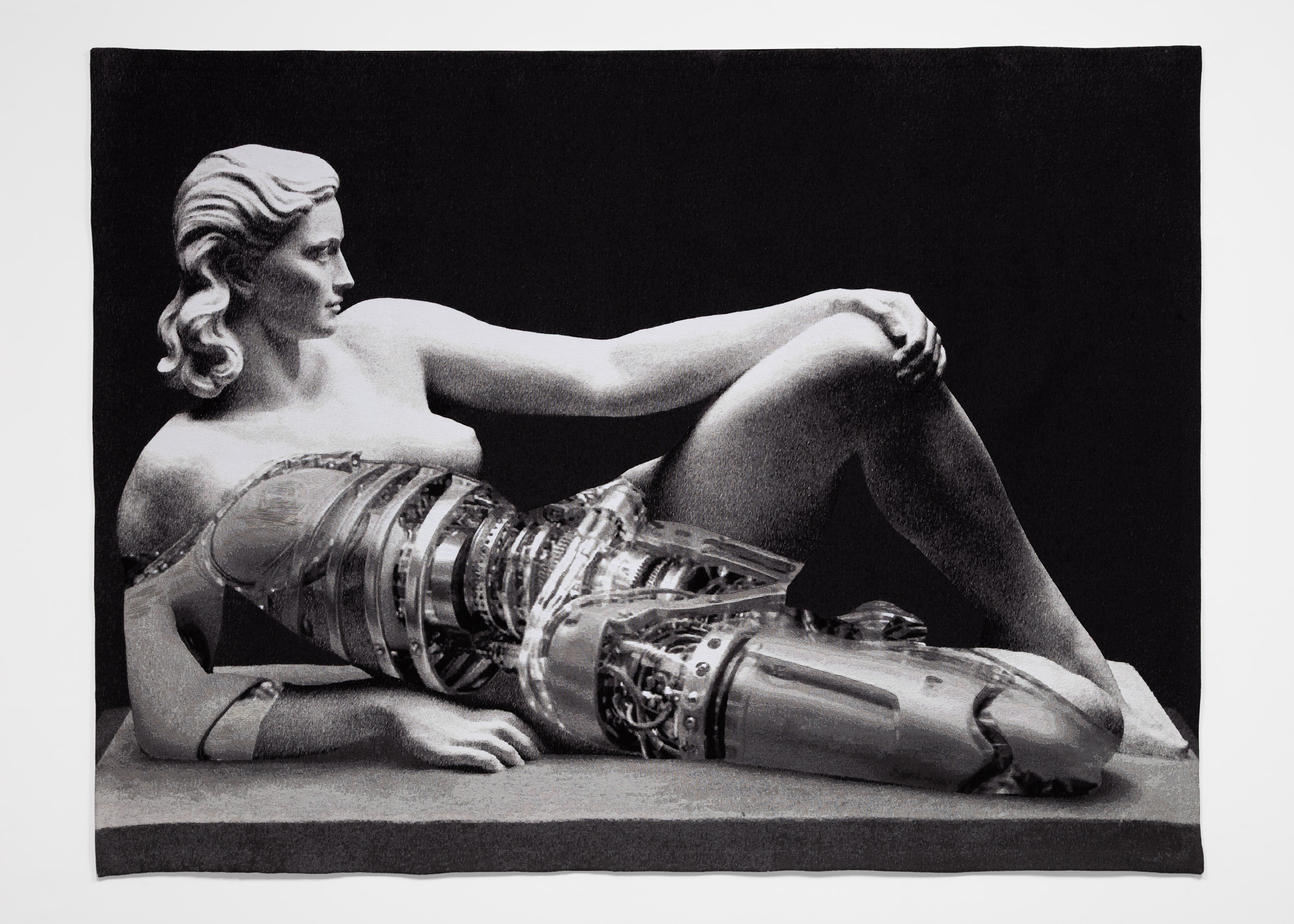
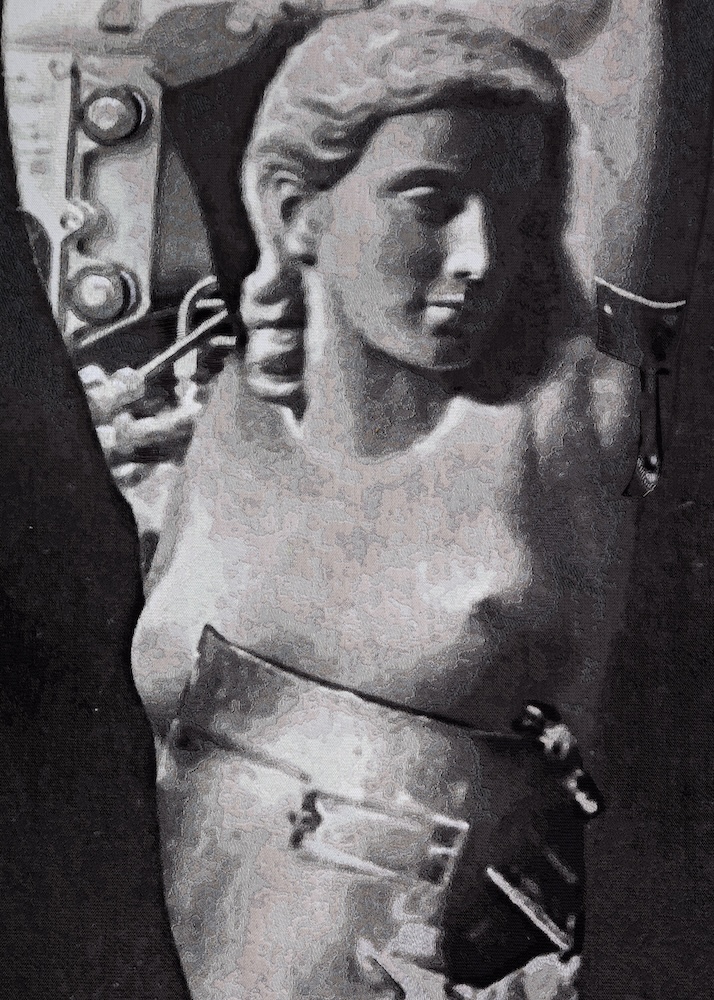
The female ideals of the Odalisque, Venus, and Pietà held the exhibition’s center, featured in large unframed, grayscale tapestries. Walking up to them feels like walking toward sculpture: You do it hesitantly, and in awe. Their iconic status and imposing presence become entangled with another projected female body, the compliant technological companion. Across the weavings and silk paintings, female and machinelike forms surface within layered scaffolding and corridors, their contours at times bleeding into the structures that contain them. This is all within Bool’s bag: taking images through which societies picture their ideals and messing with their transmission.
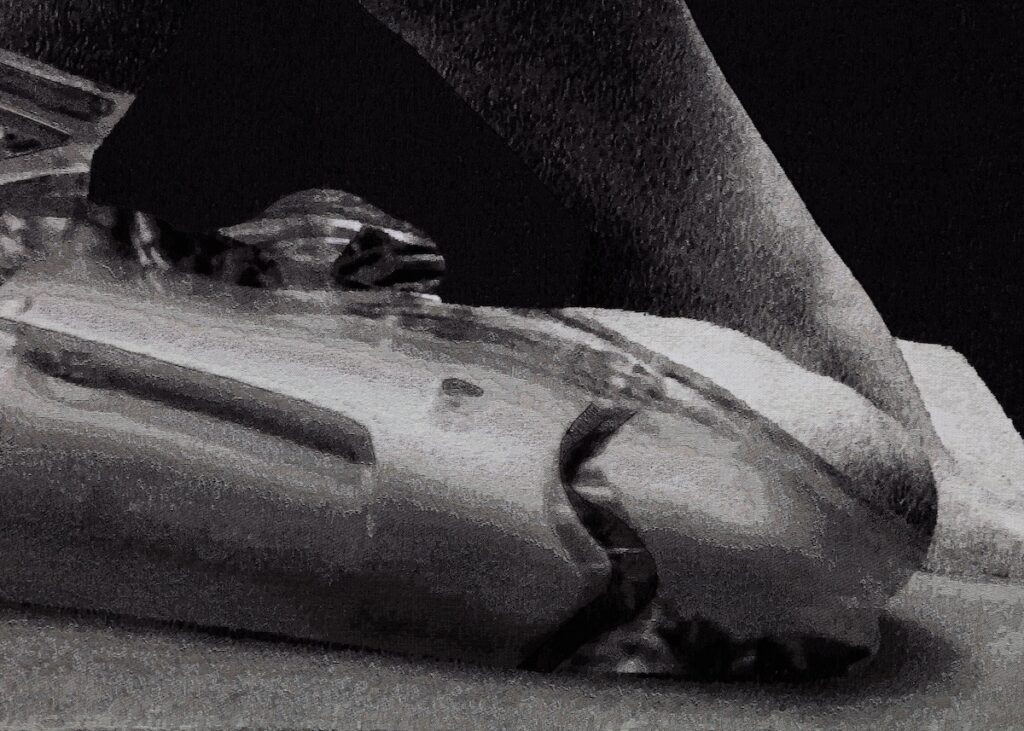
The show’s title, The Wave, has a darker provenance: It translates from Die Woge, Fritz Klimsch’s 1936 sculpture of a reclining female nude. Klimsch, like his contemporary Georg Kolbe, never joined the Nazi Party, though both artists found favor under national socialism, which saw in their romanticized female figures a useful image of the body. Bool’s wave, then, carries some troubling historical undertow: A vision of femininity shaped nearly a century ago resurfaces inside our fantasies of the technological future. Why—she seems to ask, needling at our limited imagination—does the “future” keep reproducing the same bodies?
A wave is not merely a repetition, but energy carried and transmogrified across time. Bool’s images travel accordingly. The bodily and structural forms associated with modernist figureheads like Adolf Loos, Ludwig Mies van der Rohe, and Le Corbusier keep surfacing in her work, becoming entangled with more contemporary signals—corporate architecture, say, or a snatch of misinterpreted celebrity culture. Even the exquisite precision of her jacquard tapestries seems to account for the disturbances of digital rendering: pixelation, dust, glitches, and residues registered like the coordinates of an ancient pattern.
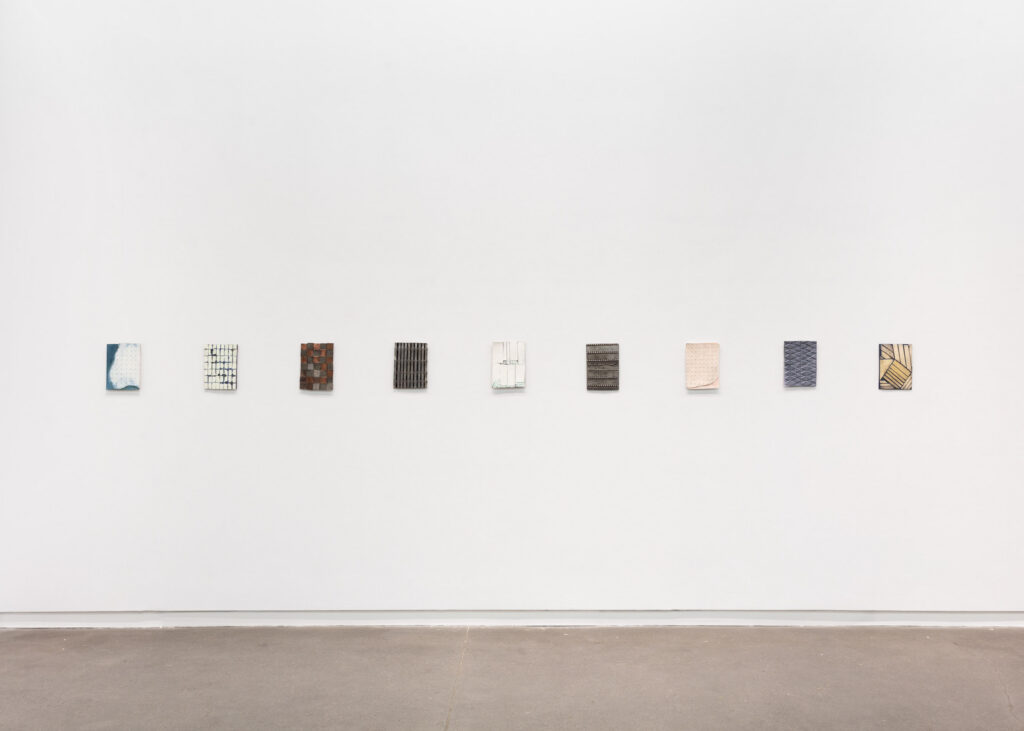
That instability is material, too. An ongoing series of small, abstract ceramics line a corner of The Wave. Deceptively simple, seemingly timeless, these tiles are in fact translated from digitally generated images. Individually glazed and fired ceramic “pixels” feature lines that bend and pool, skewer and shimmer, turning geometry into something more bodily. Bearing an unexpectedly monumental origin—they developed out of Bool’s work on an upcoming permanent installation for the Opera House in Cologne, Germany, where she also currently has a solo exhibition at Kunst-Station Sankt Peter—the ceramics make the digital image vulnerable to the contingencies of material transformation, exposing its fantasy of frictionless precision to the ancient technology of heat and glaze.
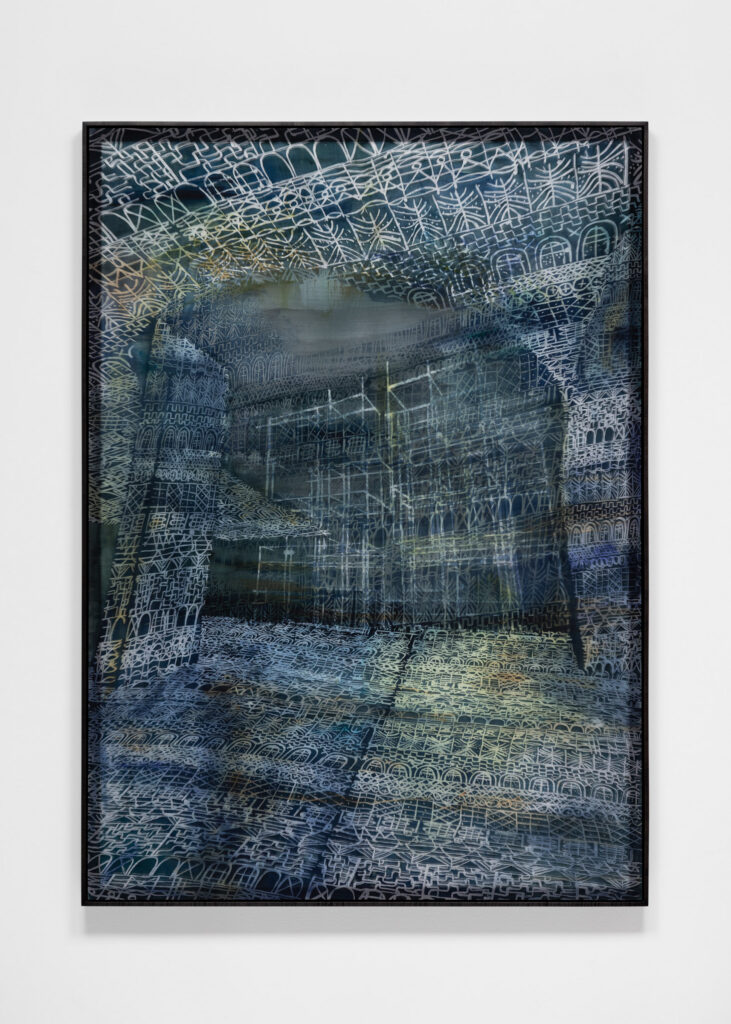
The silk paintings make this destabilizing impulse especially literal, though not always more convincing. Bool begins with photographs of modernist and fascist architecture in Italy, overlaying their facades with her own scanned drawings before transferring the resulting patterns, through wax resist, dyes, oils, and inks, onto chiffon silk stretched over a mirror. In a work like A Study in Support (2026), grids double and slip in reflection, admitting the room—and our bodies—into their surfaces. Yet for all this movement, the paintings can feel strangely unresolved. Their scale is neither immersive enough to make architecture feel newly bodily nor concentrated enough to give their collisions real pressure. The works luster, but they also diffuse.
Bool’s insistence on putting images through material processes matters in The Wave, especially because so much of what she’s contending with is the fantasy of the frictionless: frictionless images, frictionless technologies, frictionless female company. In the large jacquard tapestry Die Woge (2026), Bool makes the correspondence between illusions of bodies and machinery almost obscenely easy. Klimsch’s reclining nude retains her serene profile, extended arm, breasts, and bent knee, while a turbine-like machine takes the place of much of her torso and pelvis. Nothing in her comportment registers the substitution. She remains perfectly composed, even as woman and machine become continuous. In Venus (2026), another significant tapestry, the operation runs differently: Mechanical components—jointed metal forms, struts, and lengths of cable or tubing—seem to enter the figure as anatomy, coursing through the opened torso and leg while her classical head remains demurely inclined. Technology transforms these women’s bodies without disturbing their poses. The old ideal and the new machine seem to recognize each other.
What are the images of our period preserving? And what if they’re embarrassing? Bool captures an old energy traveling forward, altered in appearance and disturbingly intact. Her machines don’t replace these inherited ideals so much as furnish them with new bodies, new surfaces, new claims on the future. The friction comes in recognizing how little the underlying fantasy has had to change.











Contribute your thoughts by leaving a reply