


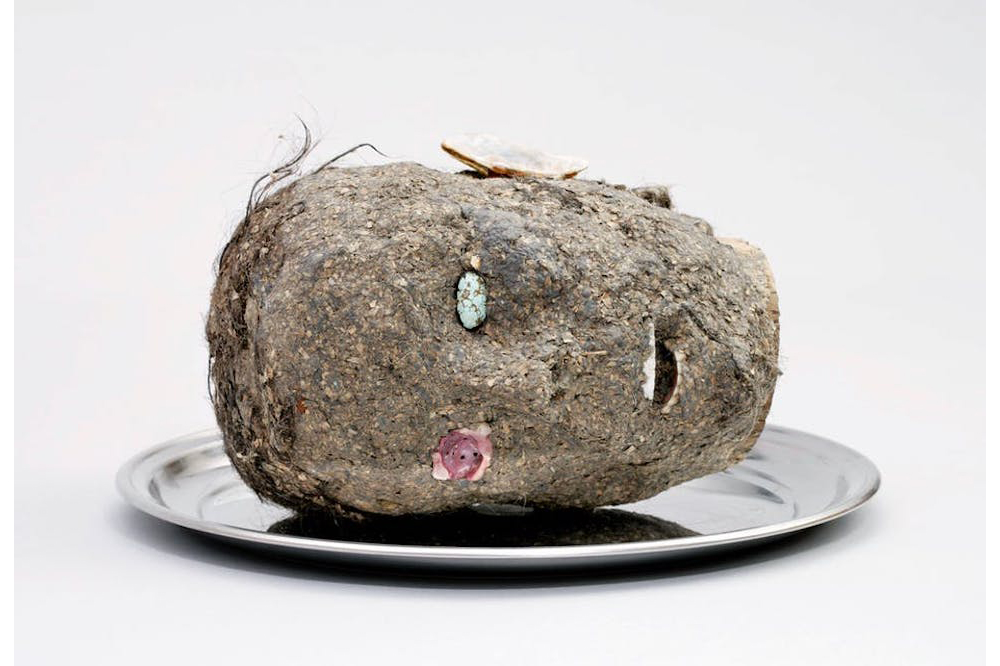






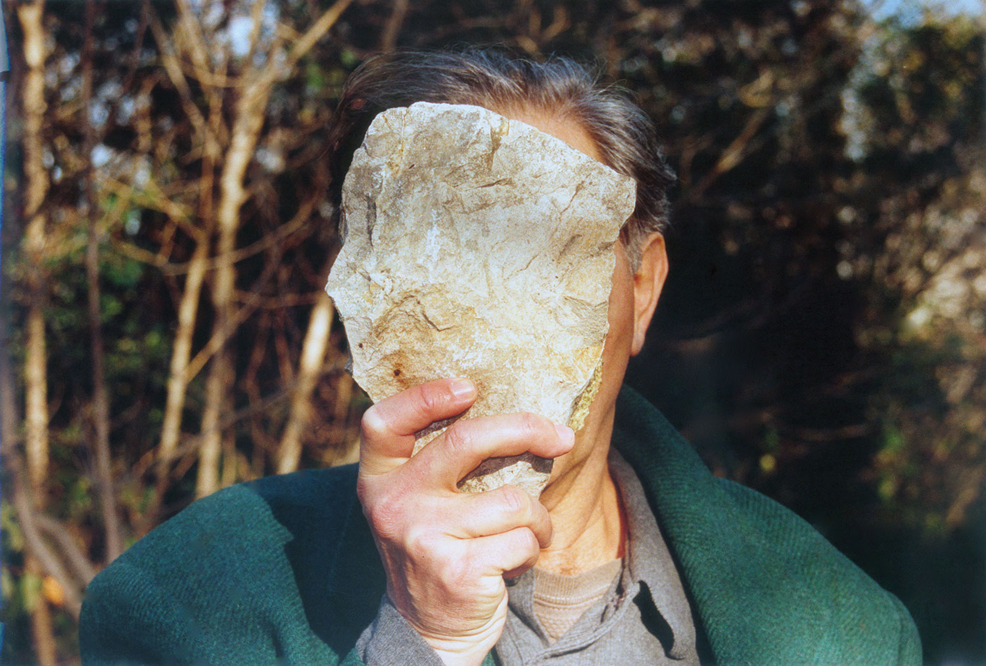
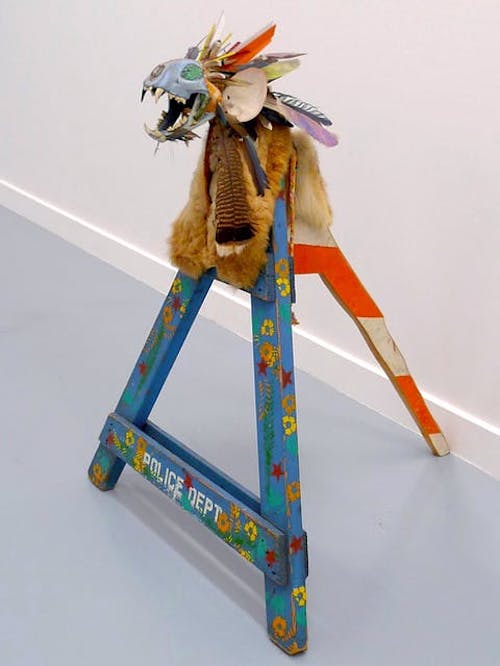
In April, I wrote a review of an exhibition at the Hammer Museum at UCLA: “Jimmie Durham: At the Center of the World.” I knew Durham’s work only vaguely, having seen it in dribs and drabs, one piece at a time in group shows; but seeing a wide collection all at once, in his first large-scale solo exhibition in the U.S., was revelatory. The work tickled all my sweet spots – it was funny, self-deprecating, ironic, anti-essentialist when it came to the artist’s own identity and the romantic stereotypes forced upon him by the artworld, and it was deeply critical.
The problem was, of course, that while Jimmie Durham’s work appealed to me – a South Asian woman determined to work beyond the bounds of my identity – precisely because of his defiant rejection of attempts to box him into the category of “Cherokee artist,” it turns out that it wasn’t his box to claim or reject in the first place.
Doubts as to Durham’s allusions to his Cherokee ancestry have been circulating since his days as an active member of AIM (the American Indian Movement) in the 1970s. They eventually led to his cutting ties with the organization in the late ’70s, and leaving the U.S. altogether a decade or so later. The Hammer made these facts clear in the catalogue and supplementary material for the show, although it explained them as a principled stand by Durham: his “refusal to register” with any of the recognized Cherokee tribes was his protest of both the U.S. government (which he said had no right to name him or his people), and of the presumably reactionary stance of the Cherokee “establishment,” who were simply picking up where the state left off by insisting on arbitrating its membership.
To my eyes, this narrative made so much sense; Durham was not that different from artists like Coco Fusco and Kara Walker, steeped in a new form of critical race theory. Around the same time, these artists also faced accusations from their own communities that their art didn’t correctly reflect their identities. (Walker seems to have alluded to this history’s bearing on the current Durham brouhaha in a recent Instagram post: a photo of a protest pamphlet made by the artists Betye Saar and Howardena Pindell just after Walker won a MacArthur “genius” grant.)
The crucial difference is that while these artists have been charged with not performing their identities appropriately in their work, no one contests that Kara Walker is Black or Coco Fusco is Cuban. By contrast, an increasingly loud chorus of Cherokee and American Indian activists, artists, and curators is arguing that Durham is not Cherokee at all.
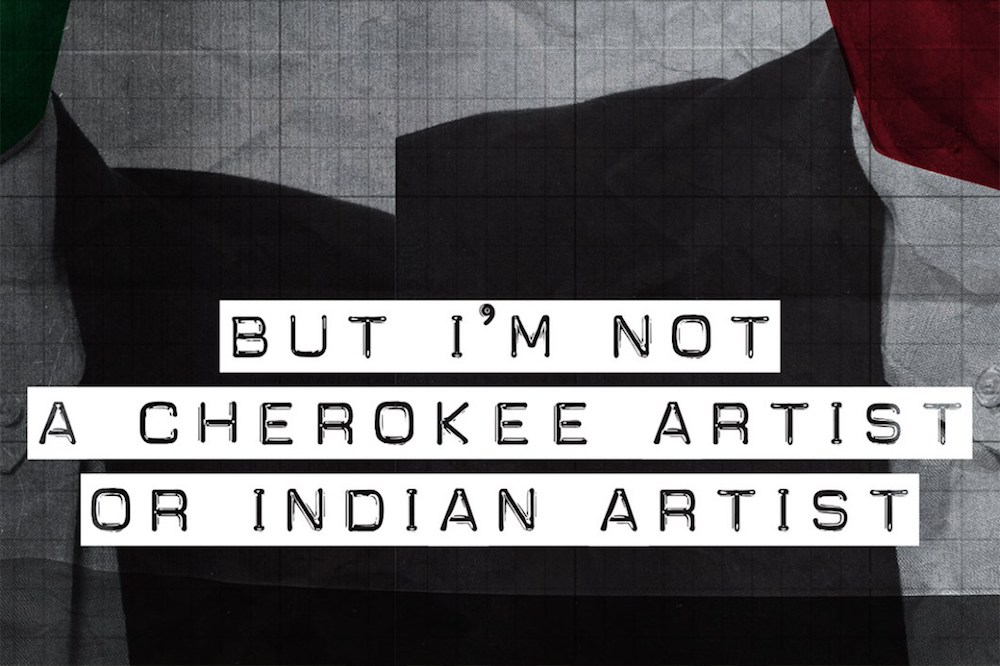
Their claim is based on extensive genealogical research, and the fact that Durham is never known to have engaged in any aspect of Cherokee culture. (His involvement in the AIM in the early 1970s was not related to the Cherokee community specifically.) Their long-standing objection to Durham’s self-styling as a Cherokee artist gained traction in recent weeks, when the show moved from the Hammer Museum to the Walker Art Center. No doubt the mainstream artworld was more disposed to hear the concerns of American Indian protesters after a recent controversy saw Sam Durant’s appropriative Scaffold, installed and then taken down at the Walker just a month or two earlier. In the face of this new awareness on the part of many non-expert bystanders, Durham’s repeated, cheeky warnings not to call him a Cherokee artist – made both explicitly, in his statements, and implicitly, in the work itself – sound rather more literal than they first seemed.
My friend Daniel Quiles, as we watched the Durham affair unfold on social media, described the reaction by non-Native commentators as akin to cycling through Kübler-Ross’s five stages of grief. In my own case, this has definitely proven to be true. That I passed through these stages in public, on Facebook threads that will forever record my stubborn refusal to accept some basic truths about art, identity, and settler colonialism, is more than a little embarrassing. But, shame aside, I was lucky to benefit from a group of incredibly patient, open-minded Native American friends and strangers who took the time to school me – and trust me, they schooled me – through every one of the inevitable steps required to process such a major revelation.
At first, I performed denial: Just because Durham refused to register doesn’t mean he isn’t Cherokee. But of course, as my interlocutors informed me, there was no refusal involved – all the Cherokee tribes have refused to claim him because they find no evidence of his relationship to the community or the culture.
Then, anger: How can the Cherokee police their membership in such a draconian way? Doesn’t it simply replicate the strategies of the U.S. government to control and at times eliminate American Indians? But what a strange and troubling slippage, to accuse an embattled minority, subject to genocidal attempts by a settler colonial power, of reproducing those power relations by simply trying to contend with the fact that hundreds of thousands of Americans have mythologized their heritage to include Cherokee ancestry. In fact, the Cherokee have one of the most open conceptions of tribal affiliation of all the U.S. tribes – even people who can trace only a single ancestor back hundreds of years are invited to reconnect with a tribe and become recognized.
Next, bargaining: Okay, perhaps he’s not technically Cherokee, but his work is still great and deals with important issues, and challenges essentialist identity politics. But of course this is nonsensical: how on earth can we imagine that an artist’s identity doesn’t frame our understanding of what they’re doing? How would we react to Walker’s play with racist stereotypes if she were a white man, for example, no matter how objectively excellent the work?
I made the briefest stop at depression – can’t we just focus on the art? why are we always getting distracted by these other controversies? – but others have spent more time here.
And finally, acceptance. I came to see no reason to doubt the challenges to Durham’s identity, other than a selfish desire to retain him for my own personal artistic canon. To take seriously the notion of Cherokee sovereignty means to honor the Cherokee’s right to define tribal membership. Whatever the future consensus about the value of Durham’s art, any discussion about it from this point forward must start with the recognition that his claims to Cherokee heritage have been rejected.
The Native American protesters have only asked that the Walker and the show’s subsequent venues (the Whitney in New York and the Remai Modern in Saskatoon) make clear in their didactics and publications that Durham is not a Cherokee. However, the artworld must go further, asking ourselves what the stakes are of promoting Durham’s work when so few American Indian artists are shown in mainstream U.S. museums. To what extent has Durham’s success been predicated on his talent as a trickster, and to what extent has it depended on what artists, critics, art institutions, and art audiences value? Are our critical assumptions leading to a situation where the only good Indian (artist) is a fake Indian (artist)? What are our collective “sweet spots”?
While some will try to frame this as another attempt to “censor” well-meaning artists working in difficult territory (cf. Dana Schutz at the Whitney, or Sam Durant at the Walker), the implications are in fact much broader. This is a question about whether our attachments to certain works or artists warrant setting aside the efforts of a community that has barely survived U.S. genocide to claim its sovereignty, and to survive under the conditions of a centuries-long occupation. If addressing ourselves to these problems makes us question our sacred cows in the process, so much the better. It won’t be easy, but it’s our obligation to do the crucial work of mourning, so that we can finally turn our attention to the long-standing, still-unresolved question of the place of Native American art in our vision of American art writ large.










Join the conversation