






Every year, colonial surveyors would try to map waterways in the Indus River Delta, to organize them into quantifiable coordinates. But each time they returned, they would find the coastlines had shifted. Their maps had to be redrawn again and again over the years, resulting in aggressive aggregations of red lines and corrections. When I asked her about the genesis of her current exhibition at Nottingham Contemporary—a collaboration with Ustad Abdul Aziz, Abdul Sattar and Aziza Ahmad, curated by Niall Ó Faircheallaigh—Shahana Rajani explained that it started with the logic of the map and the way it collapsed against the realities of this coastal ecosystem. The colonial insistence on remapping would, then, reveal an absurd faith in the act of plotting a landscape even as the landscape kept defying this process. Rajani acknowledges this human fallibility, directing her attention to practices of visual representation that already exist within the Indigenous fisher settlements of the delta. Through this exhibition, titled Lines That World a River, she documents the expansive capacity of drawing and painting within this community, showing how displaced residents use these tools to return to the riverine and deltaic ecologies and cope with the crisis of perennial loss.
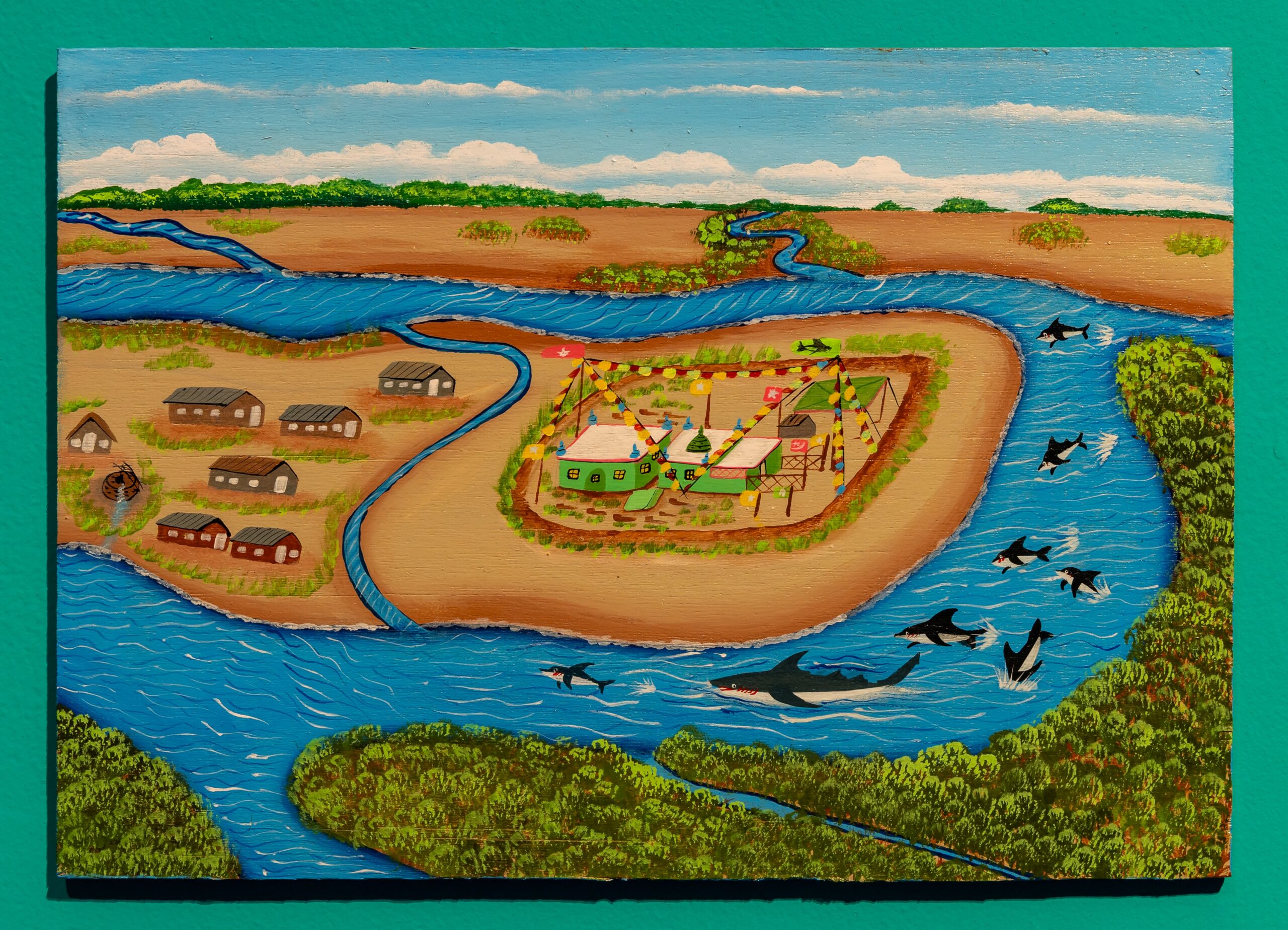
The Indus delta in present-day Pakistan is a mobile territory whose mutable nature is exacerbated by extractive infrastructure like dams and barrages that siphon off river water for agriculture and industry, interrupting the natural aqueous balance that should occur where the sea meets the river—a point of contact deemed sacred by the community. The saltwater now frequently floods the coastal areas in the delta, submerging housing, vegetation, and other markers of life on land. The water shrines that the fisherfolk have built over the years—dedicated to saints who are said to have washed ashore in the region and appeared in residents’ dreams to express their wish to be buried in particular spots—are often all that remain, as recalcitrant residue in these flattened landscapes. As Rajani told me, community members sometimes even relocate certain shrines away from their corresponding graves after lands get submerged, often because the saints ask them to in their dreams. This results in new geographies of the sacred. The shrines, each with a color flag atop, tether the community to the region (even as many are forced to relocate) while also serving as wayfinding tools in these altered terrains.
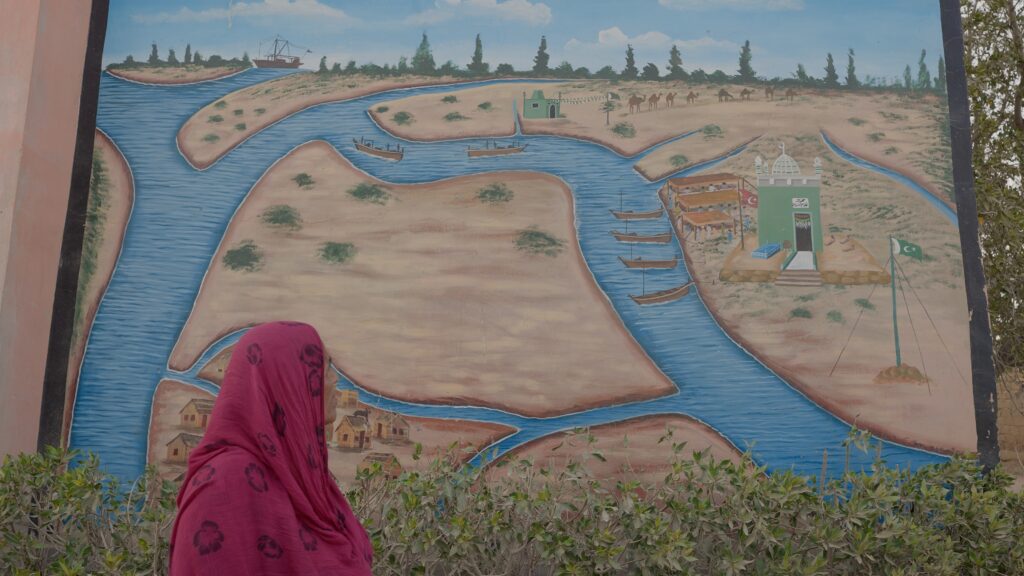
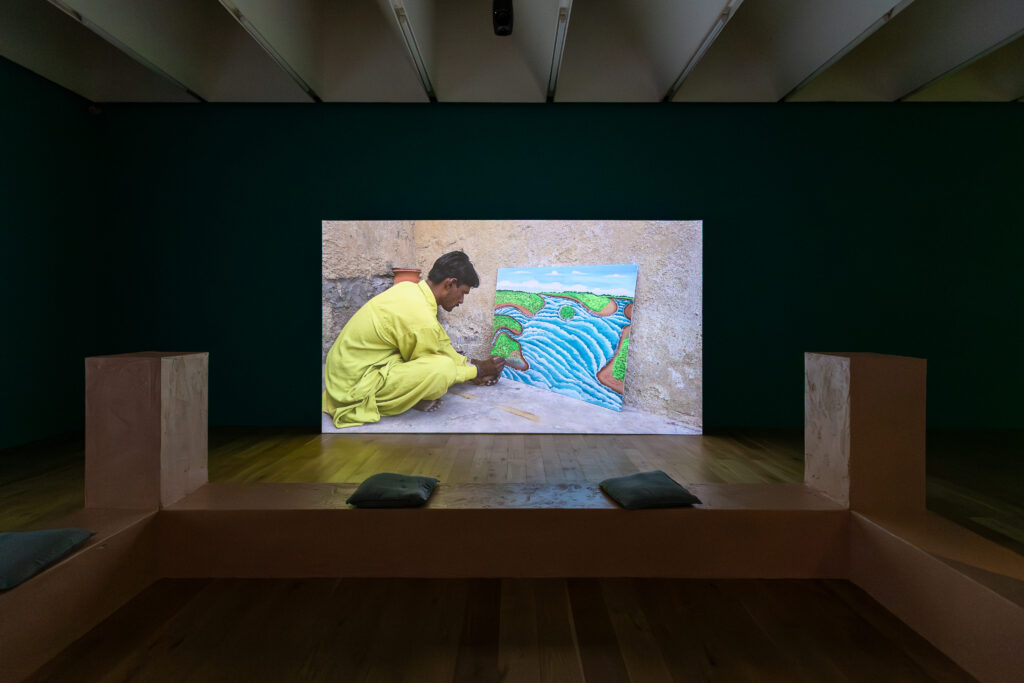
Within the exhibition, Rajani’s work shares space with the paintings of two Indigenous artists, Ustad Abdul Aziz and Abdul Sattar (the latter was taught by a student of the former), who are her longtime collaborators and whose depictions of the delta line the walls. These paintings on wood are condensed versions of the murals that the two artists regularly paint in Karachi, commissioned by erstwhile residents of the delta who yearn for their homeland. Rendered in vivid colors and from a bird’s-eye perspective, the paintings move away from reflecting the harsh reality of the landscape and instead reference a land of abundance—replete with lush vegetation, thick streams of river water, and the network of shrines to orient residents in landscapes that continue to morph. Sometimes, Aziz and Sattar paint the same place again and again to reflect the shifting ratios of land and water, resulting in a sequence of artworks akin to a time lapse. This art that the former delta residents keep in their homes, then, is as much an idyllic interpretation of the past as a breathing, shapeshifting entity awaiting further revision. This community practice of visual expression privileges relational networks, cultural memory, and unquantifiable archives of touch, smell, light, and sound—running against the totalizing approach of colonial survey maps.
This particular practice of drawing (usually passed from tutor to pupil) starts with the dot and the line—as explained by community healer Fatima Bibi in Rajani’s three-channel video installation Four Acts of Recovery (2025), which consists of three interrelated videos and plays nearby Aziz’s and Sattar’s paintings. While drawing on a piece of paper, Bibi (whose hands and voice alone appear in the video) speaks of how Allah banished Adam and Hawa from the Garden of Eden and sent them to different corners of the Earth. Moved by Adam’s consternation, Archangel Gabriel descended upon him with ilm-ul-ramal—the gift of knowledge—insisting that the dot and the line contained the mysteries of the universe as well as the answer to Adam’s questions. Adam eventually found his way back to Hawa using the knowledge bestowed on him through this conceit. The gift of drawing is, then, one of mercy meant to help humans navigate separation. Rajani explains that the taweez, or talisman, is a sacred gesture, where the divine spirit is believed to enter the boundaries of form. In the act of making talismans, which Bibi does in the video by drawing the dot and the line in different permutations and folding the paper up, she is at once invoking Allah and condensing knowledge into a wearable charm.
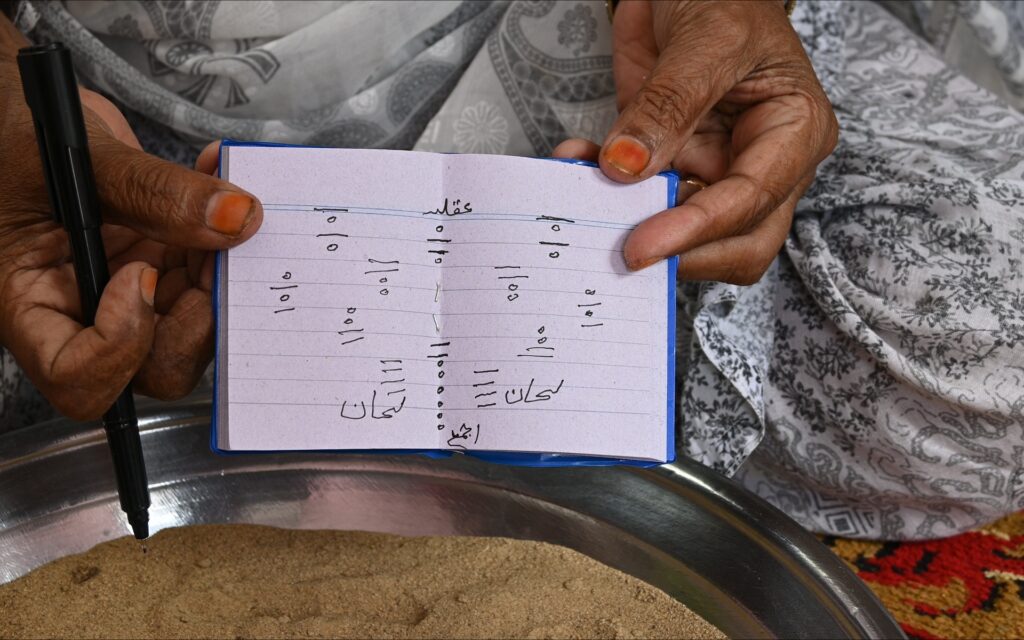
Each of the three videos in Four Acts of Recovery plays on a separate wall, and together they illuminate this Islamic creation myth (and its metonymic significance for the community) by focusing on the tactile nature of sacred practices. A product of long-term research Rajani conducted with her collaborator Zahra Malkani through their Karachi LaJamia Project, the videos together foreground different aspects of community mapmaking: Drawings and murals in one video mirror the fisherfolk as they navigate the waters in the video on the opposite wall. Occasionally, Rajani’s camera lingers on the paintings by Aziz and Sattar, pausing on the colors, shrines, flags, and other details. Rajani also focuses on the hand of a woman (whose name, we learn from the wall text, is Abida Dablo), a former inhabitant of the delta, as it traces a blank page, attempting to recall the bend of a river. As Aziz starts drawing in response to Dablo’s recollections, the page becomes heavy with the weight of absentia while she talks about how her residence, the Mul creek, has been completely swallowed by the sea. “My village was here,” she says while placing a finger on the blank page. The “here” is a definite coordinate, mutually understood. As Aziz sketches the homes that might have populated this village, we hear strains of sacred songs and the coo of local birds against the incessant hum of water and wind. There is an all-consuming grief in replicating one’s homeland this way, but Dablo exclaims that “the land is alive again” in these paintings. Diverting far from the colonial imperative to contain and control, drawing here becomes a space for care between grieving bodies.
One may view one or all the videos from several points in a seating arrangement constructed to mirror the architecture of open shrines in the delta. A series of horizontal benches form a square, with stub columns standing erect without the support of a roof, while cushions are laid out intermittently on the seating surface. Symmetrical and open, the seating itself offers a sanctuary of sorts, conjuring a story about how delta residents once created a shrine with a ceiling for a particular saint, and it collapsed multiple times until the saint appeared in their dreams and asked to remain connected to the sky through an open roof. Both a navigational anchor and a conduit to the world of the delta, the square base of this seating arrangement (which is also a makeshift shrine) offers a talismanic route across the exhibition space, inviting us to step into a world we do not know yet, one kept alive against tremendous annihilation. By observing their paintings, and taking in their lore, we partake in the community’s zikr (invocation) of Allah.
This layout also allows Rajani to expand authorship to children from the community. Aziza Ahmad animated illustrations by children (ages six to fourteen) from the fisherfolk settlement of Rehri Goth in Karachi—made during a monthlong workshop conducted by Rajani, Ahmad, Aziz, and other Indigenous artists and activists—and incorporated them into a five-minute video displayed at floor level. The children made their illustrations in response to their perception of the river, the delta, and their own position in this ecology. The video, Darya Se Dargah (From River to Shrine), turns their distinct renditions of human and marine life into a pleasant, chaotic invocation of life on the delta. There is the bustle of local fairgrounds, the strains of a chorus about revered local saint Nana Sanwlo, and voices reciting a glossary of Urdu words relevant to their daily lives, such as darya (river), dargah (shrine), and jaziro (island). Children then reorient this already alternative pedagogy, and, through their hands and eyes, community mapmaking takes a fantastical turn, becoming even more alive, pulsating, ever-evolving.
Rajani told me that local authorities periodically whitewash or break down the murals made by community artists, but the residents do not protest. She explained that as a concept, preservation is irrelevant to a community that is required to constantly adapt to new terrestrial perimeters. Mark-making is essentially ephemeral, and neither the land nor its visual representation is believed to be fixed in time. Unlike a map that calcifies land into a graph, these murals reflect the land as living memories, constantly transferred from one resident to another. In this exhibition, Rajani enters this intangible space and honors the devotion contained in these practices of representation, acknowledging their survivalist function while also celebrating them as resilient exercises. They reframe custodianship—of land, rivers, and the history of the community—as relational, challenging institutional forms of knowledge that seek to perpetuate hierarchies, softening the rigid grids of the map into tender meanderings shaped by collective learning.






Contribute your thoughts by leaving a reply