









Contemporary histories of Los Angeles seem to come in two main forms. The first, as exemplified by the indispensable work of the writer Mike Davis, deals with the existential problem of the city itself, examining how an unwieldy, inequitable, and perhaps ultimately unsustainable place came to be. (The answers: real estate speculation, political corruption, the diversion of natural resources, embedded racism, class antagonism, or, most likely, all of them combined.) The second form, meanwhile, is that of the microcosm—histories that venture deep into a single story. In recent examples, such as Natalia Molina’s intimate portrayal of her grandmother’s Mexican restaurant, the Nayarit, or Claire Hoffman’s investigation into the Protestant-cum-vaudeville empire of the evangelist Aimee Semple McPherson, a neighborhood establishment or public figure is rendered with enough detail and context that it has the potential to become more than the sum of its parts and reveal something larger about both Los Angeles and American life.
But in his series All Night Menu, the writer and publisher Sam Sweet offers yet a third, new form of LA history: that of the fragment. Sweet’s suite of five booklets, produced over the last ten years (the final in the series appeared in 2025), neither explicate the origins of current catastrophes nor delve into any particular era or person. Instead, innovatively, they motor through time and place in a way that mirrors the experience of navigating LA’s vertiginous terrain, in which layers of decades pile on top of one another and sit cheek to jowl as if in a temporally truncated Rome. Printed in limited editions, each paperback-sized volume of All Night Menu numbers under one-hundred pages of dense text interspersed with evocative black-and-white images. As an acknowledgment of the myriad lacunae present in the landscape, the book’s brief entries all take a street address as their starting point. As Sweet explains in a preface that repeats in each booklet: “Buildings are demolished, populations pass on, and neighborhoods mutate. The city changes. Addresses do not.”
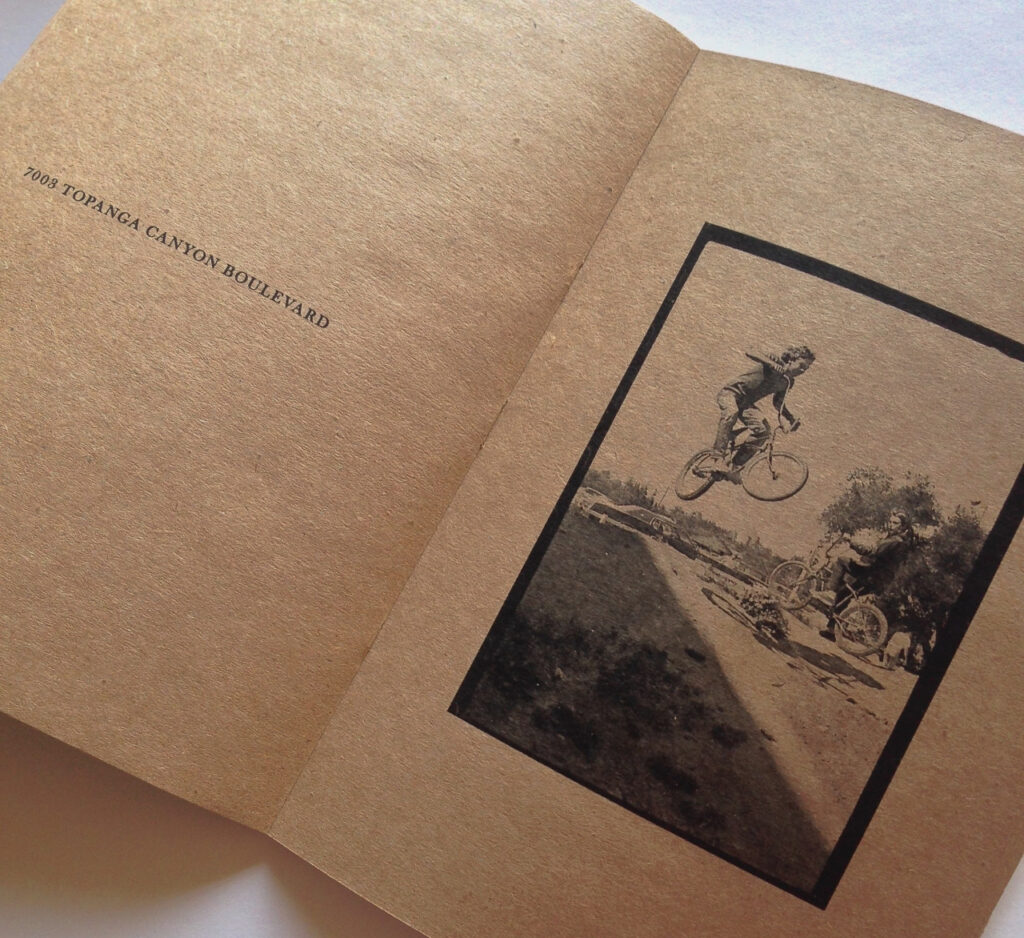
Sweet notes the ordinance Los Angeles County passed in 1925, requiring homeowners and renters to display their proper street number or risk a steep fine. By 1945, however, these numbers were scrambled. The population had boomed to more than double the size, and, through the annexation of other local municipalities, the city had grown to nearly its present footprint. A new system was implemented that took the intersection of 1st and Main Street, where City Hall resides, as the center from which to expand. In Sweet’s examples, the address of Pink Elephant Liquors in East Hollywood (not coincidentally, a favorite haunt of the debauched cult writer Charles Bukowski) is 1836 N. Western because it is eighteen blocks north of Beverly, the western expansion of 1st Street; an airport in Gardena that houses the Goodyear Blimp sits at 19200 S. Main St. since it is 192 blocks south of City Hall.
For someone who doesn’t live here, these numbers may be meaningless, but Sweet’s concession to order and actual physical space in a place that is more often rendered through drama and hyperbole is telling. “The city is vast and amorphous,” he writes. “This book is small and precise.” The lives Sweet captures through the fulcrum of an address (how and why each is chosen is sometimes obvious though always omitted) are by and large creative and expressive. His booklets are filled with lesser-known—and occasionally famous—artists, musicians, athletes, dancers, actors, writers, entrepreneurs, and overall eccentrics. By contrast, the choice to foreground the grid, and the fixed number of an address, produces measured distance. The lack of an overarching narrative makes All Night Menu reminiscent of the work of someone like the artist Ed Ruscha, whose open-ended documentation of buildings along Sunset and Hollywood Boulevard, as well as other streets, has taken a similarly fixed and objective point of view.
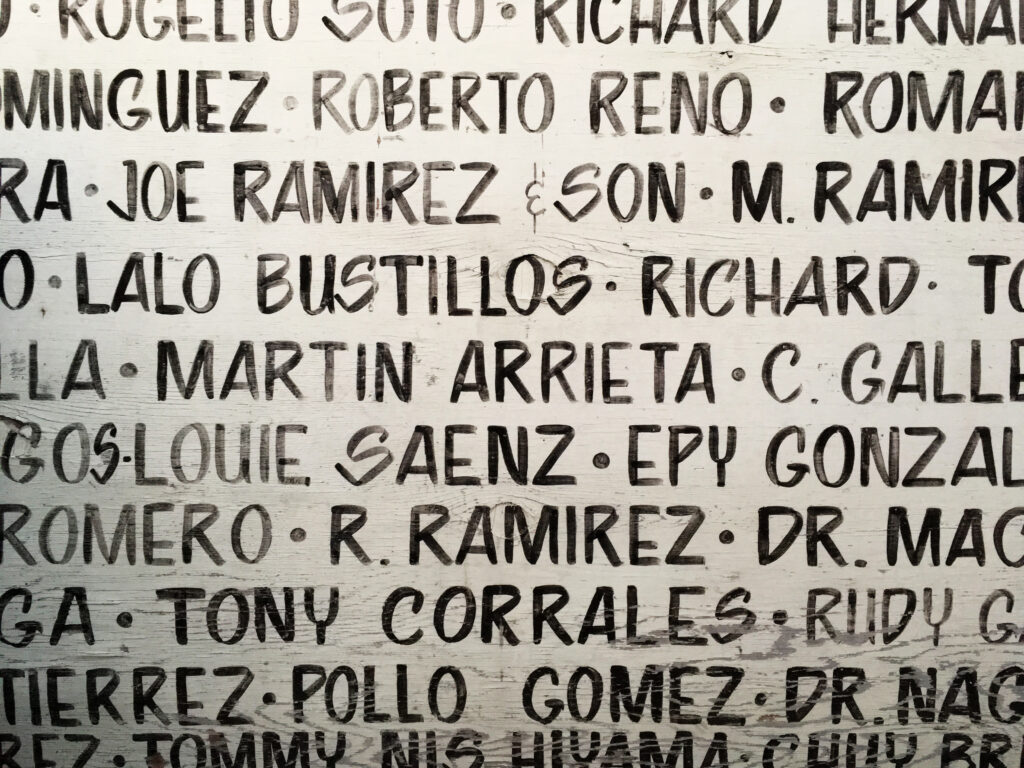
Ruscha photographed the entirety of Sunset Boulevard, a twenty-five-mile road, no fewer than twelve different times over thirty- plus years. He also captured twelve miles of Hollywood Boulevard on four separate occasions between 1973 and 2004. Each shoot was staged with a motorized slide camera on top of a tripod placed in the back of his pickup truck. For years, the artist books that resulted from the herculean tasks of these shoots were understood primarily through notions of serialization, commercial reproduction, distinctions between different types and applications of photography, irony. (With titles like Thirtyfour Parking Lots or Every Building on the Sunset Strip, it’s easy to see why). Yet the scholar Susanna Phillips Newbury has interpreted the books more through the lens of urban erasure, writing that Ruscha “pictur[ed] the speculative buildings and complexes constructed in its stead.” Elsewhere, the historian Eric Avila has asked of Ruscha’s work: “Can one create a neutral, deadpan, or nonjudgmental portrait of a landscape shaped by bias, judgment, and prejudice over time?”
Now that many of the more than one million negatives from the shoots have been digitized as part of the Streets of Los Angeles archive at the Getty, the true scope of the project has become clearer. Typically mum, Ruscha has at least stated that the archive is “part of the big picture,” of his work, not a byproduct of it. While it would be foolish to designate a single motive to Ruscha, the starkness of the changes along Sunset Boulevard—which can now be seen online, block by block, and contrasted over the years almost instantaneously—means there’s no need to. Ruscha’s images of Los Angeles present the city as primary document; the accumulation of data exerts an enormous amount of pressure from which some diamondlike, essential truth cannot help but be forged.
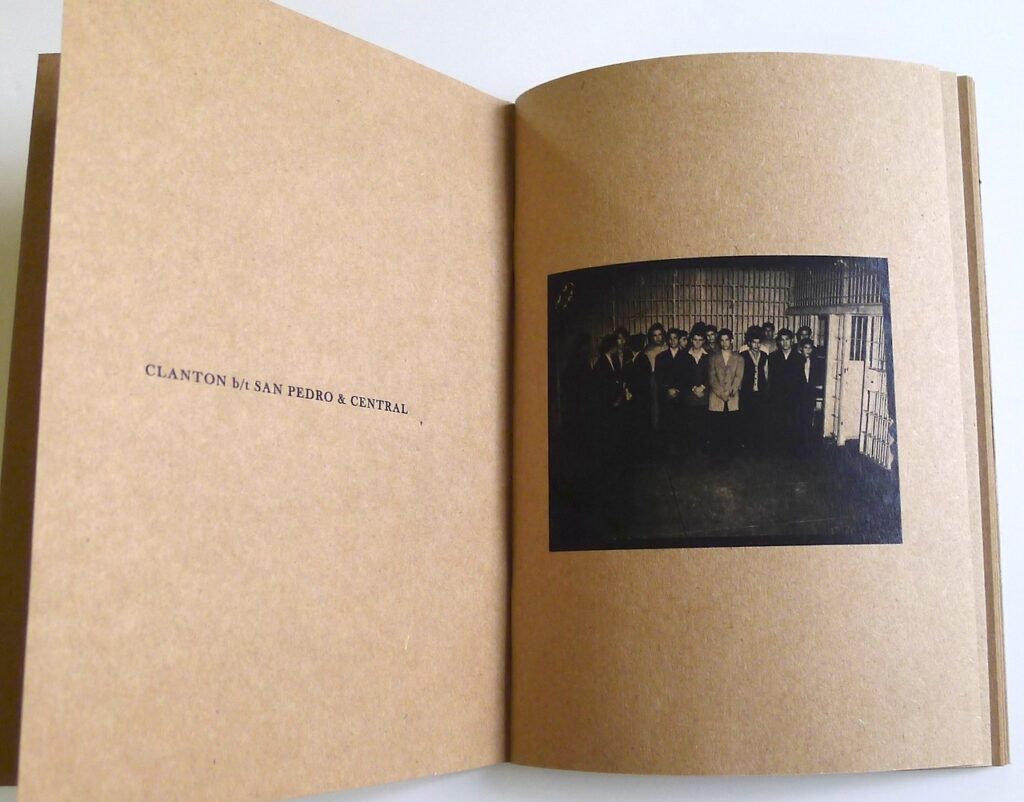
All Night Menu emerges from a similar methodology. Each booklet even closes with a Ruschaesque time lapse of a single address’s transformation over the decades. The differences are jolting: a chaotic and lively jumble of brick buildings, Chop Suey signs, electrical wires, and pedestrians at 800 N. Alameda in 1937 gives way to the austere lines of Union Station, a building many might have assumed had always been there, under ten years later. The towering edifice of the Sea Serpent, a roller coaster at Pacific Ocean Park in 1961, is leveled by 1973, the boardwalk all but a weathered shell and little more than a horizon line as of 2016. The miniature Tiki-Ti bar on Sunset, though, once a music shop, endearingly holds to the present as every other structure around it has conceivably metamorphosized. In Sweet’s entries, the archival photographs that coexist with the author’s own images anchor, augment, and sometimes run perpendicular to the stories of an address. Less illustrations, Sweet uses photos to open horizons in his histories, beg questions, or destabilize them altogether, with some pictures being so outlandish or surreal they make one wonder if they’re actually reading fiction. It seems noteworthy that in addition to his own work, as a publisher, Sweet has mainly put out photobooks: one of the Polaroid collection of the actor Candy Clark and another of Rick Castro’s pictures of hustlers on Santa Monica Boulevard.
Books are only a portion of Sweet’s output, though. In casual conversation he told me that he sees his work as accumulating over time in different forms and iterations that will eventually make a whole. All Night Menu’s website is slowly being populated with a series of interviews he has conducted with local figures ranging from the artist Senga Nengudi, to the late publisher John Martin of Black Sparrow Press, to Raymond Neutra, son of the modernist architect Richard Neutra. These also operate on a grid system, a preset series of 24 questions, slightly altered each time, that “retrieve sense memories of specific spaces: houses, apartments, roads, rooms, restaurants, clubs, cars, bars, and other locations that leave an impression.” As an offshoot of the question “What outdoor space in Los Angeles have you spent the most time?” we learn, for instance, that the site of Nengudi’s storied 1978 performance Ceremony for Freeway Fets—a formerly public incline underneath an overpass in a diverse section of downtown that she has often spoken about as having “an African energy”—is now a gated parking lot for the Crypto.com Arena. In another questionnaire, the activist Mo Nishida shares that his earliest sense memory of Los Angeles is indelibly tied to his family’s forced relocation to a Japanese internment camp. Less malevolently, in yet another, Raymond Neutra says he met Rudolph Schindler, his father’s mentor and sometimes rival, just twice: first at a film screening at the former Plummer Park auditorium and then again at Cedars of Lebanon, when Schindler and Richard Neutra, through what could only be divine intervention, happened to be put in the same hospital room.
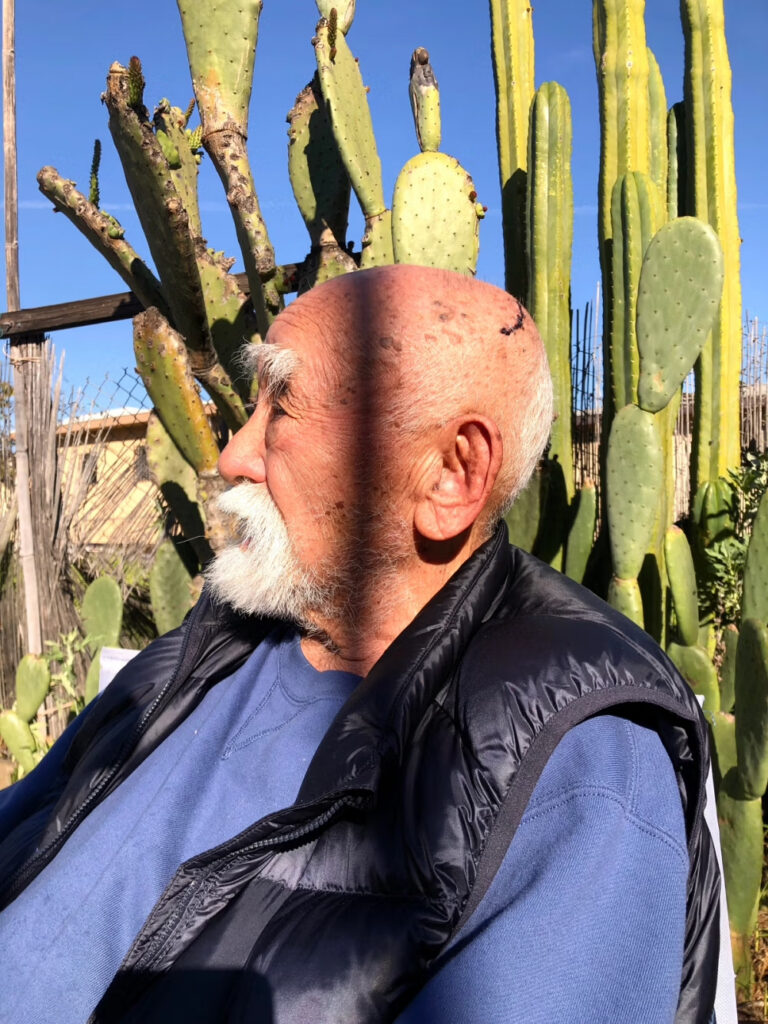
The transparency of Sweet’s questions and the investment in place as a portal become an expectorant for information. There is also a surprising amount of overlap between the questionaries. Readers are left to draw their own conclusions about what it means that Nengudi and Nishida both attended the same middle school in South LA; that Neutra and Nengudi both recall the importance of Clifton’s Cafeteria during their childhoods; that the musician Carol Kaye arrived in Los Angeles with her family in 1941, a few days after Pearl Harbor, just as Nishida and his own family were being ordered to leave.
The All Night Menu booklets allow for a similar freedom of inference, though the fragmentation of the stories and breadth of information within each publication might complicate what exactly it is a reader is supposed to take away. There is no thesis. Sweet’s stated aim is simply to “make the invisible equal to the visible.” This manifests not only in his filling out the contours of long-demolished buildings and the long-departed dead, but also in his highlighting of people on the edges of origin stories and connections that have since been obfuscated by time. In an entry in Vol. 1, for example, on 4821 Pacific Ave., he loosely associates the oil rigs that once lined the beaches of Venice, pumping as much as 46,000 barrels a day, to the pioneering figure of Dale “The Hawk” Velzy, a surfboard builder whose shop, which sat at the base of its own rig, helped to popularize wave riding before it reached Southern California’s masses by way of Malibu, surf magazines, and Gidget movies.
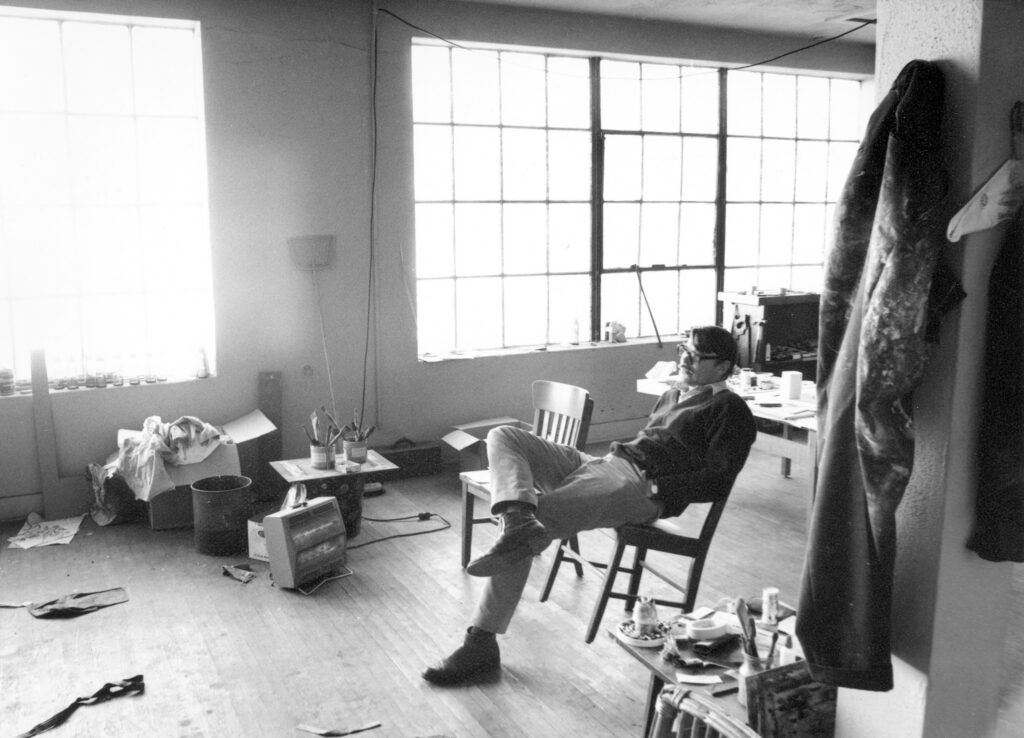
Another Venice entry, in Vol. 3, unpacks 207 S. Ashland, the former studio of the painters Sam Francis and Richard Diebenkorn. In just a few pages, the synergy of the area for which Diebenkorn’s most famous series, Ocean Park Paintings, is named becomes clear: a working-class bay full of ships driven by carpenters, surfers, and engineers, and the sail builder, Bob Broussard, on whom they could rely for the most intricate knots and needlework; the persistence and clarity of the light even in the constant haze; Z boys skateboarding down Main Street on their way to the Zephyr Shop; coin laundries, thrift stores, the soul-food counter Olivia’s Place, and countless abandoned storefronts inhabited by other artists, like James Turrell and Tony Berlant. Sweet writes that following the redevelopment that began in 1974, though, the neighborhood for which Diebenkorn’s paintings were named “no longer appears on maps.”
What does remain is a row of ficus trees Francis paid Turell and the artist Choyoshi Kawai to plant as saplings along Main Street for him one day in an effort to kick down some cash to his less established neighbors and perhaps make it a little harder for skaters to rip down the block; Sweet reports the trees now shade a Starbucks. As a writer, Sweet is especially good at drawing attention to the infinitesimal and distilling information through materiality: the tiles inside the Googie restaurant Pann’s near LAX that are covered with its interior designer Helen Liu Fong’s ruby-red nail polish, say, or the single extension cord Slayer used to electrify its guitars when the band was first getting started and practicing in Tom Araya’s garage. In one particularly moving and layered entry on 501 N. Mendik, Sweet begins with the quarry from which the bricks that form the surface of a handball court in East LA derive. He then zooms out to a nearby neighborhood store that was run by a Japanese couple who survived internment and whose sandwiches became so legendary they were discussed on the prison yard of Pelican Bay, where many of the neighborhood’s Maravilla gang members got sent on drug charges. If the range of entries in All Night Menu make the project difficult to synthesize as a whole, the overall effect of reading it, like any worthy photograph, is the sharpening of the eye to the surface of the world.
That these surfaces are destined to become but a trace of the present in the future is something Sweet clearly accepts as a given, just as the real estate speculation and displacement that form an ever-present hum in the background of his books are noted soberly without being contested, taken as an inevitable aspect of urban life. The refusal to state the obvious lends the books their ineffability and power. Their equanimity is enviable, though maddening at times, in a moment that feels beset by loss in Los Angeles: from a recent slew of legacy businesses closing to the horrendous destruction of last year’s wildfires to the imminent building boom that could result from upzoning measures like SB 79—sure to transform the contents of many more addresses in the city. If we can glean anything from Ruscha’s poker-faced chronicle of a commercially driven landscape, these changes will be influenced less by architectural principles of utility and beauty than capital’s pursuit of expediency and easy profit. But perhaps this anxiety should be tempered by some of the faith Sweet’s work shows in resonance and reoccurrence. All Night Menu offers that the present is always more of a palimpsest than it first appears. The past often remains as long as we know what to look for.
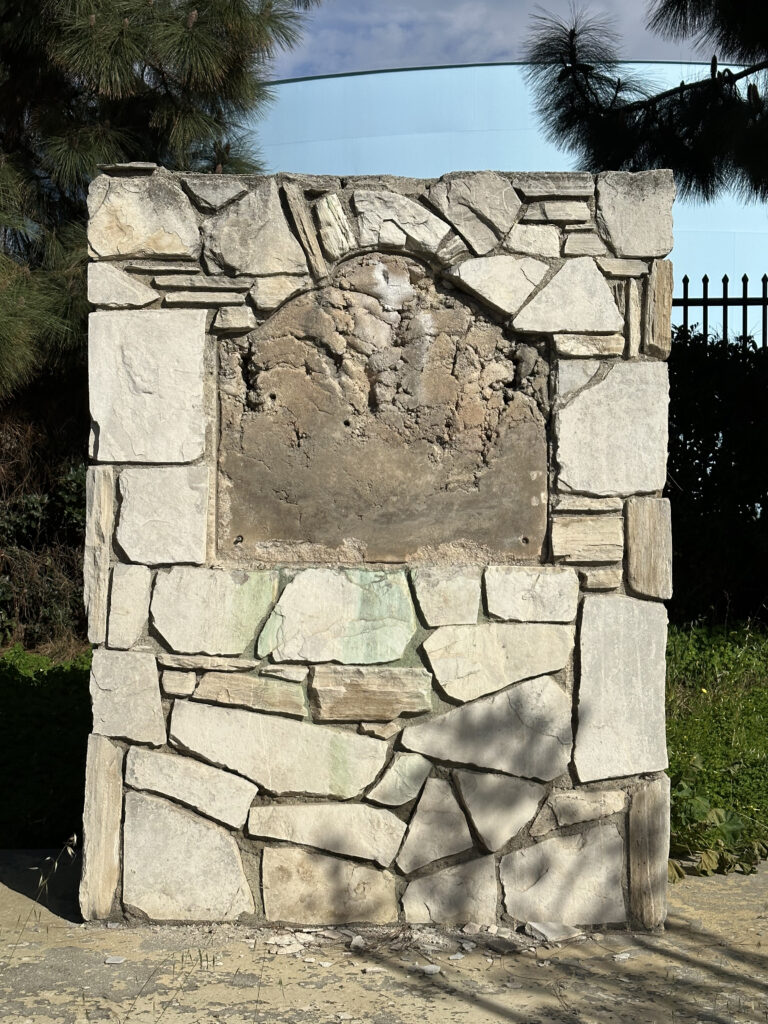
Last November, an event for the release of Vol. 5 at the Philosophical Research Society began with Sweet playing the audience a recording of a 1959 song by Big Jay McNeely, “There Is Something on Your Mind.” The song repeated on the jukebox in a screening of Thom Andersen’s short film Olivia’s Place, a portrait of the former soul-food counter in Ocean Park before its demolition. The night closed out with a live rendition of the same song by the musician Mark Lightcap. Beforehand Sweet had read some entries from his book. The final one in the series, 18501 Wilmington St., documents the field in Dominguez Hills where on the day after Christmas in 1910, an aviator named Arch Hoxsey set a record for flight, sailing two miles above the ground for the first time in history. Sweet showed a slide of the empty slab of concrete where a plaque of this historical record had once been affixed. Like so much copper and bronze currently being lifted from lampposts, graves, and memorials, he figured it had probably been stolen for scrap. “I know it should look defaced,” he read of the empty spot, “but it doesn’t. It looks complete.”







Contribute your thoughts by leaving a reply