








For much of its institutional life, folk art has occupied an uneasy position. Celebrated as a repository of heritage, it has often been denied the status of contemporary practice. Pata Dekhabo? (Shall I Show You a Pata?) at the Kiran Nadar Museum of Art, in Delhi, challenges that relegation, presenting Pattachitra—one of the oldest art forms in eastern India—as a living tradition capable of transformation. The exhibition, which includes centuries-old art alongside recent work, resists framing authenticity as dependent upon a form’s resistance to change. Here, the artists’ engagement with contemporary realities becomes proof of the form’s vitality rather than a departure from tradition.
There is something uncanny about encountering this itinerant storytelling convention in the Art Passage, a sky bridge connecting two Delhi shopping malls: Nexus Select Citywalk and DLF South Court, where the museum is located. At first glance, the setting seems to domesticate the work in Pata Dekhabo?, reducing it to ornament. Yet the curators chose the bridge, rather than the museum’s galleries inside DLF, for a reason. Patua artists, called Patuas or Chitrakars, historically worked in spaces of circulation rather than contemplation—temple festivals, village squares, princely courts. The mall’s accidental spectators reproduce these conditions in a more modern setting. Attention here is still provisional.
The title of the show poses a deceptively simple question: Shall I show you a picture? Traditionally, this was the phrase Patuas used as an invitation for the audience. But a pata has never been merely a picture. Pattachitra—derived from the Sanskrit patta (cloth) and chitra (picture)—is a scroll painting from eastern India (Odisha, Jharkhand, and West Bengal) and Bangladesh. The Patua was a one-person multimedia apparatus. They unfurled scrolls, singing the accompanying story, activating the painted surface through voice and rhythm. What emerged was an immersive, cross-modal encounter.
The exhibition contains 46 reproductions from the museum’s collection, alongside replicas from other institutions. The original artworks, which are ancient handheld scrolls and delicate paintings made with oil and natural pigment, have been reproduced as digital prints on paper pasted on cloth and blown up in size for easier viewing, to address safety concerns. However, the reproductions raise questions about who is granted access to the “authentic” object and who must encounter its surrogate. The exhibition leaves these cultural hierarchies largely unexamined—a significant gap in its otherwise nuanced treatment of authenticity, power, and artistic value.
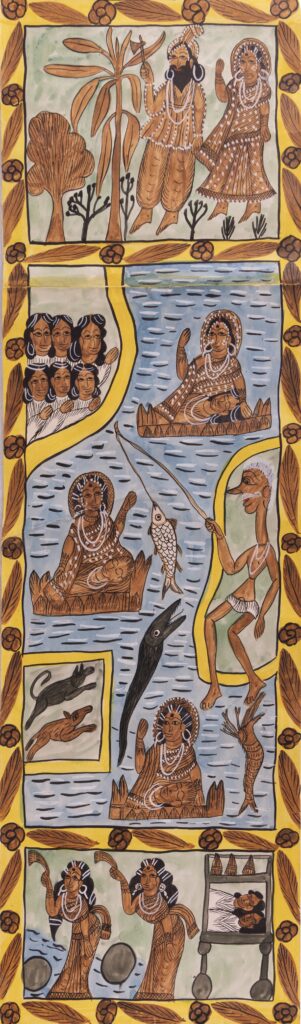
The ideal way to view the exhibit is to start from the DLF mall side, as the works are curated chronologically. The first three scrolls narrate ancient mythologies—Chandimangal, Manasa Lakhinder,and Gaur Netai. Archival recordings of songs that accompanied these stories can be heard through three sets of headphones installations, pulling the aural element of Pattachitra into the exhibition. The voices, rhythmic melodies, and tribal language bring the folk character of these paintings to the fore, allowing visitors to imagine them as part of a larger oral and performative tradition.
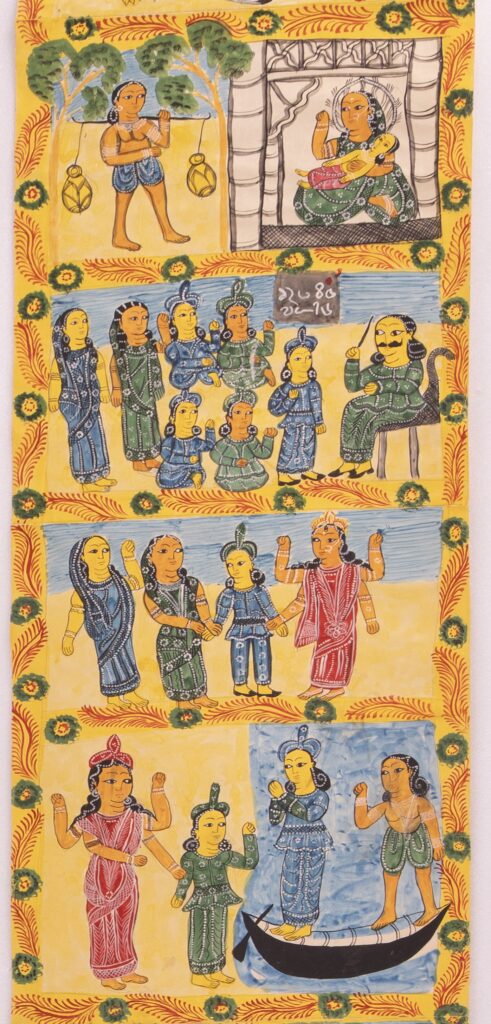
Patuas have a fluid religious identity that merges their original Hindu ancestry and their later large-scale conversion to Islam to escape caste discriminations. They effortlessly adopt and embrace both Hindu and Islamic myths and iconography as their own. The display reflects this fluidity through works like the thirteen-meter-long Gazi scroll. Created in Bengal in the nineteenth century in the Murshidabad style, it features fifty-four vivid, detailed floral and geometric frames, arranged sequentially, depicting the chronicles of Bengali Muslim saints Gazi Pir and Manik Pir. Drawn in a flattened graphic style with rich color contrasts, the iconography involves both Hindu and Islamic sensibilities, like in the panel where a resplendent Gazi Pir is shown holding a cobra like a staff and mounting a tiger like a vahana; figures that resemble Krishna and Radha make an appearance elsewhere. The intricately detailed depictions of Bengali-hut-style Muslim shrines and the Buraq—a winged composite creature that has a crowned human head, feathered peacock tail, and body that is part tiger and part camel— co-opt Islamic styles. The onlookers, through their dress and comportment, also appear to belong to both Muslim and Hindu communities.
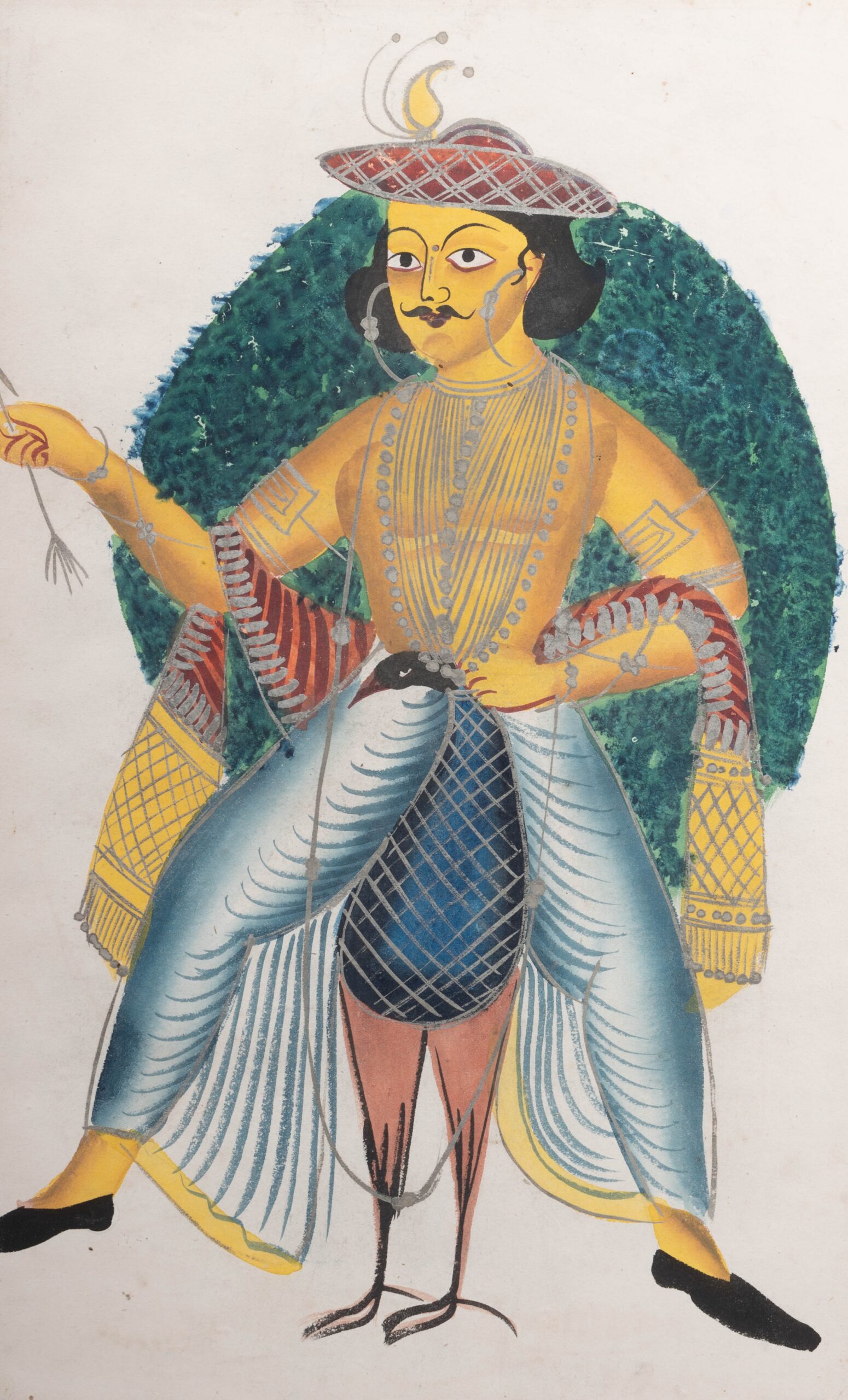
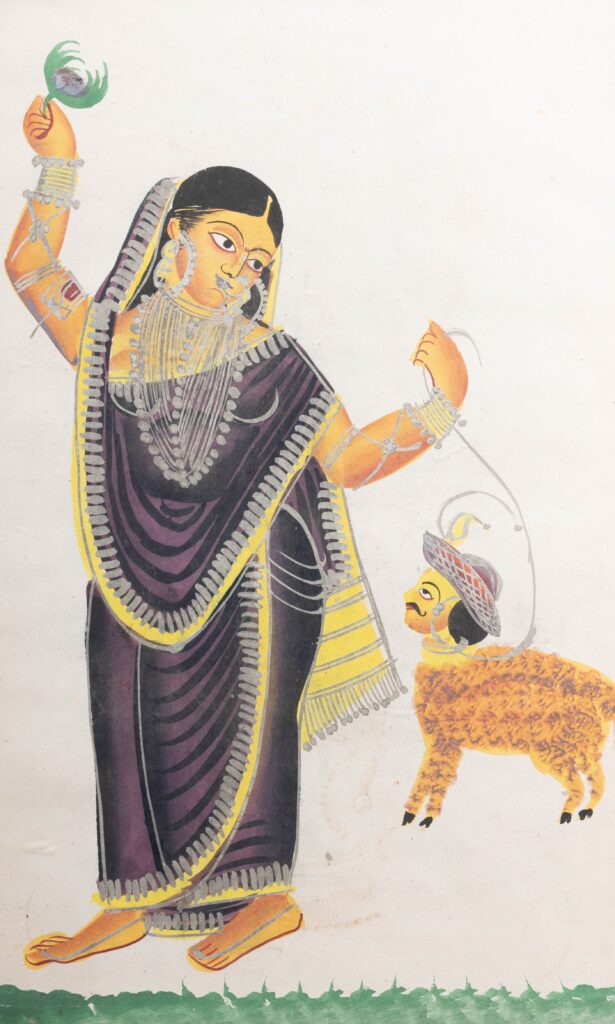
The second section traces the evolution of Pattachitra as a result of the migration of Santhal Patuas to Kalighat from the mid-eighteenth through nineteenth centuries, driven by famine and the search for better economic opportunities. British occupation and the zamindar system also shaped the tradition that developed there. Kalighat painters condensed the scroll’s sequential narratives into single panels centered on a figure or scene, an approach that notably recalls Eurocentric cataloguing of Indigenous bodies, suggesting internalized colonialism. In the earliest works from this period, artists drew on familiar Hindu iconography; later, divine figures became increasingly humanized, as in Karthikeya. Scandals of the time also became fodder: Babu and Bibi satirizes Western influence on newly rich gentlemen and their female companions, while Murder and the Bazaar portrays the 1873 Tarakeshwar scandal. By the 1930s, inexpensive mass-produced prints had largely displaced the Kalighat tradition.
On the glass wall opposite the Kalighat Pattachitra, Mrityu patas by Jadopatuas of Jharkhand hang morbidly, depicting dull, brown-tinged, washy images of deceased Santhals—clad in white—drawn on postcard-size paper canvases. Often described as “magical” painters from the Santhal community, the Jadopatuas used a more muted palette and simpler compositions than the Bengal Patuas, addressing tribal life and death. Once, these Mrityu patas, or death paintings, performed the role of guiding the deceased to the afterlife. The Jadopatuas arrived with an image in the likeness of the deceased without eyes, and later, after ritual performances and offerings, eyes were added to denote the gaining of vision in the afterlife.
The curators also rather dutifully include the twentieth-century modern artists Jamini Roy and Ramkinkar Baij in this section, asserting their influence in bringing wider audiences to the aesthetics of Pattachitra with their refusal to let Western influence dominate Indigenous styles. Baij fused Impressionist, Cubist, and Expressionist sensibilities with Indigenous subjects and is known for his paintings of rural life in Bengal and his sculptures of the Santhal community in Shantiniketan. Baij’s Mill Call (c. 1946), the only work of his displayed, depicts the Santhal community and is positioned next to Roy’s depiction of the same community in A Santhal Couple (c. 1934). On the opposing wall at the end of the long corridor hangs Roy’s iconic Untitled (Seated Woman). Shownalongside the Kalighat paintings, Roy’s bright colors, sweeping brushstrokes, and flattened figures reveal how much his signature style owed to this tradition and to Bengali folk motifs.
But the institutional attention generated by Baij and Roy did not always translate into equivalent recognition for other practitioners. Many scrolls still circulate without attribution, even in parts of this show, denied individual authorship. Their makers are absorbed into the generalized category of “folk art”—less a descriptive term than a mechanism of containment. While contemporary artists are granted biographies, catalogs, and intellectual ownership, folk artists are subsumed under the names of their communities, regions, or traditions, like “Madhubani,” “Warli,” or “Pattachitra.”
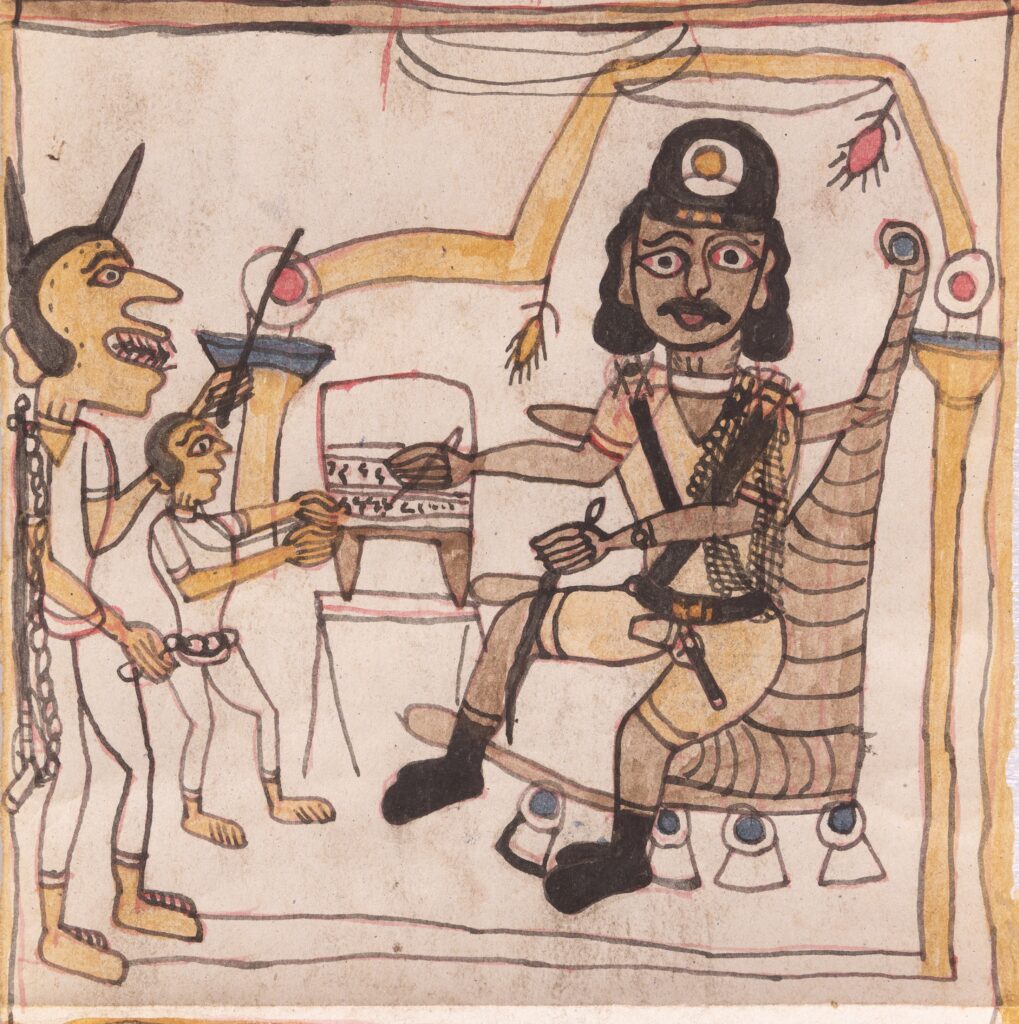
The curators of the show acknowledge that tracing provenance in folk art is a time-consuming and often fruitless process. Many folk artists consider their work part of a collective tradition rather than an expression of individual authorship, and thus leave their works unsigned, resulting in countless unrecorded makers. Pata Dekhabo? attempts to correct this long history of asymmetrical recognition. Artists such as Bapi and Tagar Chitrakar, who created wall murals for the exhibition, have been encouraged to sign their works, creating a visible record of their individual contributions. This gesture, however, exposes a deeper tension: The art world’s obsession on individual attribution does not always align with the values of community-led arts, where knowledge, motifs, techniques, and visual vocabularies are inherited and collectively understood. The question, then, is not simply whether folk artists should be given individual authorship, but how institutions can acknowledge individual artistic agency without imposing the notions of ownership through which the art world has historically defined “fine art.”
In the third section of the exhibition, three arresting, oversize contemporary scrolls hang from the ceiling, two of them by artist Madhu Chitrakar. Chitrakar strikingly integrates global catastrophes into the visual grammar of the Bengali scroll with 9/11 Attack (c. 2001). In this work, the narrative opens with an imagined camaraderie between George W. Bush and Osama bin Laden that gradually curdles into betrayal. Flames rise, an aircraft pierces the skyline, its nose morphing into bin Laden’s likeness, and a final panel arranges victims, predominantly women, on the left, and perpetrators—dressed in stereotypical white desert clothing and skullcaps and possessed of thick, dark facial hair—on the right, to juxtapose good and evil.
Her Tsunami (c. 2004) is even more persuasive. A monumental blue deity of catastrophe crowns the scroll—red tongue protruding, eyes brimming—while serpentine waves coil downward through drowning cars, buildings, a yellow airplane, and finally a seabed littered with bodies and debris. At the base are journalists with cameras and excavators clearing wreckage.
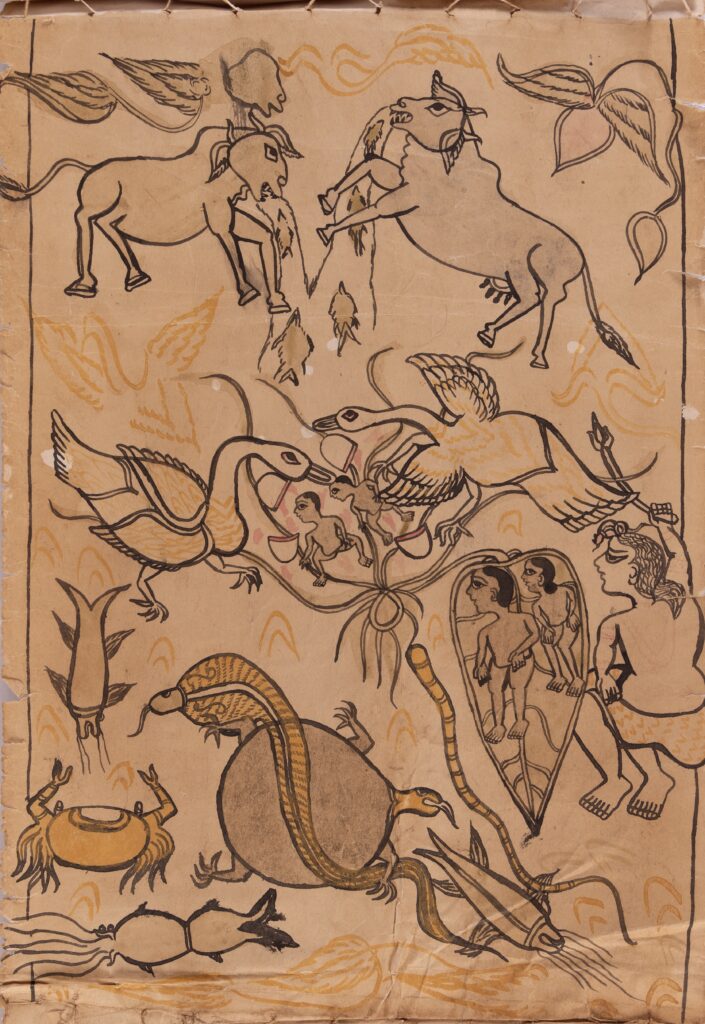
The third work is Communal Riot, of unknown authorship. Here, the trajectory of a communal riot takes the limelight. Depicted in muted colors, with simplified two-dimensional figures set against a simple white background, it is a deviation from the vivid and dense style of Pattachitra. Yet the motifs and flattened perspective remain recognizable. The first four panels capture the mutual acts of violence and carnage committed by opposing factions. The fifth shows the displacement of those affected, and subsequent panels depict the intervention of authorities, with the perpetrators being arrested. In the final register, figures bearing placards advocate peace over destruction and unity over division. Here, the panel resembles poster art, calling for peace.
These new works are argumentative, adaptive, and politically alert. Rather than custodians of an inherited form, their artists become authors whose choices, experiments, and interventions actively shape what Pattachitra can become. In this way, these hereditary artists who survived collapse of old patronage systems, indifference of modern economies, and seductions of markets—which prefer heritage neatly framed and safely dead—refuse to be embalmed.
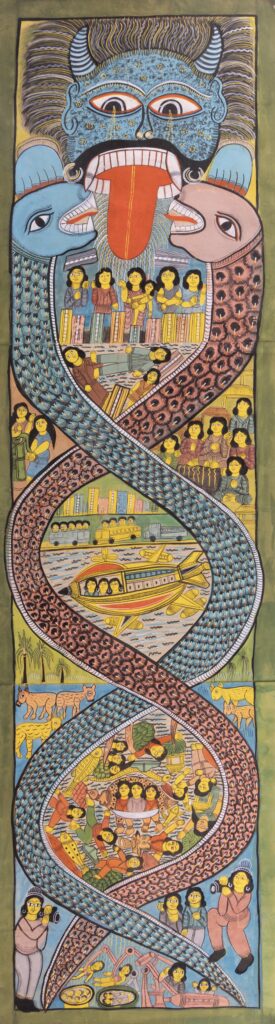
The visual grammar of Pattachitra—flattened perspectives, intricate line work, densely populated narrative scenes, and vivid chromatic contrast—remains recognizable. But the works address present realities, demonstrating how historical forms can become tools for thinking through contemporary cultural and political conditions.
The final section portrays Kalighat painting following its revival, beginning in 1987 with Kalam Patua, a postmaster who taught himself the art form by visiting archives and museums before sharing his knowledge with other artists. Depictions of political rallies (A Campaign by Mamta Banerjee, c. 2018, by Moyna and Joydeb Chitrakar), gallery shows (Group Show, c. 2012, by Kalam Patua), and cellphone photographers (Studio at Home, c. 2012, also by Kalam Patua) line the walls, familiar scenes of everyday life in the present.
The exhibition transforms Pattachitra from an object for preservation into a site of ongoing artistic production, suggesting that practitioners do not merely inherit the tradition but write its future. Pata Dekhabo? argues for a different understanding of contemporaneity that need not emerge from the genealogies of modernism. The show suggests that a form rooted in devotional and community-based conventions can generate its own contemporary trajectories. Tradition is not sealed into a vitrine. It must be continually unfolded, panel by panel, sung aloud, argued with, and stained by the weather of its own time and times to come.







Contribute your thoughts by leaving a reply