







The day I went to see Roksana Pirouzmand’s everything was once something else, in Los Angeles, I woke to vibration—a push notification from The Guardian, telling me that a US-Israel airstrike on Shajareh Tayyebeh girls’ school in Iran had killed more than one hundred children. It was a strange kind of spectatorship, watching the consequences of my own country’s international interventions play out across the world. The digital feedback loop that transforms a detonation into a haptic alert can make us feel that we are everywhere and nowhere all at once, immersed in a web of data that mirrors our remote entanglements. Our technical omniscience lends itself to a certain sense of impotence—the acts of destruction we encounter through our screens seem to constitute a separate realm where our actions have little effect.
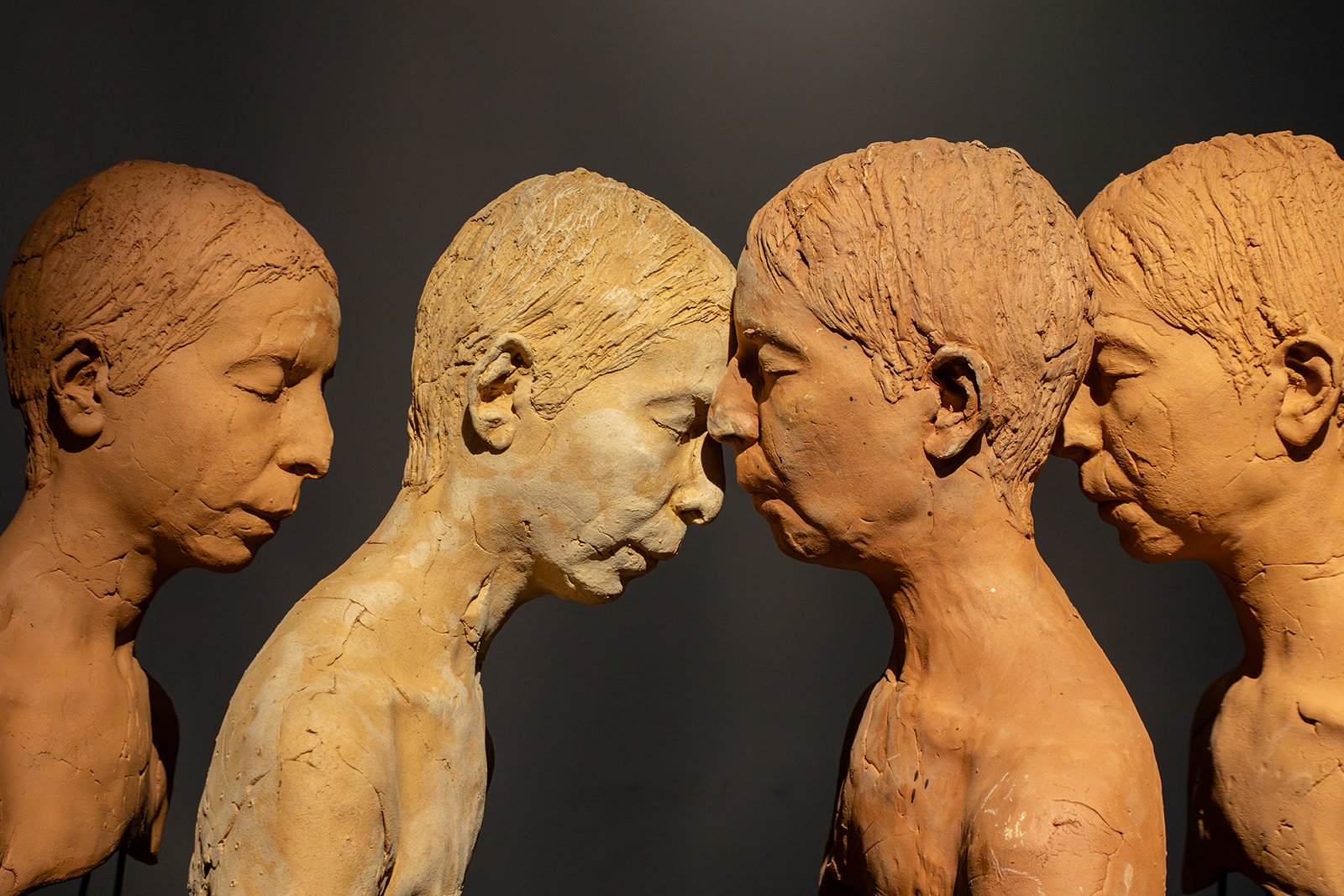
Attuned to the dispersal of the self across time and space, Pirouzmand anchors her work in the physicality of her medium, creating a tactile counterpoint to the stream of images that shape our virtual world. Appearing across two nonprofit art spaces, JOAN and OXY ARTS at Occidental College, her three-dimensional works foreground their fragility and material limitations. Life-size bodies cast in clay appear splayed out on slabs or suspended on wires. They split into pieces or multiply into serial iterations, a crowd of figures made from a single mold; most of the works are modeled on Pirouzmand’s own body, as well as her mother’s and grandmother’s. Her sculptures are mounted on malleable metal poles that bend and wave in a state of constant motion, mirroring the movement of visitors in the gallery and causing collisions that slowly erode the works over the course of the exhibition. Our presence among them is a fraught necessity: The same footsteps that activate the works on display also cause them damage over the course of the exhibition.
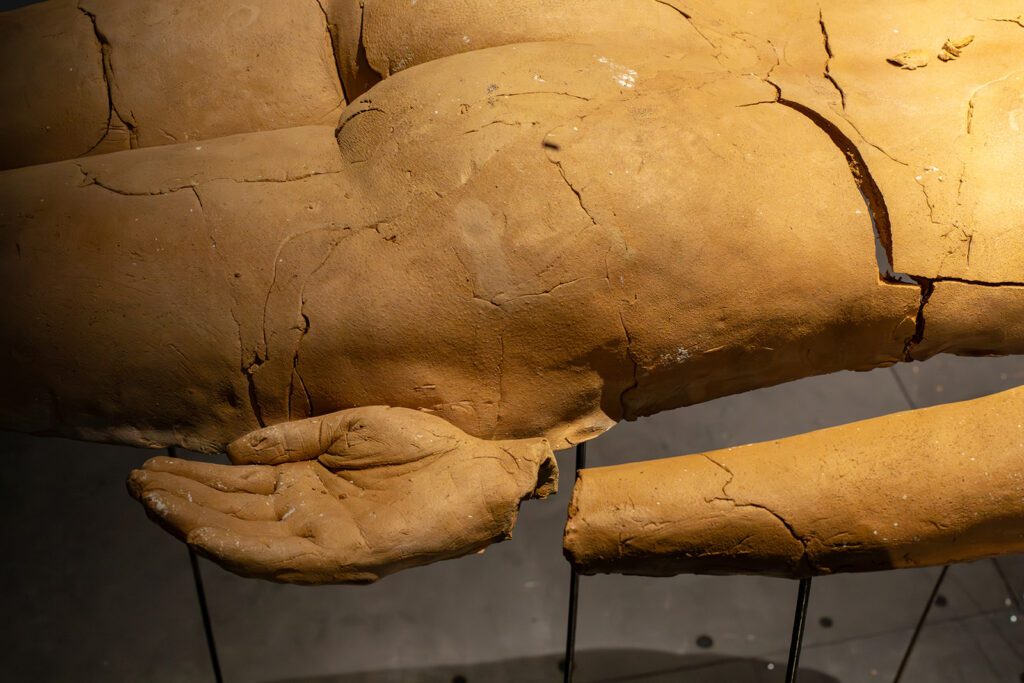
For Pirouzmand, material often gives way to metaphor, her medium conveying absence and displacement. Clay has an uncanny capacity to capture not only the shape of human flesh but its frailty—as it dries, it creases and cracks like aging skin. The porosity that creates this organic texture also renders it permeable. Like the human bodies they resemble, these sculptures are subject to the incursions of their surrounding environment, shape-shifting over the course of the exhibition as they’re reformed by the flow of water and thrum of vibrations. In foregrounding the vulnerability of her medium, Pirouzmand denies us the comforting distance of a neutral perspective. To witness the works on display demands that we confront our own co-imbrication in the exhibition’s unstable evolution, acknowledging the ways our presence is a catalyst for consequences that carry beyond the gallery walls.
Pirouzmand was born in Yazd, Iran, in 1990 and is based in Los Angeles. Working across performance, sculpture, and etching, she contends with the complications of distance and resonances. For the past year, she has created a series of new works as the 2025–26 Wanlass Artist in Residence at Occidental College. At an exhibition walk-through, Pirouzmand reflected that “in immigrant bodies, a part of you is always elsewhere,” a tension that manifests literally in this multisite presentation. Movements recorded through the floor at OXY ARTS register in the collisions of the sculptures on display there; the sounds made by these contacts are then transmitted across town to JOAN in the form of sonic waves. There, they manifest in vibrating sculptures and pulsing platforms that seep water and unseat their sculptural subjects, spilling them across the gallery floor. The exhibition’s daily execution is contingent on its visitors, since if the galleries at OXY ARTS are empty, the works on display at JOAN remain dormant.
Multisite installations are having a moment in Los Angeles, an appropriate adaptation in a city known both for its sprawl and its spirit of institutional exchange. The much-lauded ongoing Monuments exhibition was organized in collaboration with the MOCA and the Brick, and Simone Leigh’s 2024 survey was copresented by the California African American Museum and LACMA. But Pirouzmand’s presentation fully embraces the perils and potential of its exhibition format. While her project investigates the interdependence of distant subjects, it also reminds us of our limitations: There is no viewpoint from which a visitor can experience the exhibition in its totality. It is impossible to see the simultaneous impacts among sculptures at OXY ARTS and their consequences at JOAN. Pirouzmand’s work makes us attend to the ways we are insufficient witnesses to our own acts of unwitting destruction. As a viewer, experiencing her works means acknowledging our own investment in their physical precarity, the ways we remake them and are remade in turn by their dissolution.
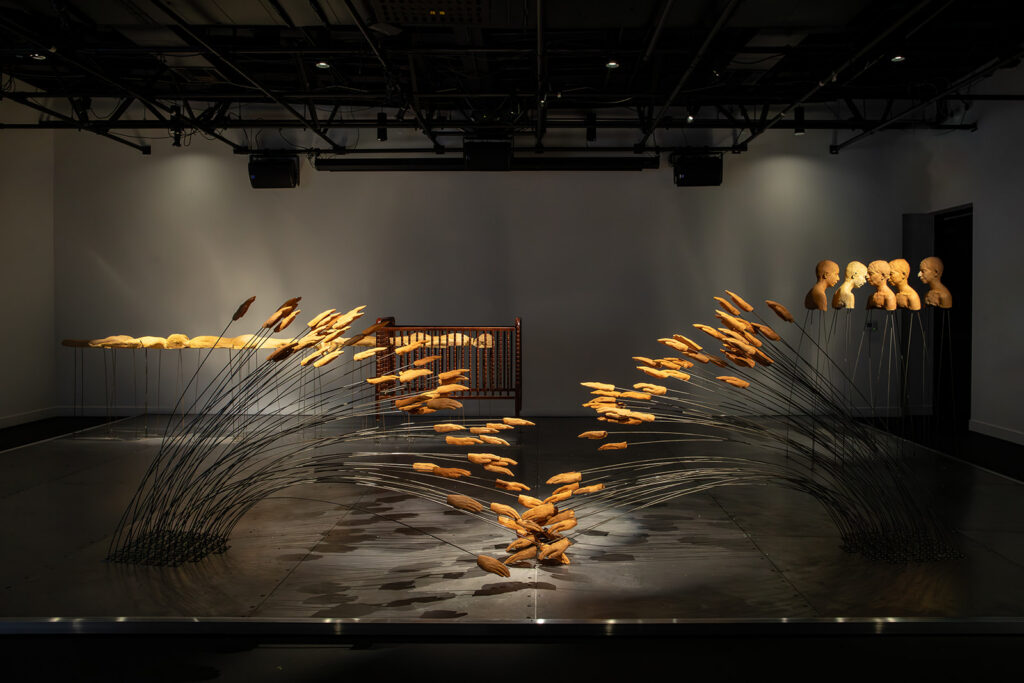
At OXY ARTS, I walked through a darkened gallery across a sheet-metal platform that bowed and creaked under my feet like a ship’s deck. Every step triggered a series of soft blows among the surrounding installation of sculptures. At the edge of the platform, Wave (2026) floats like a shoal of fish, a cascade of dozens of clay hands that shuddered with motion as I approached. Deeper in the gallery, blank-eyed clay bodies appear in various states of deterioration. Among a crowd of sculptures, Horizon (2026) features a figure suspended face down, its segmented limbs rubbing up against one another. My passing presence brought them back together, the same contact that breaks them down over time rendering them briefly intact. To examine Pirouzmand’s work is to be complicit in its slow erosion, experiencing the percussive chiming of clay heads clinking together and cast fingers crumbling gradually. The soundscape is a constant reminder of the friction of the physical encounter between sculpture and spectator, a counterpoint to the smooth digital textures that often mediate our contemporary experiences of destruction.
But despite the shock of watching delicate cast clay works crumble and break, the prognosis isn’t entirely pessimistic: Much of Pirouzmand’s work suggests that the destruction her sculptures dramatize and dissect is inherent to her medium. In the land was the sea, the sea was the land (2025), two sets of outstretched clay hands are connected by a winding metallic column that spans the gallery wall. The work, created during the artist’s residency at Occidental, combines her conventional practice in cast clay with a solid bronze element, poured through a mold of sand where it solidified into dark, dramatic rivulets. The process that produced the work both breaks it and holds it together: The thermal shock of the molten metal creates cracks and discoloration across both sets of hands, but it also repairs them, filling the gaps and fusing them in place. Witnessing, Pirouzmand suggests, involves leaving some skin in the game and accepting that we ourselves are as porous as the bodies on display in the gallery.
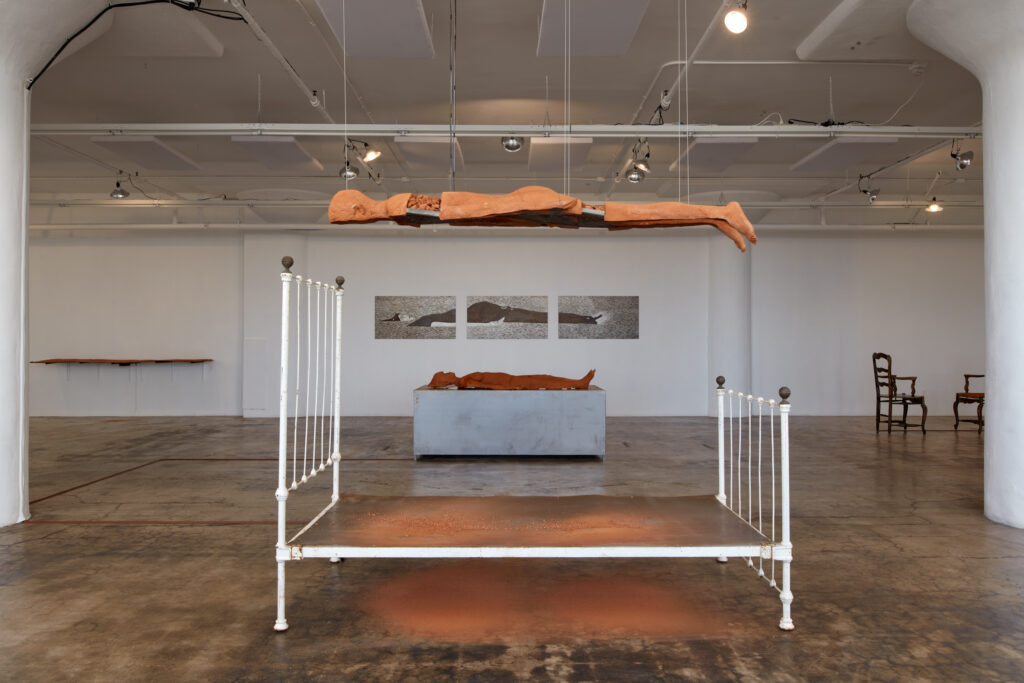
At JOAN, my immersion was apparent the moment I entered the exhibition and met the mineral scent of wet clay, its particles dispersing as the sculptures slowly disintegrate. This exhibition, mounted in a light-filled industrial gallery, is anchored by two life-size figures suspended in states of opposite but equal erosion. They pulse intermittently, animated by the movements tracked and transmitted from the gallery at OXY ARTS. In dreaming, sifting, settling (2025–26), a face-down figure floats above a twin bed, slowly spilling its dried clay contents through the filaments of the metal frame to create a powdered shadow of desiccated dust. Beside it, spring (2025–26) consists of a figure mounted on a metal plinth expelling water through its mouth, its face hollowed and contours dissolving with the constant flow of liquid. Over time, the contact of steel and water catalyzes oxidization, transforming the plinth to rust. Sculpture and support are mutually entangled in an ongoing process of remaking each other, their alchemical evolution mirroring the material dissolution of the works enacted through sonic vibrations. Every act of destruction is also a transformation—the traces of oxidization and decay may scar her sculptures, but they also accrue a tangible record of their encounter and a material record of the work’s history.
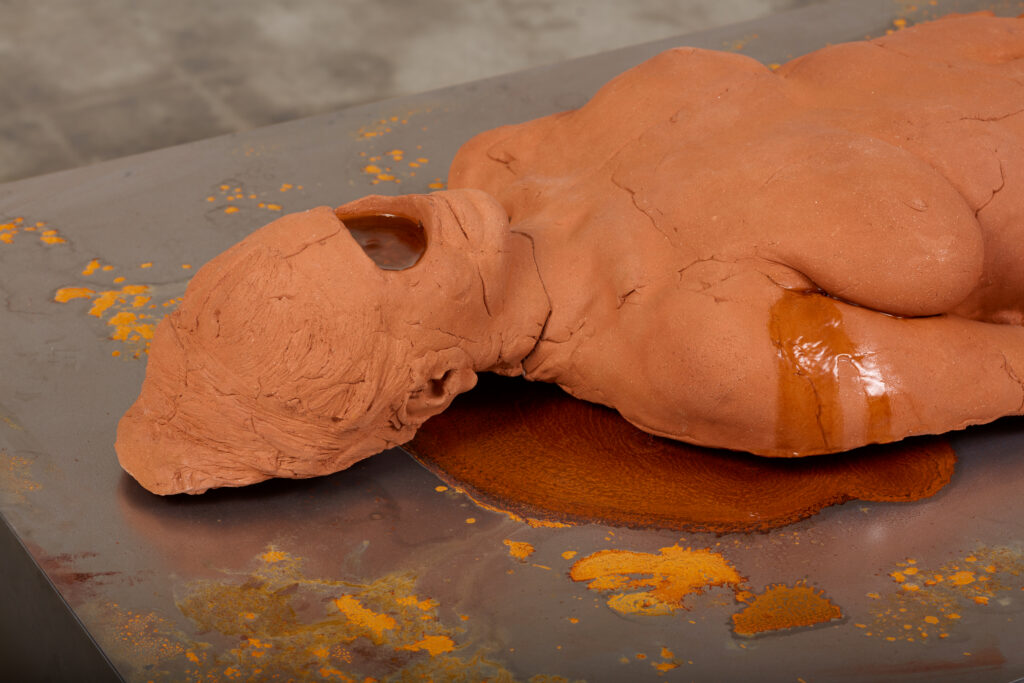
If the protective function of the gallery is to preserve an artwork in stasis, Pirouzmand’s sculptures seem to reverse this imperative. They resist the archival impulse to fix a piece in place, instead accepting their own degradation as a necessary condition of the sculpture’s activation. Without a witness, the works would remain intact in the gallery, but they would also be incomplete, absent of the sounds and movements that make us most aware of their material qualities. In some ways, Pirouzmand’s exhibition seems like a performance piece concealed within a series of sculptures: The detritus left behind is not just evidence of their destruction, but a tangible record of the ephemeral encounters with visitors. If we were to return to the gallery at the end of the exhibition’s span, we would find the evidence of our own presence. These works teach us to look for the trace of our own hand in a distant subject, to witness in ways that reckon with our own complicity.
Walking across the gallery, I felt a soft crunch: A single finger had rolled to the center of the floor and disintegrated under my foot. It was painful to see it fall to pieces, and yet I knew I had rehearsed this gesture a dozen times before, damaging the sculptures from a distance with each step I took in the previous gallery. When, like Pirouzmand, we turn our attention to the material qualities of our surroundings, we find that even the instruments of our digital alienation are implicated in an exchange of military intervention and global capital. The microchips that make up our smartphones are themselves contingent on a flow of commodities through Iran, a system that becomes apparent to us only in the moments when it begins to break down. This is the strange power of everything was once something else, which displaces the impact of our interventions and then compels us to witness their consequences. It felt like a reminder of the limits of our digital omniscience, of the subjects that fall outside the frame of our virtual worlds and the ways we can come to know our surroundings only through the friction of a physical encounter. Like Pirouzmand’s figures that inevitably come into contact, we find ourselves endlessly entangled. In these galleries and outside of them, Pirouzmand suggests, there is no neutral ground from which to witness our destruction.





Contribute your thoughts by leaving a reply