


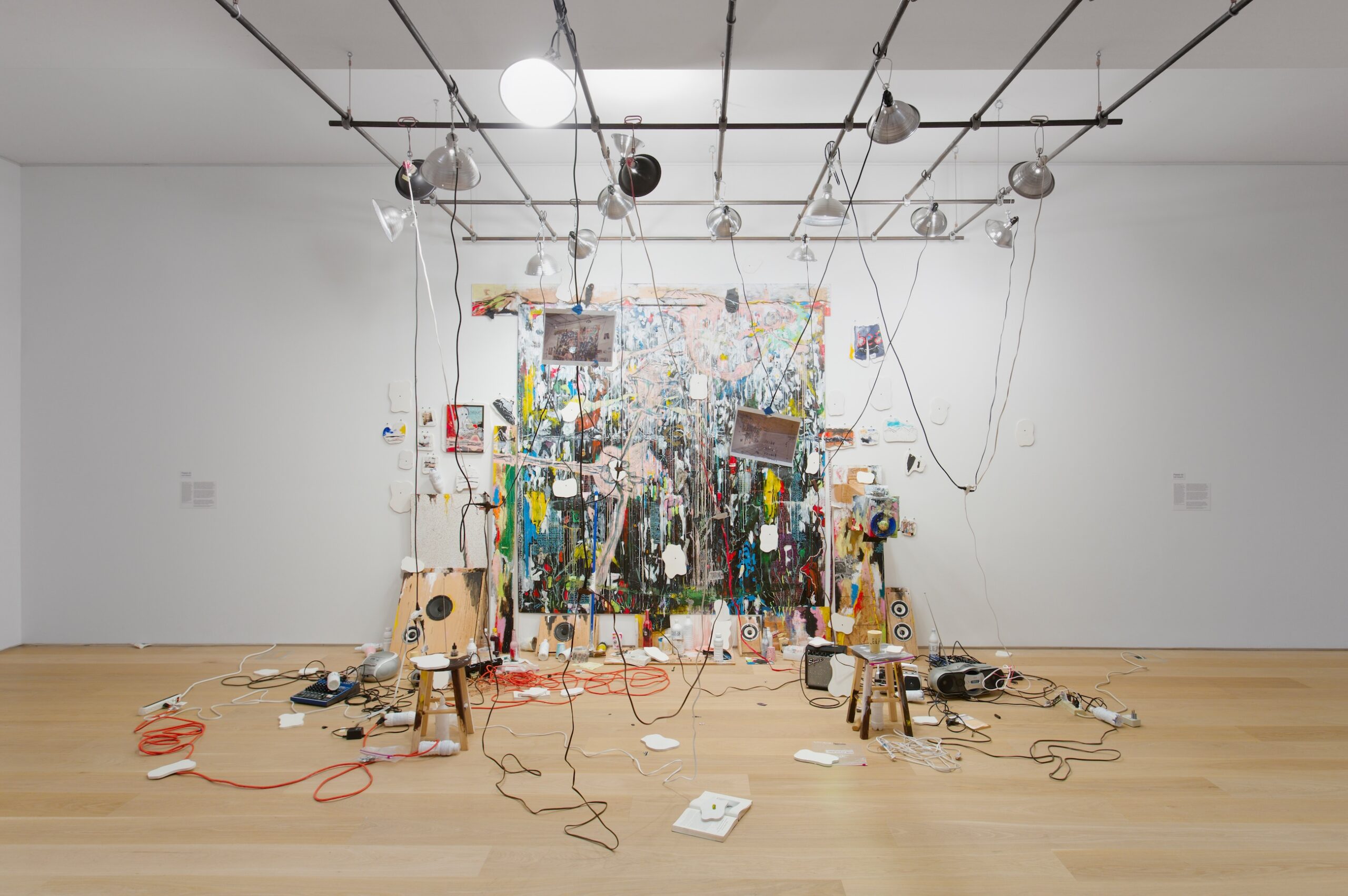




Sound is among the most mystifying sensorial phenomena. It’s a bodily incursion that’s both acoustic and psychoacoustic. It can be defined as an event and its effect: an invisible pressure wave that travels through a conductive medium (air, water, bone) and the auditory impression of this process. Sound can threaten and entice, such as the Greek siren and Irish banshee, as well as maim—the pressure differential of a shock wave can shear soft tissue and rupture air-filled organs. And yet, despite sound’s dizzying array of physical ramifications, human models of perception can often deprioritize it. Most works of art echo this trend––understandably, given the fact that creating sound necessitates the kinetic transfer of energy, a material process that’s generally anathema to drawing, painting, and other static art forms. Pope.L (1955–2023) upended this predisposition with his wall-sized drawing installation Relational Painting a.k.a. If Black Is Beautiful… (2003–22), recently included in Certainly an Act, a survey of his works on paper at the Drawing Center in New York City. The installation, which spans a large wall and spills into the center of the room, harnesses sound as a crucial element of its composition. It proposes a sonic approach to mark making that ultimately reflects the material qualities, both gestural and textural, of the drawn line itself––subverting silence and flatness as accepted attributes of drawing.
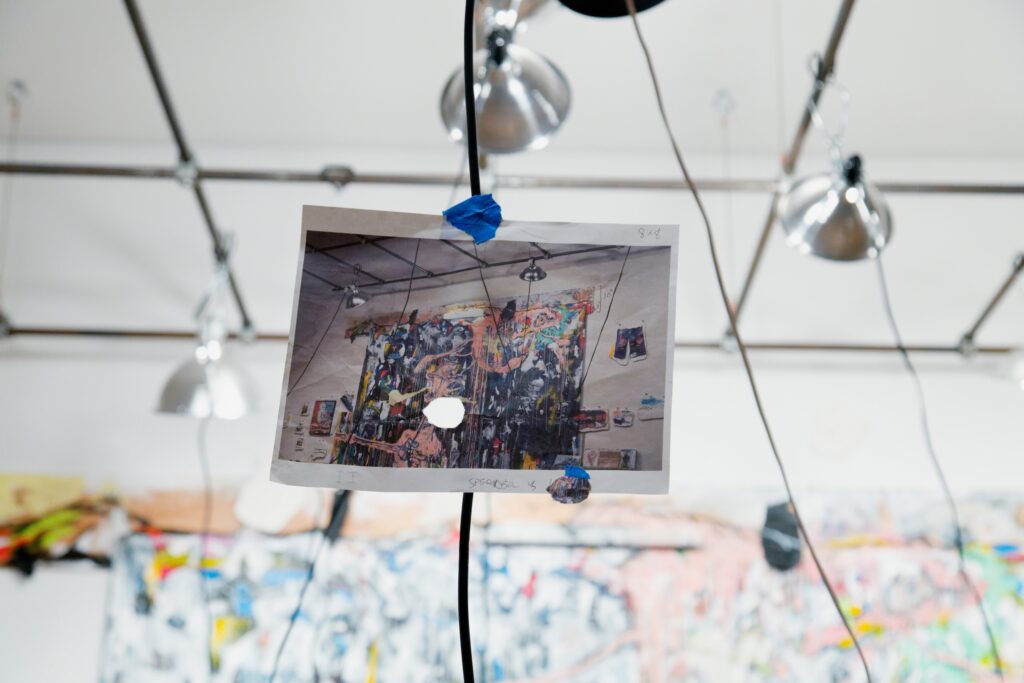
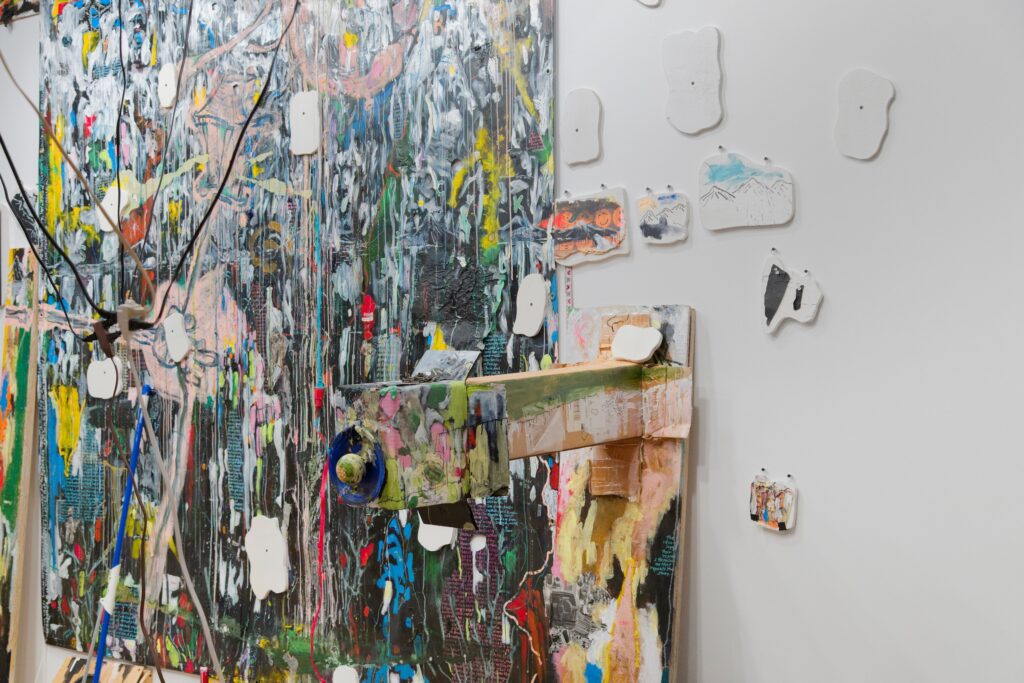
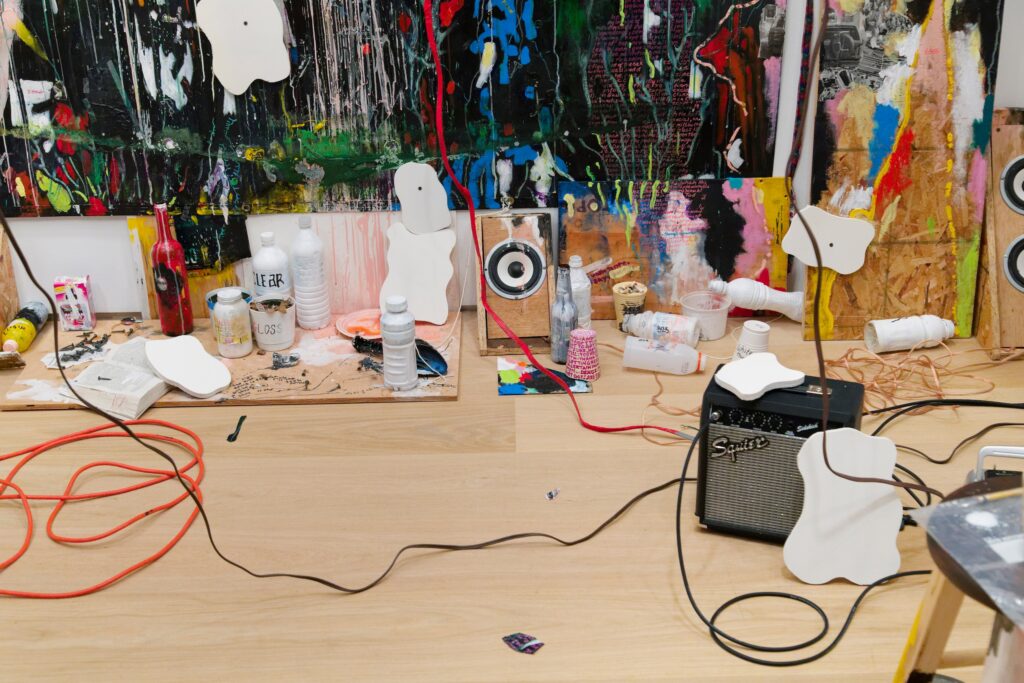
First exhibited at the Art Institute of Chicago in 2007, Relational Painting presents as a drippy, multilayered, polychromatic drawing on black vinyl tarpaulin with a constellation of loosely connected parts, including painted wood beams and a cardboard appendage that extends from the gallery wall, each element a grapheme within the wider script of the composition. Scattered bottles, books, stools, cups, paint cans, speakers, amplifiers, boom boxes, mixers, and other miscellaneous painted and drawn objects—ninety-nine elements in total—line the floor below and in front of the drawing, with tangled extension cords snaking throughout. Amorphous white wood shapes sporadically dot the entire area, as if crawling about the space—an implied locomotion that recalls the artist’s famed Crawl performances (1978 onward), during which he propelled his prostrate body across the streets of New York City. On the ceiling above, a matrix of pipes supports numerous clamp lights, which illuminate various sections of the work. Hanging from their intermingling cords are two printed images of the drawing itself, a self-reflexive index of the work’s material history. The artist cleaved a small hole into one of these images, creating a miniature lens that, from a certain angle, allows the actual drawing to peek out from behind its simulacrum. Finally, a cacophonous score pumps through the included speakers, positioned under the drawing and across the floor, enveloping the viewer in noise and, at full volume, extending the edges of the installation beyond the gallery’s walls and into the street, where the clamor finally fades as you cross its invisible acoustic boundary: the fuzzy threshold where a sound can no longer be heard.
This kind of slippage—between sanctioned and unsanctioned space, from the gallery to the street—is a hallmark of Pope.L’s work, which spans performance, video, installation, writing, drawing, sculpture, and painting, with the artist adamantly resisting the preconceived hierarchies associated with each. With performances such as Eating the Wall Street Journal (1991), for which he installed himself on the sidewalk and physically ingested the newspaper, and projects such as Flint Water (2017), during which he sold bottles of the city’s contaminated tap water as editioned artworks to benefit local relief organizations, Pope.L similarly subverted conventional sites and modes of display, dissolving the barrier between public and private space. In his notable sonic work Choir (2019), the artist harnessed sound as a circulatory sculpture that likewise permeated the gallery’s walls, this time at the Whitney, where a thousand-gallon water tank, connected to an upside-down drinking fountain and a vein of copper pipes, cyclically drained and filled with water. The roar of its pumping and sloshing, recorded in real time from the tank’s plumbing mechanism and emitted back into the gallery via speakers, emanated throughout the space and drifted into the museum’s lobby as an amplified live score, which also included prerecorded gospel singing. The work functioned as both event and effect, breaching its container. While inherently conceptual and inspired by Cageian philosophies of sound, Choir––like so much of Pope.L’s work––reached beyond its own material grammar for relational meaning, pointing instead to the vernacular mechanisms that structure racist policies (segregated pools and water fountains) as well as to the pernicious contamination and commodification of public water sources (Flint, Michigan), all the while subtly implicating the rarefied, elitist underbelly of the institution itself. In his other notable sonic work, Whispering Campaign (2017), which highlighted hardships endured by refugees and immigrants, Pope.L broadcast the layered sounds of whispering voices––interwoven personal stories from migrants in Athens and Kassel, Germany, both live and recorded––from public sites and maintenance trucks that roved the streets of both cities, creating a boundless auditory performance.
The title of Relational Painting proposes connections beyond the work’s immediate material juxtapositions, reflecting a philosophy of interconnectivity that the artist himself espoused: “All things exist with other things in the universe,” an uncited quotation noted in the work’s extended object label. The title can also be interpreted as a nod to relational aesthetics, the late-’90s term for artworks, often immaterial ones, that frame human social interactions as their definitive medium. In her catalogue essay on the work, Aria Dean contextualizes this idea of relationality in terms of Pope.L’s longtime exploration of Blackness as both a subject and an identity, homing in on his inclusion of books by W. E. B. Du Bois within the installation (a paint-splattered copy of Black Reconstruction in America rests atop a slab of plywood) and addressing the “conditional statement” that makes up the second half of the work’s title: If Black Is Beautiful. She writes: “One must conclude that the relation between this ‘if’ and the unspoken ‘then’ must be one of the ‘relations’ at issue for Pope.L,” who, while reveling in fixed references, consistently resisted fixed meanings. Somewhere in the work, according to wall texts (although I was unable to locate it at the time), the artist embedded the complete titular phrase: “If black is beautiful and beauty is only skin deep then blackness is not all that it seams.” This play on words between seems and seams is prevalent throughout the Drawing Center exhibition, emerging throughout various drawings, in the form of scrawled marks and phrases, as visual and linguistic homophones. Each word suggests a conditional or contingent relationship, with seems pointing to the impression of one thing as another and seams pertaining to the haptic meeting point between two separate things.
In my experience of Relational Painting a.k.a. If Black Is Beautiful…,the work’s sonic element paralleled these linguistic blurs, with dissonant sounds clamoring, colliding, and masquerading as other resonances. Serendipitously, my visit coincided with the daily fifteen-minute time frame when gallery staff turn the work up to its full intended volume, a curatorial intervention designed to mitigate viewers’ exposure to the work’s “overwhelming” sonic atmosphere, per wall texts. I had already spent considerable time with the show when staff members began quietly distributing earplugs (I declined) before ceremoniously adjusting the speakers. Each speaker emits a unique tone, hum, or blare, which together interweave to form a palpably disarming acoustic tapestry––a thick, electric assault to the ears with the force of a closely passing freight train. The immediate effect proved to be astounding: For nearly the full fifteen minutes, about eight other visitors quietly gathered with me in front of the work and simply looked and listened, enraptured by this drawing that breached two-dimensionality. I was reminded of Pope.L’s monumental installation Trinket (2015) at the Museum of Contemporary Art, Los Angeles, which featured a massive American flag blasted by industrially powered wind, its woven edges gradually shredding. Here, the viewer’s body endures a similar external force.
Over the course of this time period, my perception began to shift. The sound pummeled my eyes, and the air rippled like a mirage. The gestural cadence of the surrounding works also seemed to metamorphose, with marks and colors unfurling at the seams, enacting their embedded lexicons. I heard buzzing bees and chirping crickets, the whirring of torpedoes and warplanes, incessant beeps, grating shrieks, metallic scrapes, roars and creaks, murmurs, cracks, and hisses, both industrial and animalistic, their violent frequencies ever-bleeding. Compositionally, each aural texture found its analogue on the accompanying drawing’s surface––a whistle as a staccato drip, a rumble as a color smear––their gestures braiding together in material pandemonium. I thought of the constant din of data centers and the invisible torment of sonic weaponry.
Sound envelops. It’s durational, and it reverberates with a chronological beginning and end. According to the event theory of sound, it also functions as both physical disturbance and temporal occurrence. “What is drawing?” Pope.L asked. “It’s time. It’s action. It’s event. It’s a way of marking time by enacting an event.” Relational Painting’s sonographic qualities (son/o: sound; graph: to write or draw) expand this deliberation by framing the act and object of drawing as a composition completed by listening. Here, by listening to, and thus physically absorbing, Pope.L’s artwork, we become living, conductive receptacles for its textured sonic field.







Contribute your thoughts by leaving a reply