







A Queer Arcana: Art, Magic, and Spirit, curated by David Evans Frantz at the Palm Springs Art Museum, is a summer blockbuster eons away from what you would expect of a regional art museum known for championing West Coast abstraction. The artworks are potent and arresting, while the show presents magic’s cultural history with meticulous care, making palpable the very real political struggles that shaped these artists and their strength of purpose: Queer magical practitioners worked within a state that criminalized gay sex as recently as the 1970s and prohibited so-called magic, hypnotism, and clairvoyance in California until 1985.
A Queer Arcana’s subtle power lies in its commitment to artworks that are not simply on magic, but rather art created in the process-focused registers of the magical working itself. The sensation of the show recalls the temporary autonomous zones of the early 2000s, sites that allowed cultural indeterminacy to remain intact.
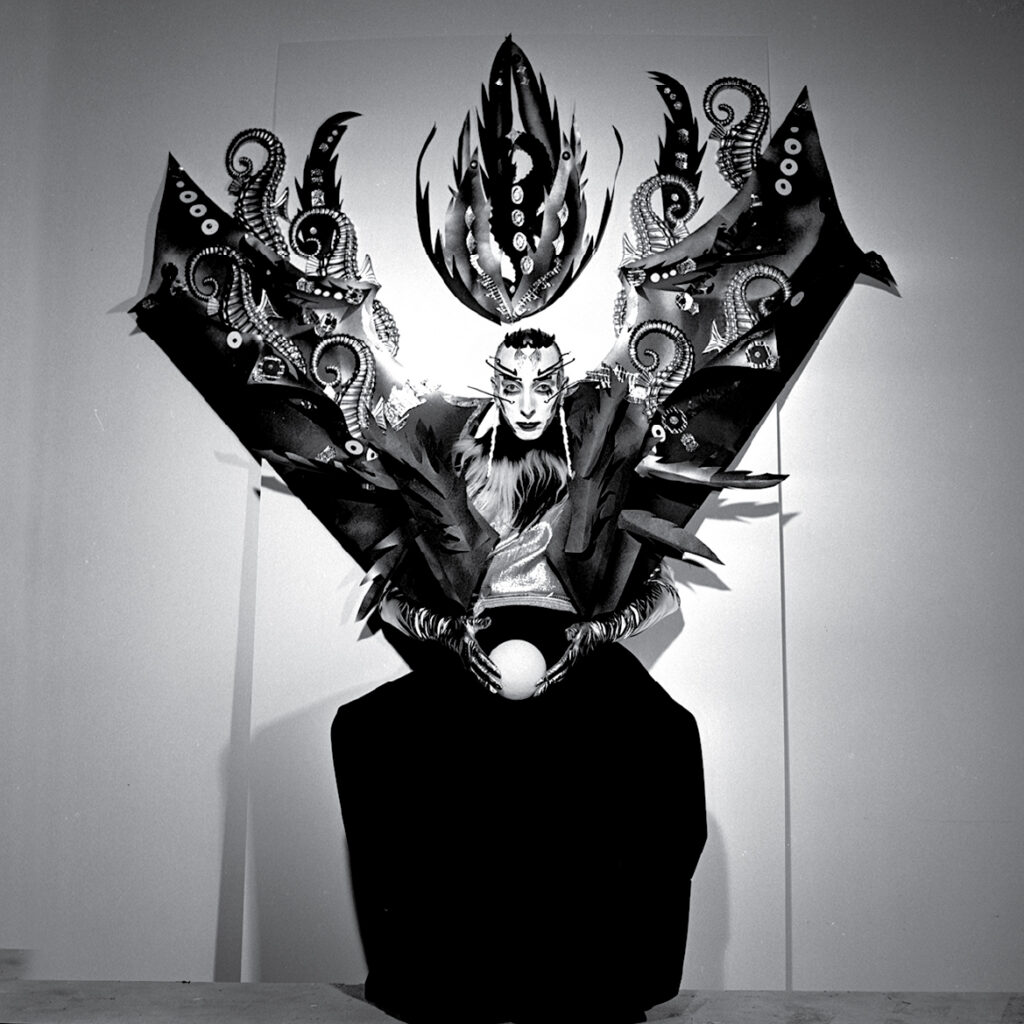
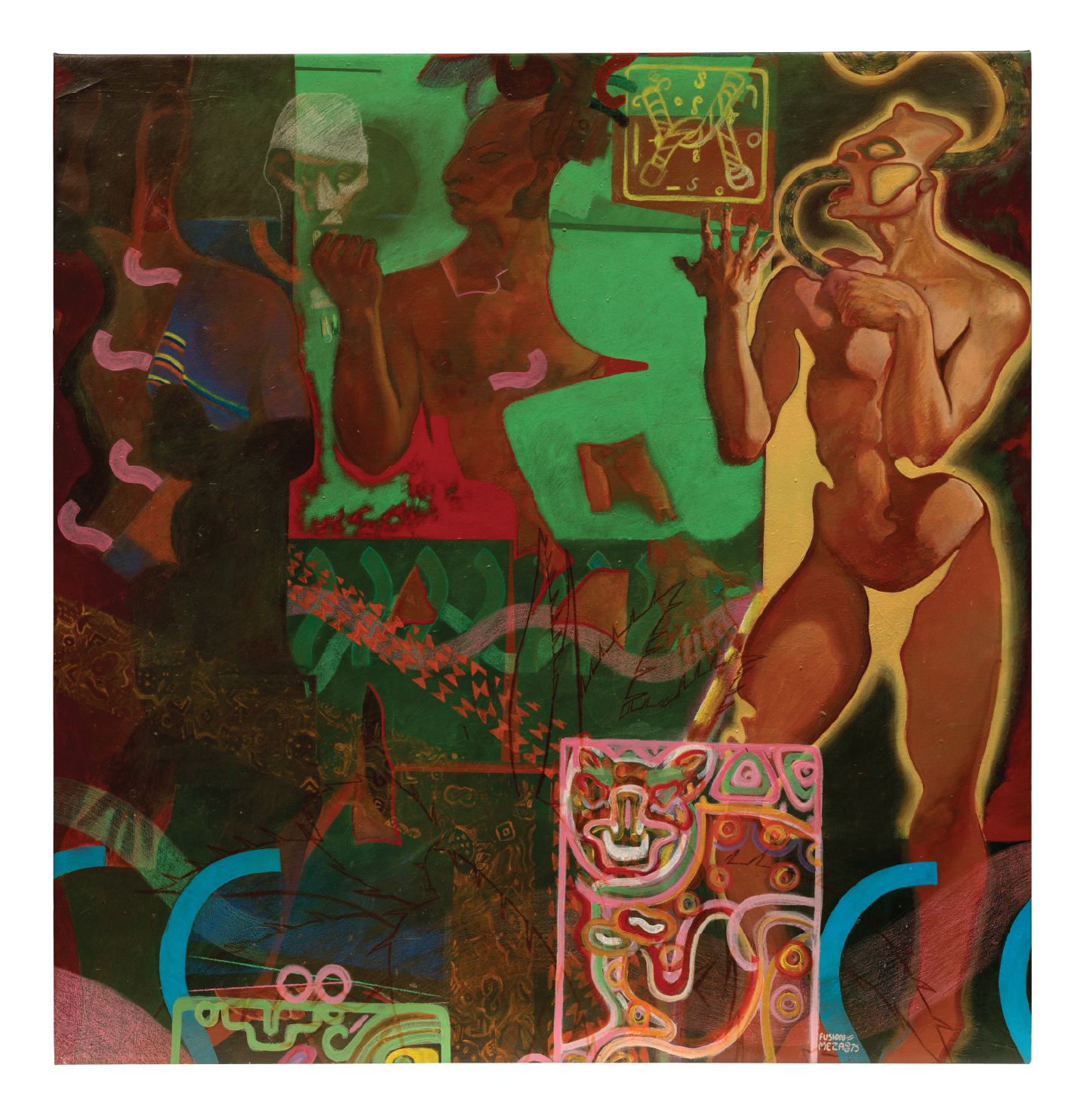
The exhibition has its own intuitive momentum. Works by formidable artists stand like sentinels against a purple wall, flanking the gold text announcing the exhibition’s title: Striking black-and-white photographic mandalas from Los Angeles psychedelic maximalist Steven Arnold and Ingo Swann’s painting Proto Adam (1988–89) of a mystical hunk flexing with arms raised, replete with sunglasses, Sephiroth diagram, and a constellation superimposed on a six-pack. This is Palm Springs, after all. Then, deeper into the galleries, comes Agnes Pelton’s gorgeous holy book of a painting entitled Future (1941), a metaphysical, symbol-laden drama drawing out spirit forms through desert landscapes and firmament. By this point in the exhibition, my thoughts began to race. I started to wheel through, sweeping past heavy hitters of queer California mysticism. From Jayne County to Mundo Meza, I was propelled from one marvel to another, almost short of breath.
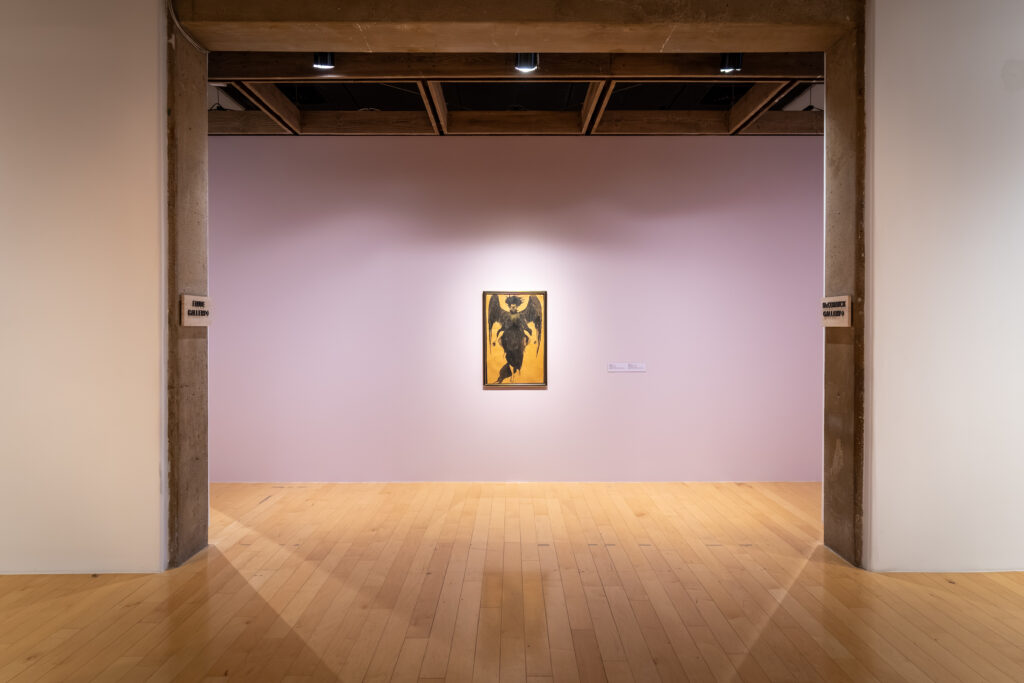
It was near the physical heart of the show that I finally found pause. Framed between two cement columns hung a painting I immediately recognized as the work of the mid-century LA mystic, actor, occultist, astrologer, and painter know by the mononym Cameron. The painting, entitled Dark Angel, features the form of an angel with arms outstretched in a gesture like Christ’s “fear-not.” The being’s hair, wet and carefully mussed, is rendered in ink. The ferrous film of ink and paint together shimmers slightly above the yellowed paper. A generative swirl on the angel’s front remains gorgeously raw and tempestuous amid a slightly restrained and careful brush elsewhere, like the angel’s mantle contains a twinkling firmament.
While Cameron’s work is significant, and her star is firmly established in the firmament of Southern California avant-garde occult fringe, her lesser-known lore has its own arresting power. Her story includes creative collaborations with Kenneth Anger, a censorship scandal following an LAPD raid of a gallery showing her drawing, and her attempt during the 1950s to physically destroy her body of work, through rituals related to grief over her husband’s death.
The other, equally striking Cameron painting included in the show (incidentally, the very work that caused the aforementioned scandal) features a pair of figures drawn with lines that contour their edges while their energetic bodies arch their backs in ecstasy. The figure topping is hunched over, their seemingly transparent skin revealing a cascading spiral staircase of spinal form, bodily shapes, and perhaps orgone; the person receiving is on all fours, head tossed back with abandon, eyes shut and forked, brushlike tongue to the wind. A network of fine lines fan out across her body in more diffuse, intuitively designed patterns constructed with thinner shape, like corporeal ley lines or acupuncture meridians. The breathtaking scene nearly writhes with its own energy from the yellowed, water-stained paper it is unpretentiously painted on. I wonder if this drawing was planned—or is it the manifestation of a moment of trance, its creation an act of spirit collaboration?
Cameron’s ritual destruction of her own work may read to us as an act of vandalism, but that judgment assumes her paintings and drawings were intended to survive, leave the studio, and circulate among collectors. For Cameron, the purpose—and perhaps the power—of these works was thoroughly entangled with her ceremonial practice and the spiritual world she inhabited. Their destruction belonged to that life, too.
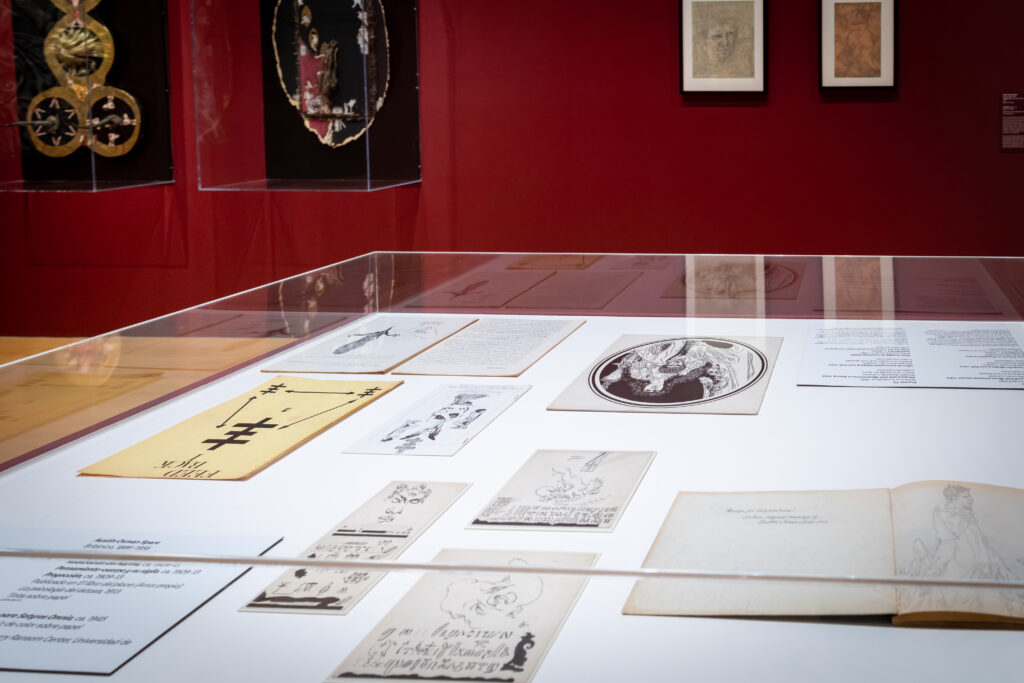
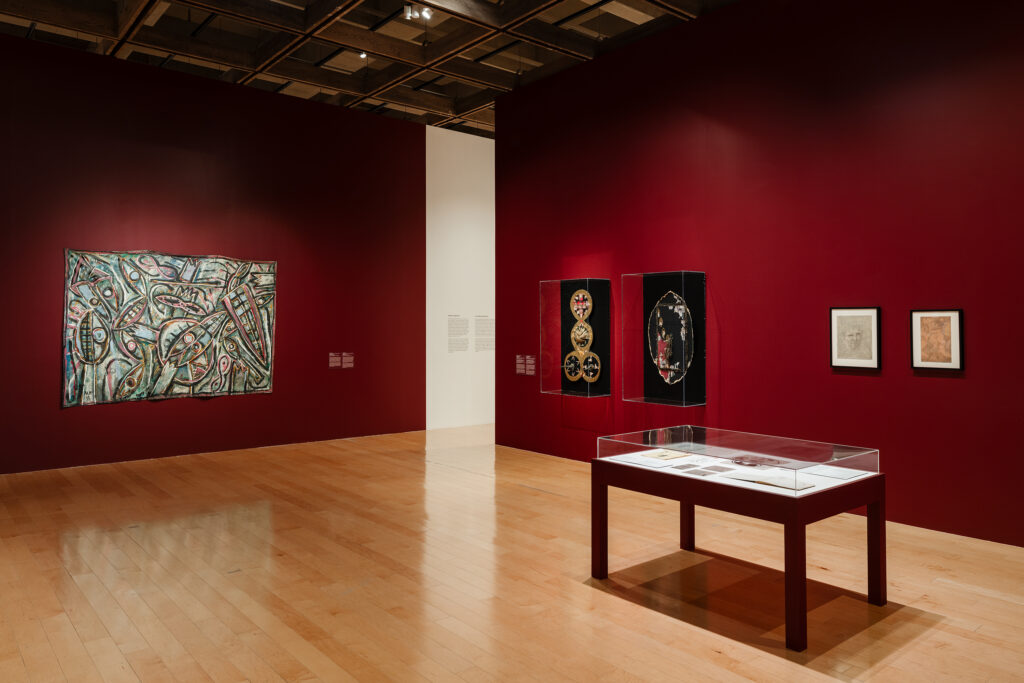
The English occultist and artist Austin Osman Spare created much of his work in the state he referred to as gnosis, or a trance state of vacuous emptiness brought on by ecstasy or exhaustion. Crucially, he documented his techniques, making them available to later practitioners. His drawings are broadly instructive, and they have inspired sigil experimentation in many young artists, though it was his written work that really brought sigil magic to vast new audiences.
With soft, repetitive pencil strokes, Spare depicts a satyr deep in the gyre of dance, throwing himself among animal and intermediary humanoid beasts. Paired with it, another graphite sketch bears scratched, repetitive marks that register the psychic stream of consciousness driving this “automatic” creation. Spare considered his drawings to be co-authored by the spirits themselves and by the unconscious forces within him. The experience of beholding these works can’t be described easily. And therein lies the fascinating nuance of encountering artwork born of magical practice. There is a sense that the drawings themselves radiate with the schmutz of twinkly soul stuff; hairbrush stuff; and, in some queer art, father stuff itself. But I can just as easily read these images, so tied to “automatic” or trance-based practices, almost like the psychic puppy pads of the ritual moment: Though they point to epiphany and transcendence, the traces, displayed here as discrete objects, also underscore the fact that you are in a museum and the ritual is over. The circle has been closed, and the spirits have been banished. These are the indices, the remains. But they contain all the component parts you need to take this mantle on yourself; they can also serve as recipes.
Inside a glass-topped vitrine lies another series of stunning drawings in black ink: the iconic serif-heavy alphabet of Spare’s personal cypher, the material prima for the sigil technique, one of the first modern magical techniques, designed in tandem with the psychoanalytic theory of mind that was de rigueur in the early twentieth century. Brilliantly, Spare’s 1913 drawings from The Book of Pleasure (Self-Love): The Psychology of Ecstasy, an intimate bound publication, share a vitrine with fellow British artist Genesis P-Orridge’s 1980s adaptations of her forebear’s writings and reproductions of his drawings. P-Orridge set about diffusing the elder occultist’s techniques for a generation of industrial music fans, ravers, and practitioners of chaos magic.
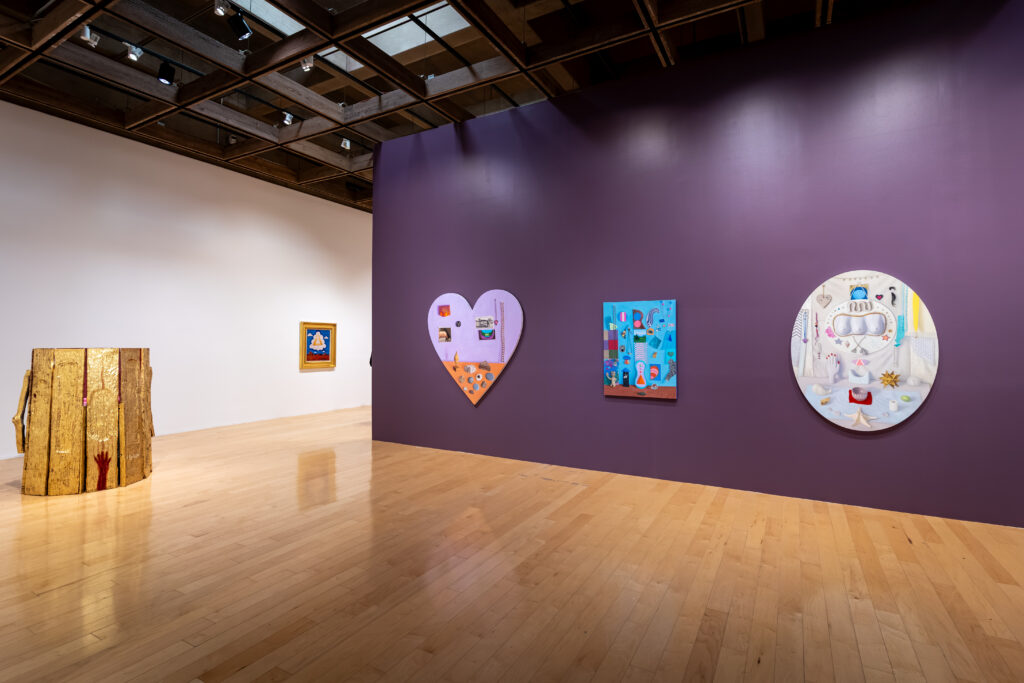
P-Orridge, who coined the term pandrogyne for their expanded gender identity during a public project of surgical and magical gender and personality deconstruction, is well-known for impregnating and charging artworks with magically potent, talismanic spellwork. The four-foot-tall ensorcelled mixed media works on display, Phallus Dei and P-Androgeny Sigil, include the artist’s dreadlock, along with rubies, sexual fluids, and paint. To P-Orridge, these works are literally charged, talismanic artifacts themselves, some even activated by the attention given to them by unwitting viewers. Art and artifacts of this sort exemplify the type of magical thinking that anthropologist of religion James Frazer believed operated through a logic of contact or contagion, predicated on the idea that contact can create permanent connection across time and space. (The other primordial law he proposed applied to magic that functions with a logic of similarity, wherein symbols and associations are manipulated to affect one another, paralleling the Victorian obsession with the taxonomical and the structural). The contact-charged hair of the artist, potent due to contagious, magic does feel like it brings the presence of the artist, who died in 2020, into the room.
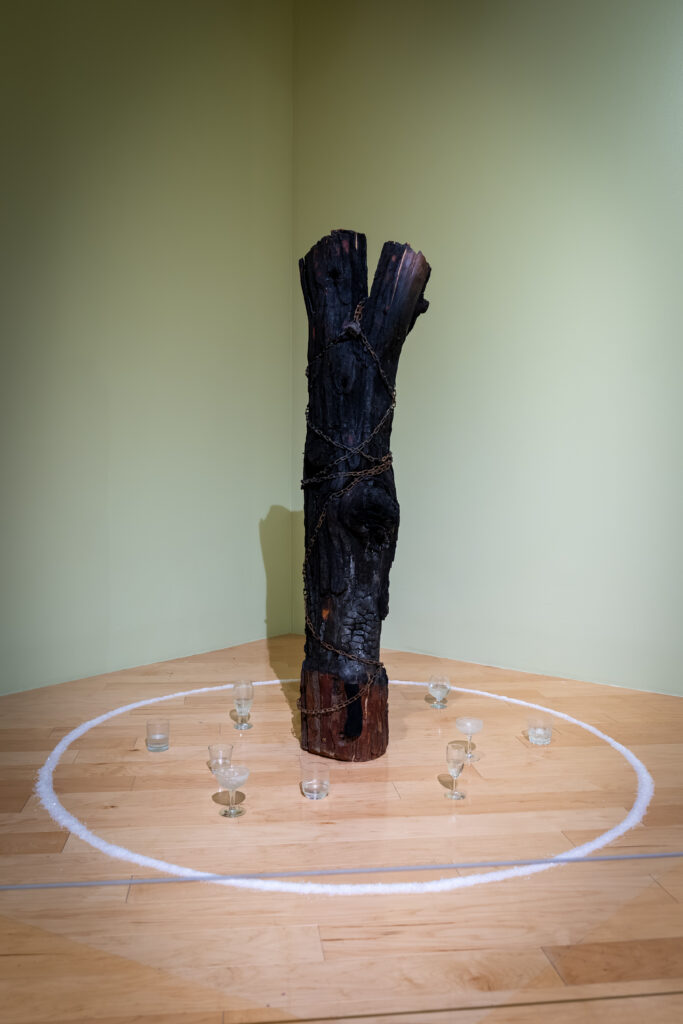
Indeed, many of the artists in the show pay homage to the departed. Candice Lin’s kinetic sculpture honors Sycorax, the witch from The Tempest. Fans blow indigo-dyed silk fabric against the flutter of gravity, revealing a pillar covered in apotropaic vulvas. Joseph Liatela dedicates his sculpture, assembled around a burnt redwood trunk, to a historical “woman calling herself Jeanne the Pucelle,” referring to Joan of Arc’s chosen appellation, a poignant reminder that naming ourselves is itself a magical act and one many of us perform as we come into our selves as both queers and magical practitioners. Nao Bustamante sends legendary TV astrologer Walter Mercado a heavenly shout-out in a magnificently maximalist four-minute looping video.
Alongside homage, an abiding sincerity undergirds A Queer Arcana. It is present in the breathtakingly intimate filmstrip The Wedding, documenting the ritual union of Lin Barron and Pauline Oliveros on July 4, 1970. An unassuming small line of printed photographs, only slightly bigger than those on a contact sheet and installed horizontally like a comic strip, the work allows access into a deeply moving ceremony of love, replete with historical costumes, Celtic bronze trumpets, conch-blowing on the Pacific shore, nude body-painting, and lunch back at the sound artist and her former student’s San Diego home.
Even the inclusion of Moonshadow: The Voice of the Transexual Action Organization and Mirage, among the first magazines in North America to come out of the fledgling transsexual movement in the late 1960s and 1970s, feels earnest. It would be exceedingly hard to overstate what these magazines would have meant to trans magical practitioners in that era, and their tender arrangement in a display case conveys this significance.
In a way, this sincerity connects the show to the political performance of its small host city, where a 36-foot rainbow flag now flies on a massive six-story pole, three times higher than any of the buildings in Palm Springs. Installed during the 2025 Halloween season, over eight months into President Donald Trump’s second term, it is designed to fly indefinitely.
The few places—Provincetown, Palm Springs, and Key West, all located way out on long highways—that became the gay capitals of North America in the twentieth century in many ways attracted magical practitioners for the same reasons they did gay and lesbian people: Their relative remoteness offered privacy. They were places built around cultures of discretion. But the luxury of discretion is no longer as attractive.
What would the artist Cameron, who retreated to the California desert herself, do in a time like this? I wondered how these artists would have contended with the liberal political gains made by our trading in liberal human rights as “sexual minorities,” not mages, with rainbow flag bumper stickers instead of invisibility cloaks.
It may be tempting to render these magicians and queer people of the past “loud and proud” and to name them so we can build out the list of heroes for our present-day human rights campaigns. I appreciate the importance of this work, especially in this time. But true membership in our most vibrant little communes, traditions, and cliques has never been an exercise of identification or purity. They have mixed and mutable, furtive and factionalized little lineages. This nuance is borne out by A Queer Arcana, and that is where its subtle strength lies. So many of the artworks included in the show spark little twinkles of the numinous contact between their creators and the spirits that joined them: flickers of ribald, unruly queerness under a long shadow cast by the largest rainbow flag in the world.








Contribute your thoughts by leaving a reply