







From June 1942 until its dissolution in 1945, the Office of War Information (OWI) generated public support for World War II, operating as a centralized federal apparatus established by President Franklin D. Roosevelt. Officially, the agency was charged with spreading news about US military action, but in practice it formulated and executed propaganda that functioned on two fronts. Domestically, the OWI deployed mass media, including radio broadcasts, film, and photography, to drum up patriotic fervor at home and legitimize the US as global police. (For instance, the OWI produced Japanese Relocation, a short film supporting the forced removal and incarceration of Japanese Americans in internment camps.) Abroad, the OWI carried out psychological warfare designed to dismantle enemy nations, which, at this time, included Nazi Germany, Japan, and Italy. Chief among its instruments were leaflets dropped into targeted regions, a tactic still deployed today.
The prints, such as the ones air-dropped over Japan as a part of the US’s Pacific War propaganda, were framed as a necessary form of communication to offer supposedly benevolent warnings to civilians and soldiers. The design of many of these evoked the political cartoons printed in American newspapers and magazines around the same time: hyperbolic, hand-drawn, and often relying on racist caricatures. One leaflet has the outline of Japan with the sky polluted in a cloud of black smoke; nearly a dozen missiles rain down from above. Another shows a plate full of stereotypical cuisine, including sushi and sashimi, dropped over islands as a way of tormenting hungry, stranded Japanese troops. A town collapsing and erupting in flames appears in a third print, rendered in a bright crimson; it also shows civilians screaming in terror and clutching their young. These leaflets harassed and ridiculed, trivializing and othering those they depicted while simultaneously instilling fear in their recipients, many of whom were civilians. Enacting warfare is as much about controlling the mind and body as it is the land and its resources.
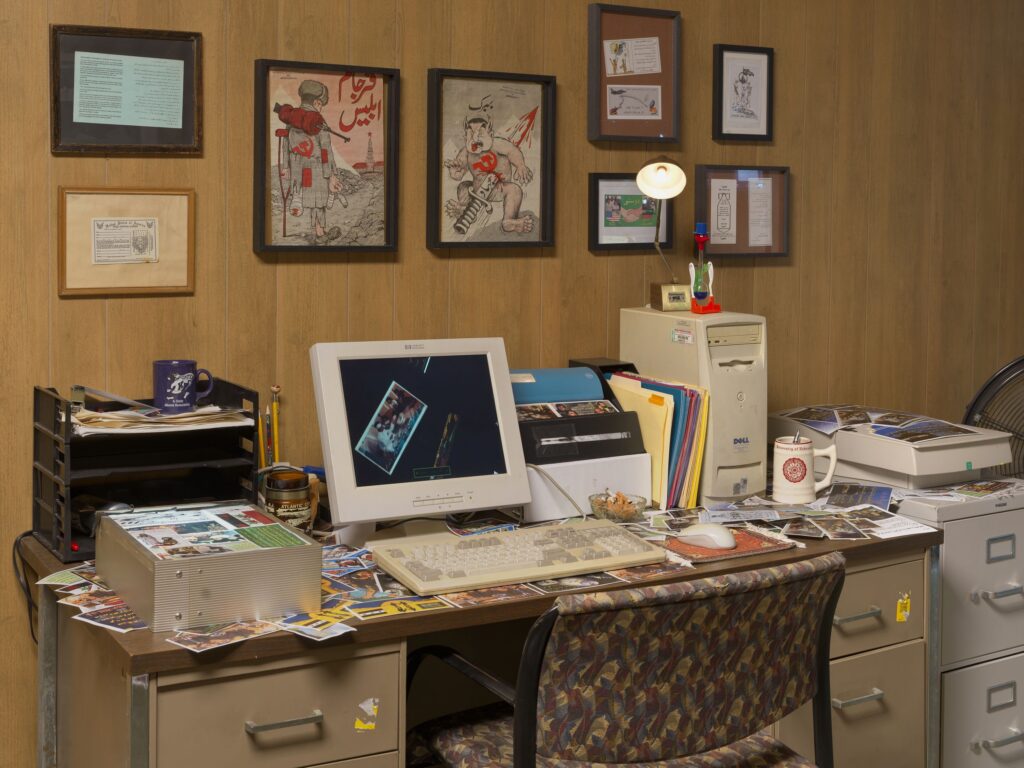
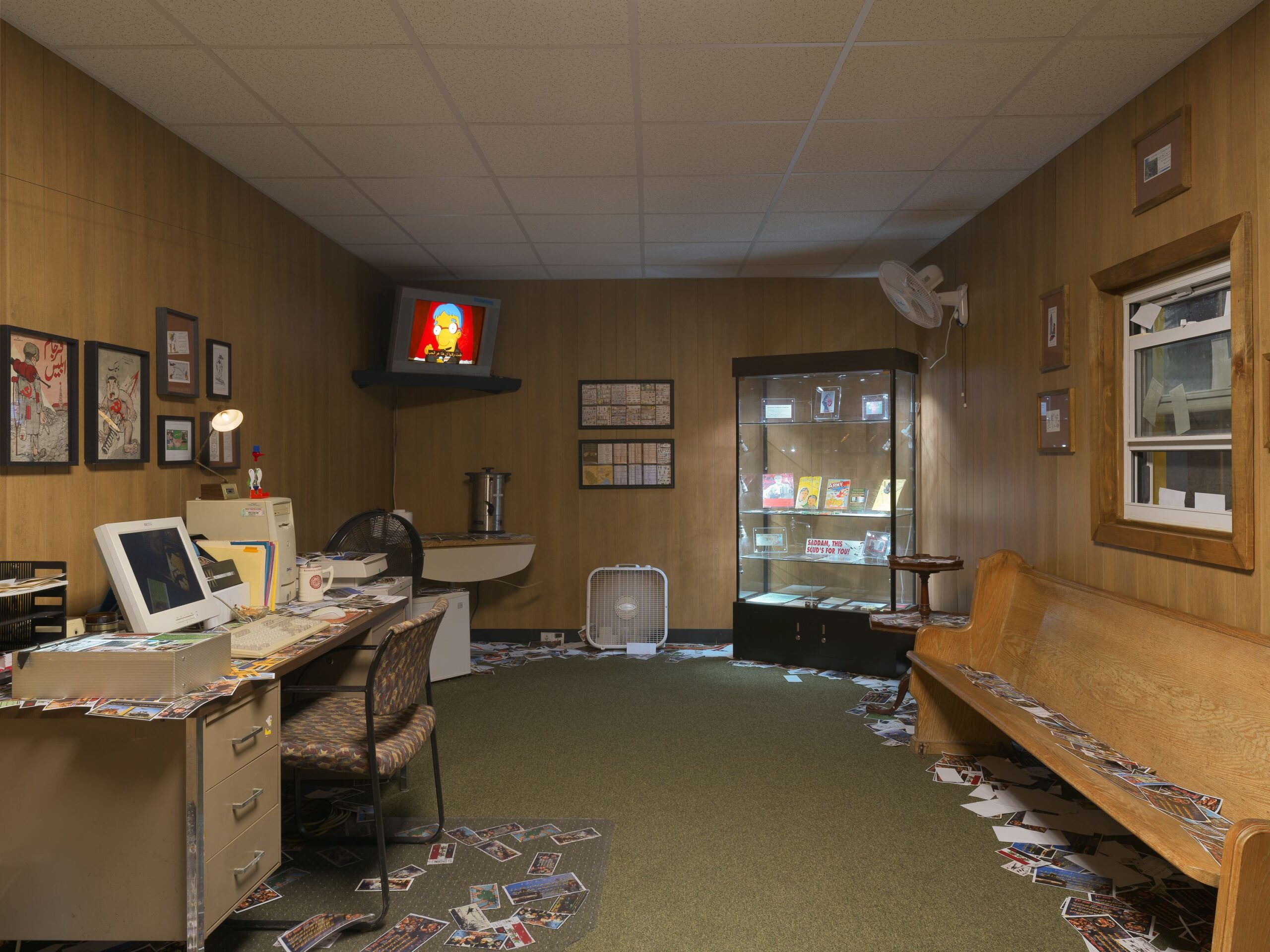
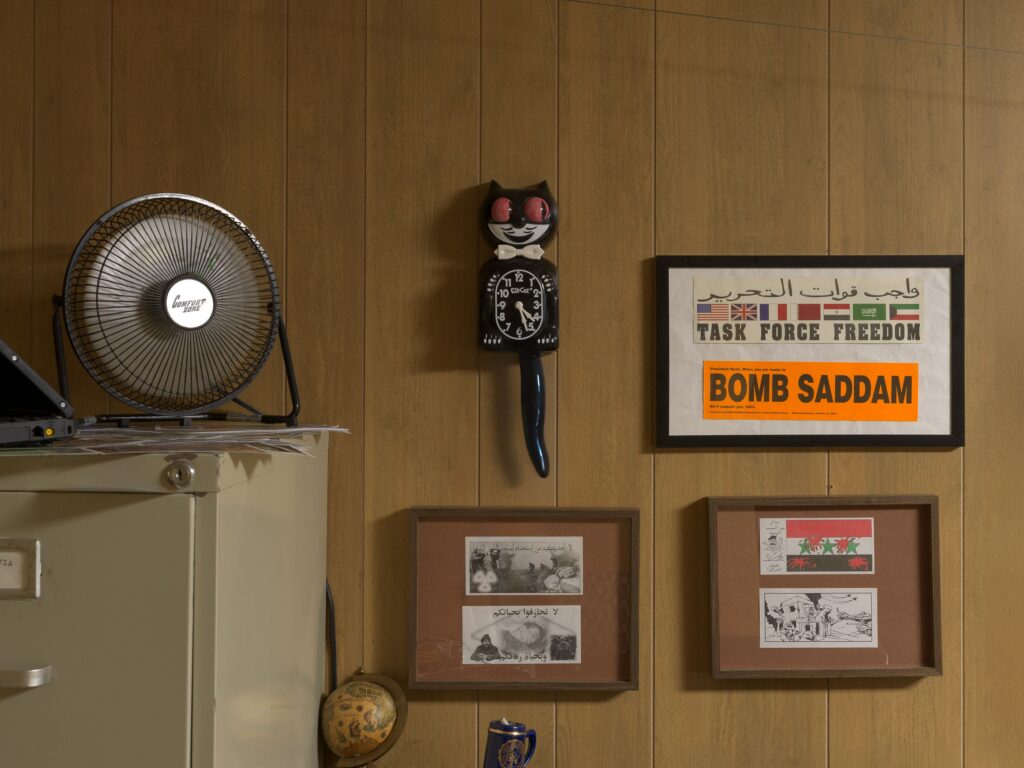
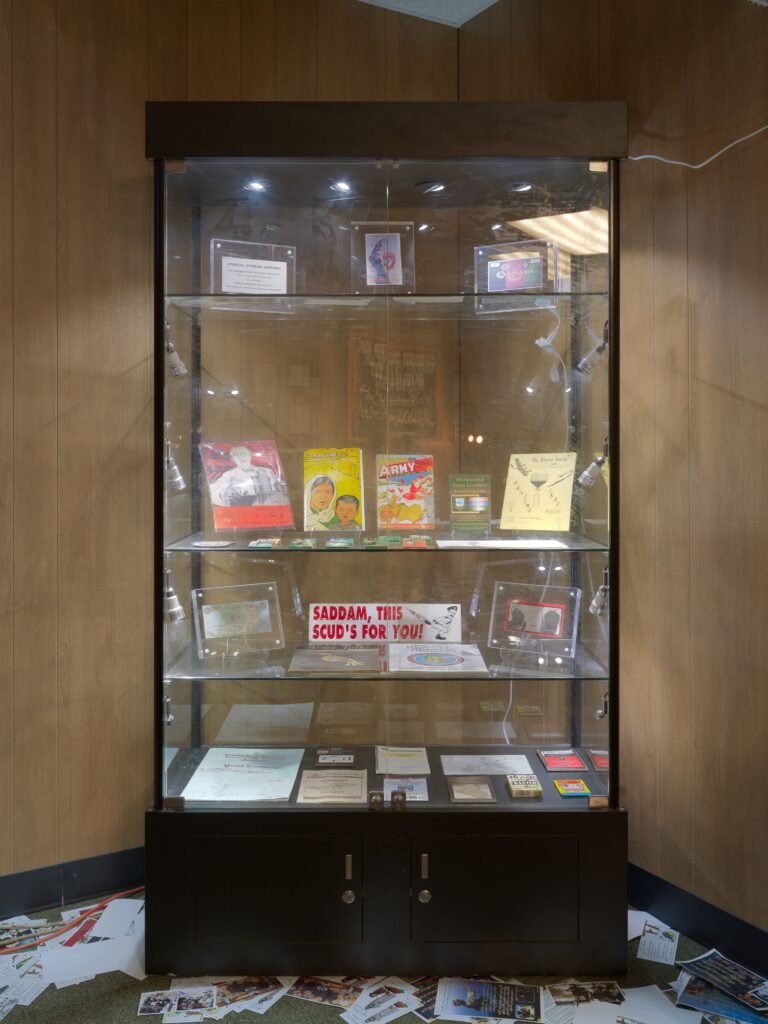
These original leaflets were framed and hung in the foyer of Office of War Information (O.W.I.), an exhibition from Khajistan, a New York–based archive and publishing platform that collects and digitizes censored media from South Asia to North Africa. Curated by filmmaker and archivist Saad Khan and designed by Joey Chriqui, the exhibition unfolded across the third floor of Pioneer Works in Brooklyn, and ran from May 8 to August 9. Around the corner from the foyer, Khajistan transformed a gallery room into an immersive, speculative re-creation of an OWI workspace stuck in the low-tech 1990s. Two cluttered steel tanker desks outfitted with clunky computers were paired with worn chairs upholstered in a busy pattern of muted purples, blues, and browns. The floor was carpeted in a musty olive-green tone, and leaflets hung on the office’s wood-paneled walls. While the space was absent of employees, their work continued; a printer spat out replica leaflets that were also scattered across the room, covering the floor, desks, and filing cabinets. The propa-materials in this room included those distributed in Afghanistan, Iraq, Kuwait, and Libya from the ’90s until the present day. Although several decades passed between the OWI’s existence and the creation of these more modern papers, the same tactics were present. Both iterations of leafleting show not only the normalization and continuation of the logics of war, but also how war is manufactured in overt and covert ways across our media and information systems. The archival materials were also displayed alongside everyday objects branded with American pop culture iconography: a Charlie Brown–themed trash can sat below one of the desks, classic sitcoms played on a mounted TV, and a Kit-Cat Klock hung on the wall. The installation presented war as a bona fide, made-in-America commodity ready for mass consumption, not dissimilar from the kitschy products on display.
Khajistan was founded by Khan in 2021. It has created publications on Pakistani cinema and erotica from Iran, while also spearheading the preservation of magazines, literature, and ephemera, with a focus on media rarely included in official archives. In 2022, Khajistan began acquiring US war propaganda, collecting materials produced and distributed by the OWI, as well as by military and state departments and intelligence agencies like the CIA. Khajistan has amassed hundreds of objects, including pamphlets, guides, and booklets, from a variety of sources, such as military servicemembers and their families, commanders, and antiquarians. Many of the leaflets on view also appear in American War Propaganda Leaflets (1990 – 2022), a book published by Khajistan in 2024.
Inside the OWI office re-creation, a single recessed troffer served as the main source of light, casting a hazy, fluorescent glow on the center of the room. The liminality suggested that the office existed outside of time, like a backroom, uncanny and familiar. It was the 1940s, 1990s, early 2000s, and present day all at once. Ambient noise also enveloped the space. A handful of fans of various sizes, placed on the floor, atop the desks and cabinets, and on the walls, sounded as if they’d been on for decades, clanking and humming in cacophonous concert. By design, the space appeared as banal as any depressing bureaucratic workplace from the mid-to-late 20th century. War has seeped into all aspects of our everyday lives, duplicating and remanufacturing itself through the endless production of propaganda. Though the leaflets and ephemera argue that this is a necessary, unavoidable, even ordained process, the conditions in which they were created makes plain the reality: that war is a product, these materials are its advertising, and we are equal parts marketer and consumer. (This remains true today. Look no further than the way our papers of record spew Israeli propaganda, manufacturing consent for genocide, or how our so-called “Secretary of War” posts AI slop and sensationalist sizzle reels on Instagram, recruiting “American warriors” to “kill the enemy.”)
The exhibition encouraged visitors to interact with its scene of bureaucratic disarray. Each loose replica leaflet featured a yellow numerical code printed in the corner. Once you found a code, you could enter it into a database using the desktop on the left side of the room. The database would then populate with the leaflet’s record, including its imagery, year, place of distribution, and translation. Objectives were also included in the records, which name the motivations for the flyers, including warning residents of bombs or mines, lodging threats to crush resistance, regulating civilian behavior, and presenting military intervention as a pseudo-peaceful act toward stabilization and nation-state-building. Mimicking the motions of a worker in this space made palpable the dissonance in America between the quotidian work we’re compelled to produce and the material devastation that that work helps to realize. “Americans are trained to think that whatever America does is with benevolence,” Khan told Broadcast, Pioneer Works’ magazine. “First the bombs and then the nonprofits, but before the bombs are the leaflets.”
One of the replicas on the floor, Leaflet 4, depicted Iraqi soldiers fleeing as a US F-117 stealth fighter bombed an airfield. The print’s design style mirrored those produced by the OWI and dropped over Japan; the soldiers run like cartoon characters, and an explosion pops as if drawn inside a comic book. At the top, in Arabic, it reads: “This site is being bombed!” The computer stated that this one was dispersed from 1990 to ’91, created as a part of Operation Desert Shield during the Gulf War and aimed to instill panic and disorder to compel Iraqi forces to abandon their posts. Leaflet 265, which targeted so-called “wanted insurgents” and “armed opponents,” was dropped as part of Operation Iraqi Freedom, the 2003 invasion and subsequent eight-year occupation of Iraq led by the US. In it, a pair of piercing, wide-open eyes stares at the viewer, exemplifying how the US has evolved its leafleting style since the OWI. The use of photography adds a chilling, realistic effect to this print and others, coupled with commands that are outright threats. Under the subject’s eyes, the leaflet reads, in Arabic: “No matter where you run, no matter where you hide, Coalition Special Operations Forces will find you and bring you to justice.”
Other leaflets showed a deeper investment in misinformation and dehumanizing imagery. In Leaflet 6, the US attempted to evade its part in the Gulf War, showing a bloodied Iraqi flag alongside a cartoonish Saddam Hussein; it reads, in Arabic, “Saddam is the only reason to bomb Iraq,” as if to suggest the US had no hand in Iraq’s suffering and that we left the nation alone after Hussein was executed in 2006. (The US would maintain a military presence in the country for some twenty years after that.) Also dropped in Iraq during Operation Iraqi Freedom, Leaflet 257, aimed at children, featured especially violent language alongside a collage of kids. The text, written in Arabic, states, “When a child throws stones at coalition vehicles, this may be misunderstood by the soldiers as an offensive act that results in them being injured or killed.” Despite their differences, when compared to the original OWI leaflets, both iterations of flyers illustrate the ways in which the US machine works to flatten histories of conquest and turmoil, producing propaganda that promotes simplistic narratives of enemy versus ally and ensuring American warfare remains a consistent—and uncontested—part of everyday life around the world.
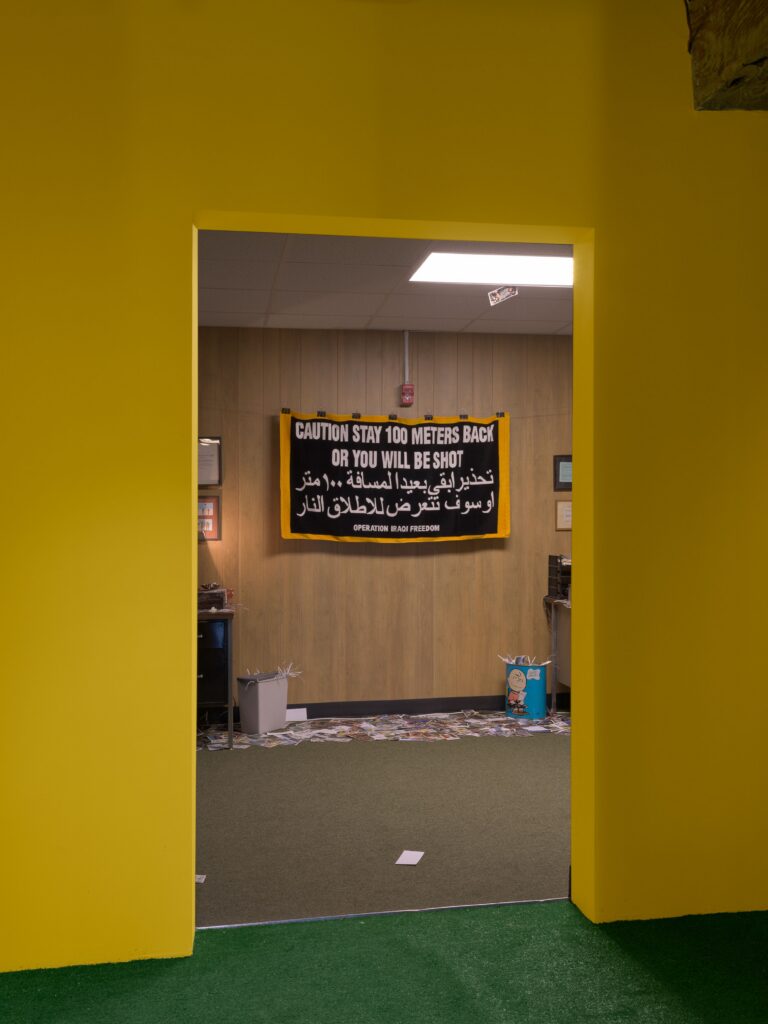
In the far-right corner of the room, a small TV played episodes of Friends, Everybody Loves Raymond, and The Simpsons. In “The One With the Embryos,” from Friends, the New Yorkers made bets, played games, and tried to get pregnant. “Baggage,” an episode of Everybody Loves Raymond, showed a suburban husband and wife at odds over household labor. With glitchy transmission, these looping clips ran with closed captions in Arabic, the audio often warping into a deeper pitch, as if to lull its targeted populations into a charming conception of their aggressors. Functioning as soft propaganda, these episodes portrayed the US as civilized, welcoming, even funny on the surface. But then the screen flickered, and the audio warped again; a parody of America came into view, wherein we come across as vapid and, for lack of a better word, annoying. We’re cartoonish and stereotypical, simplistic in our moral dilemmas. As I moved through the office, the voice of Jennifer Aniston’s Rachel Green blended with a faint noise buzzing like a drone. The sound, which came from inside a metal wardrobe, was emitted by a radio playing audio from a US airstrike carried out in Baghdad in 2007 that murdered two civilians and injured two children. Hung at the center of the room, equidistant from the wardrobe and the TV (the muffled bombing harmonized with the hum of the fans and the still-audible Friends episode), was a black towel with a bright yellow border. In white text, the towel read in both English and Arabic: “CAUTION STAY 100 METERS BACK OR YOU WILL BE SHOT.” Here, the sights and sounds of an unremarkable workday, a quintessential American sitcom, and US-sanctioned death became indistinguishable.





Contribute your thoughts by leaving a reply