










It’s an understatement to say that Michael Asher was a site-specific artist. His work quietly—but insistently—demands attention to the contexts in which he made it: gallery architecture and infrastructure, institutional mirror mazes. He favored, and generated, economies that resisted seductive exchange values. He engaged all these ideas as one of Los Angeles’s foremost practitioners of place-oriented conceptual art, and as one of the few who not only was born here but stayed. How curious, then, that the Museum of Contemporary Art, Los Angeles’s presentation of Michael Asher hesitates to lay claim to the artist on behalf of his city. The introductory text—both on the wall and in the exhibition pamphlet—buries his hometown four paragraphs in and then lingers on it for a mere two sentences. And while Los Angeles emerges consistently from the work on display, there is little grappling with what this place meant to him and what he has meant to this place. It is as though his institutional critique would become lesser if he were outed as a scion of the city.
Without Los Angeles, Asher’s work may never have existed. The artist was born to the legendary Betty Asher, an art world maven whose curatorial practice at the Los Angeles County Museum of Art (LACMA) was intertwined with the flourishing of Ferus and Gemini G.E.L. She eventually co-ran a gallery with Patricia Faure that continued making New York relevant to Los Angeles and vice versa. A 1964 Artforum feature, “Collecting in Los Angeles,” included the Ashers’ extensive collection, which was filled with art that reimagined the everyday and, therefore, reimagined what art could possibly be. The photographs in Betty’s archives at the Getty Research Institute tell a story of fortunate proximity: Here is Betty glowing at a banquet with her arm around Marcel Duchamp; there is a young Michael standing admiringly in front of Roy Lichtenstein’s Roto Broil (1961). That Michael Asher became an artist wasn’t preordained. (Betty observed that her son “didn’t really become interested [in art] until he was at the University of New Mexico in Albuquerque.”) But, for Asher, becoming an artist had to happen here—when he returned to start his art-making in earnest at UC Irvine—and because of here. He became a mentor and educator, spending decades teaching at CalArts—holding slow-burn critique sessions where he and his students could go on for 15 hours, just to situate a work of art in the world in which they lived.
For all the aspersions cast on nepo babies, Asher turned his inheritance into a practice that wildly exceeded the sum of its parts. His serious mischief responded to the systems of art that were specific to time and place. (Jonah L., a MOCA gallery attendant, affectionately described Asher as a “troll.”) And often, that time and place defied description. But never did the broader conditions diminish Asher’s critique. Quite the opposite: They made it stronger.
For instance, Grinstein Collection (1979) would have been impossible to realize anywhere else. The only private commission Asher ever accepted, Grinstein was ostensibly the reconstruction of a wall that divided two properties in Brentwood, one of the city’s leafiest and toniest enclaves. The commissioning couple, Elyse and Stanley Grinstein, were avid collectors, party-throwers, and cofounders of the artist-editions publisher Gemini G.E.L. They were keen to let their home at 441 N. Rockingham Ave. be changed by art. They were also friends of Betty’s. With Grinstein, Asher stretched the bounds of collaboration, forcing the involvement of the Grinsteins’ next-door neighbors because the wall would sit astride their property line. The wall’s completion even required the Grinsteins to cede part of their land (and thus, a tiny sliver of property value)—a yes-in-my-backyard ethos, born of creative class intermingling, that is little to be found in Brentwood today. The wall is long gone, replaced by low-slung stucco that surrounds a modern farmhouse. And yes, O.J.’s house was but half a block south.
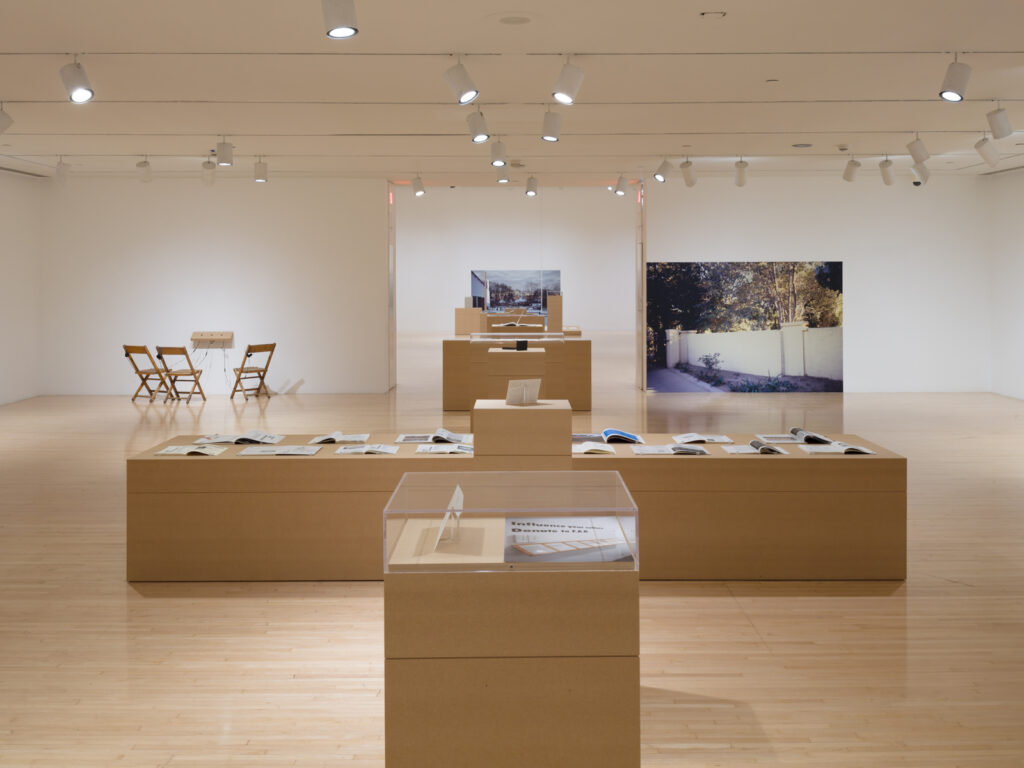
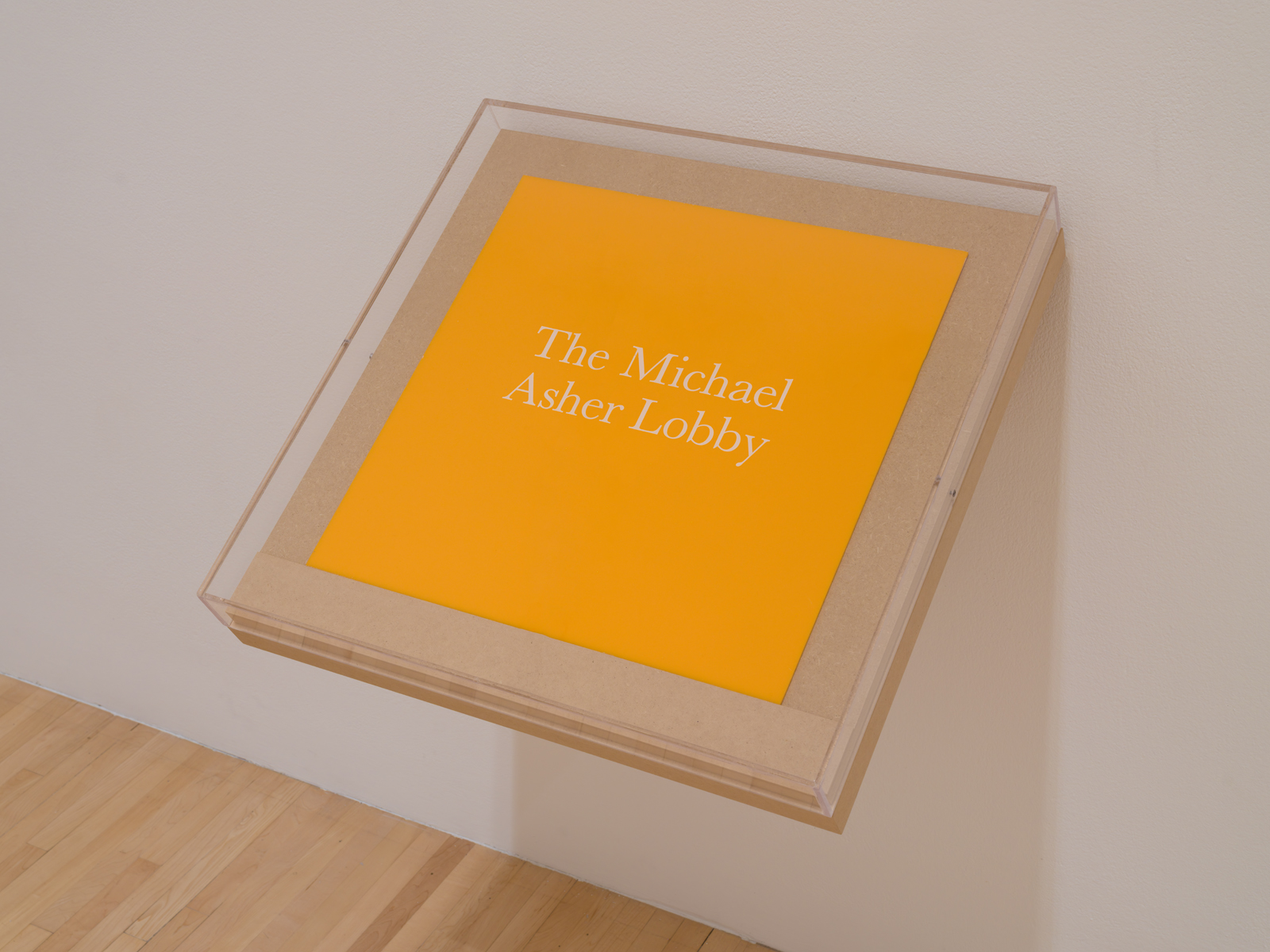
Or take In Context (1983–85), which now reads as an elegy to an earlier version of LA’s scene. Its centerpiece was the Michael Asher Lobby, a contract between Asher and MOCA in which the artist received the naming rights to the lobby of the museum’s newly opened expansive Temporary Contemporary space in Little Tokyo. Asher—keen to test the institution’s self-description as an “artist’s museum”—purchased the licensing rights to the lobby and then sublicensed them back to the museum for $200 per month for almost two years. If not for the cards at the front desk that explained the project, visitors could have easily mistaken the work for yet another sign of a donor’s largesse. These days, the original sign mounted on plexiglass and the large wallpaper photograph of the Michael Asher Lobby on display at MOCA’s subterranean Grand Avenue location feel like send-ups of Los Angeles philanthropy’s quainter days. The museum rechristened its Temporary Contemporary as the Geffen Contemporary following a significant donation from the music mogul in 1996, and the Geffen Contemporary shrinks in expense compared with LACMA’s new $724 million, two-decades-in-the-making, Peter Zumthor–designed, ultra-luxe David Geffen Galleries.
Given that Asher lived and worked in this city, and given that MOCA is the very place to stage Michael Asher in Los Angeles, why shy away from the LA-ness of the artist? Curator José Luis Blondet, his MOCA team, and all his Artist Space colleagues are undoubtedly co-presidents of the Asher Appreciation Society. They admire those central questions of Asher’s career—why do we value art in the ways we do? Who gets to decide what art is?—and how his work consistently returned to these questions with fresh insight. But maybe they got skittish after Roberta Smith’s 2008 declaration: “The California artist Michael Asher may never have a museum retrospective.” Rather than steadying the artist’s questions with a conceptual anchor, they seize them as a curatorial remit. In other words, they create confusion by dispensing with chronology, clear thematization, and, especially, geography.
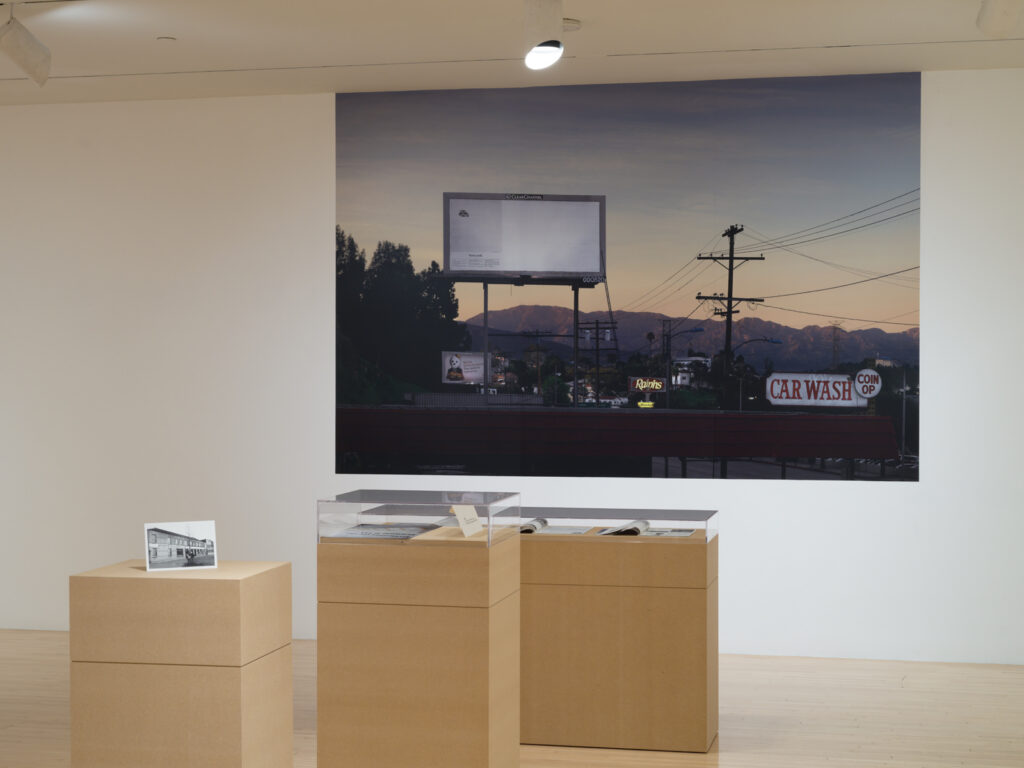
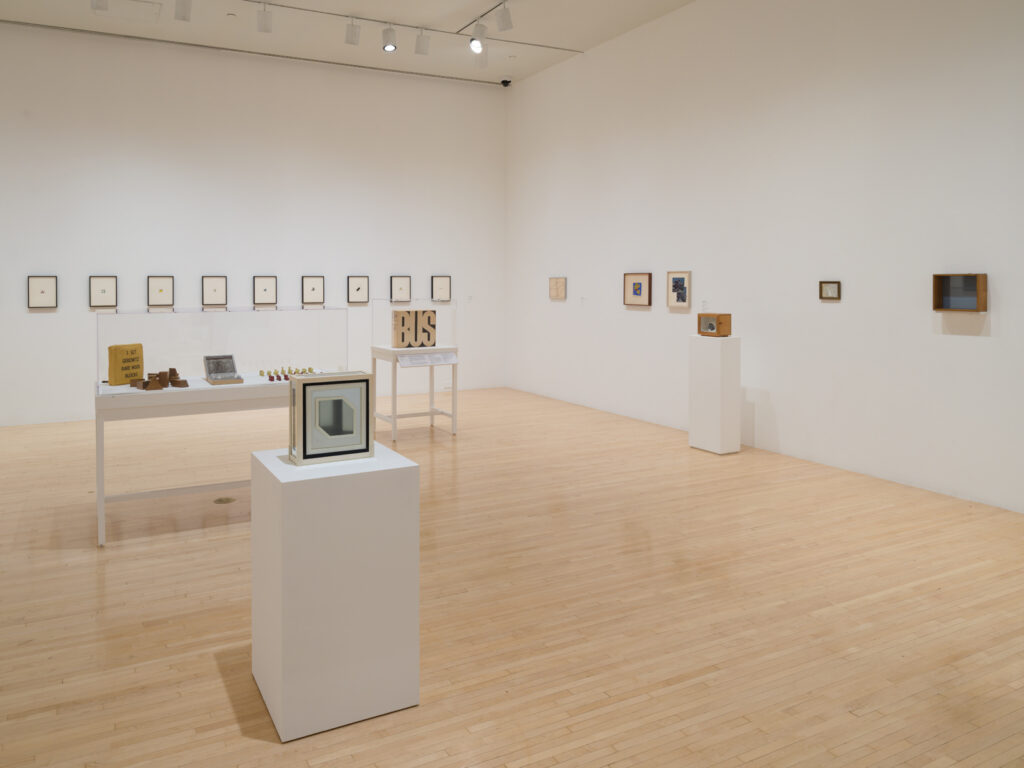
Blondet set up an axis of plinths and vitrines in the center of two galleries. A few other items, including blown-up photographs installed like wallpaper, smaller documentary photographs, and an audio listening station, play second fiddle in corners or off to the sides. These amount to a random assortment of vertebrae rather than a spine. A case—or, rather, a disarray of things—in point: In Context first greets visitors as a large wallpaper photograph on a prominent wall. Then it pops up again in the middle of the gallery on a plinth featuring a floor plan of the Temporary Contemporary as well as the cards that were distributed to inform visitors of the revelatory prank. Then, surprise (!), across the gallery, in a little corner sits the original orange Michael Asher Lobby placard. All this hopscotching makes the gallery guide and pamphlet necessities. At worst, such clever distribution shapes the exhibit into an inaccessible, self-serious collection of things made by and for insiders. And if that is the point, why not give Asher’s work pride of place, centering his relationship to the art scene he was most completely inside?
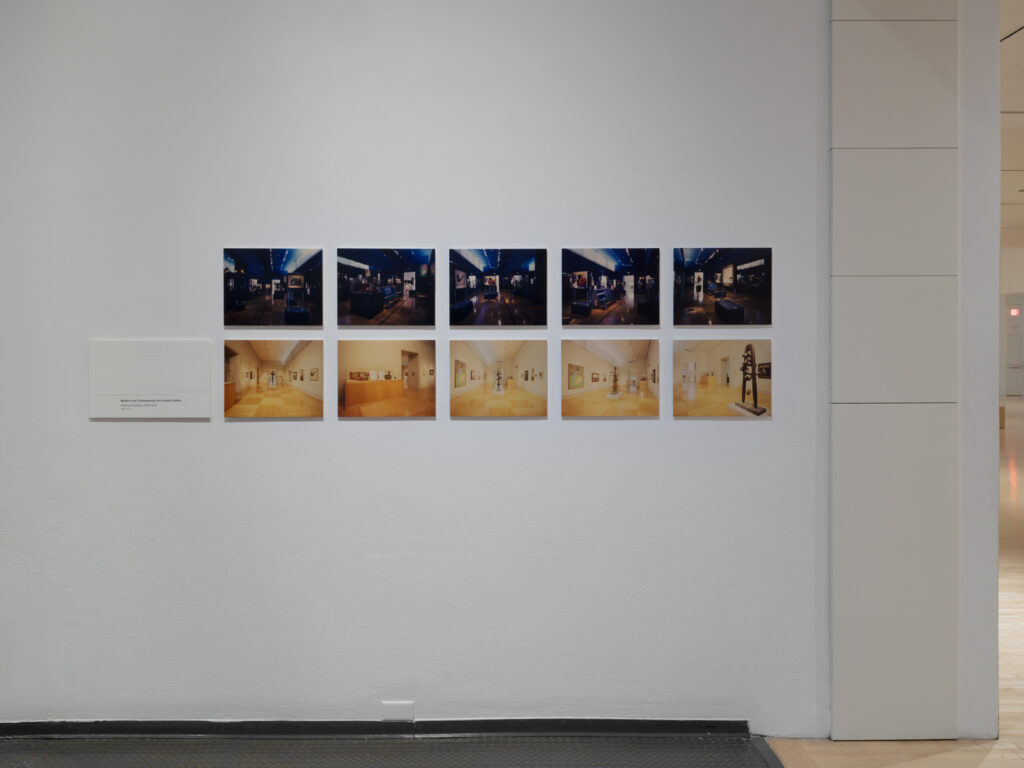
Eschewing Asher the Angeleno betrays an assumption about endurance: that entrance into the pantheon is granted only because of ideas about site specificity rather than attention to the specificity of the places in which those ideas are generated and/or implemented. I suspect this is why Reinstallations (2000–01, 2002–03)—a decidedly anti-white-cube project—is unceremoniously displayed in a dark side hallway off the second gallery. Reinstallations allowed Asher’s incisiveness to take on a playful, social-practice-y form, inextricable from Los Angeles. LACMA had commissioned Asher to participate in a group show. Asher teamed up with the museum’s experimental educational hub, LACMA Lab, and asked a group of Fairfax High School students to re-curate one of the permanent galleries. Though practically commonplace now, Asher’s elevation of high schoolers was radical for the early aughts. The teenagers’ interpretation of the nineteenth-century European art galleries was such a hit that a second set of students reinstalled early-twentieth-century galleries. For that second exhibit, the students painted the gallery walls dark indigo, made visible the provenance labels that were on the back of the works of art, and even had music by John Coltrane continually piped in to evoke the Jazz Age. Fittingly, they installed large mirrors to distort Duchamp’s From or by Marcel Duchamp or Rrose Selavy (The Box in a Valise) (1966).
MOCA’s presentation suggests embarrassment over LA’s illegibility, its volatility, its sunshine, its looseness, that absence of center. But Angelenos pay attention to where their feet are because of that lack of center, and that tendency may have been exactly what motivated Asher to engage so attentively with the invisible systems holding the art world together. His history with this place gave him clarity to forge ahead. For all the broken systems in which art was imbricated, Asher still believed in its capacity to upend expectations—and in profound knowledge about art as a vehicle for criticality. LA was central to that principle.
After suggesting it might be un-retrospect-able, Smith, in summing up one work by Asher, summed up his entire oeuvre as no one has since: “It is history made visible yet Minimalism gone nuts; it includes more of his personal story than usual; and it is a tale that will travel.” What MOCA seems to have forgotten is that this tale travels from somewhere. True, the Michael Asher Lobby can only ever be invoked through its ephemera. The Grinstein wall’s specs will live on only in a contract. And Asher’s Los Angeles has itself become the kind of vanishing site his work was always already about. But the systems he critiqued have metastasized. MOCA’s leaders and staff must know this. Angelenos the city over seem to know it better. Asher’s work shows us where we came from.









Contribute your thoughts by leaving a reply