







In mid-September of last year, as the light was streaking gold and the prairie air smelled of yellow, I had the pleasure of visiting Badlands Art Department, a residency that doubles as an art project by art-and-life partners Miruna Drăgan and Jason de Haan. They’re located about an hour outside of Calgary, coiled by the Akokiniskway (Rosebud) River that rushes at its bend. There, the surreally beautiful—and inhospitable—Badlands hills bracket you, impossibly steep and close. Bears and moose and deer and snakes and herons spangle the hills most days, and walking them means palming sun-bleached bones and spotted antlers and open clams ossified in red sediment, tracing the marks of flitting hooves and thinking about what’s underfoot and how it used to be water. That experience was front of mind this spring when I visited two exhibitions of de Haan’s work, first at the Foreman Art Gallery in Sherbrooke, Quebec, and later at Clint Roenisch Gallery in Toronto (this latter show a collaboration with Drăgan). De Haan’s work lingers with what remains. All the meteorites, mirrors, geometries of the gods, apiaries, mirror portals, and found objects suspended somewhere between artifact and talisman: These are things made to hold time rather than tell time, and de Haan wields many timelines at once.
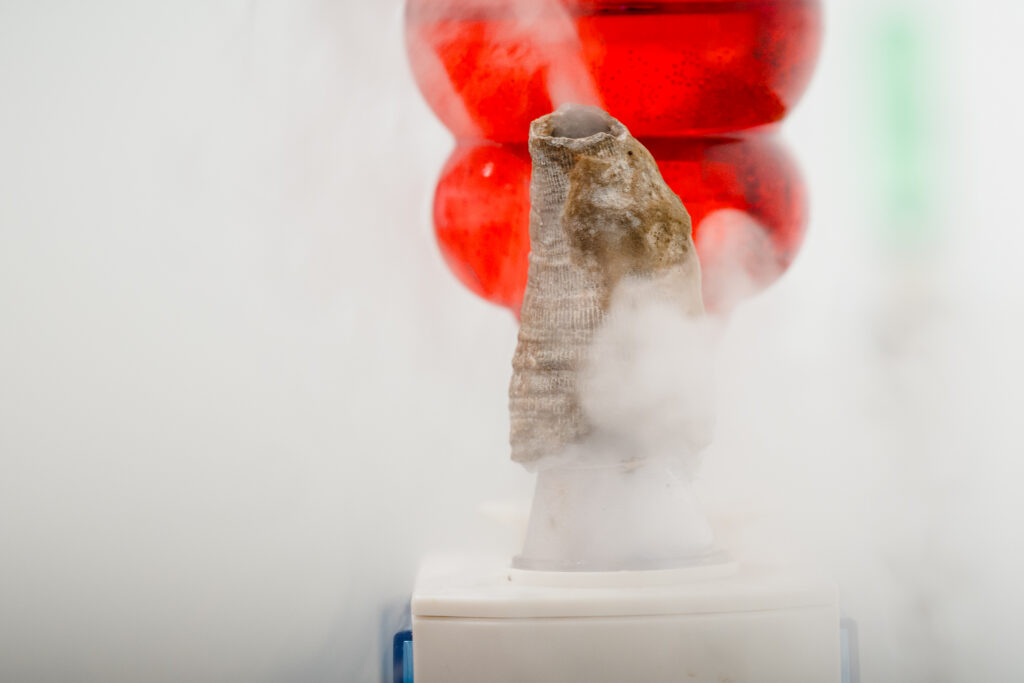
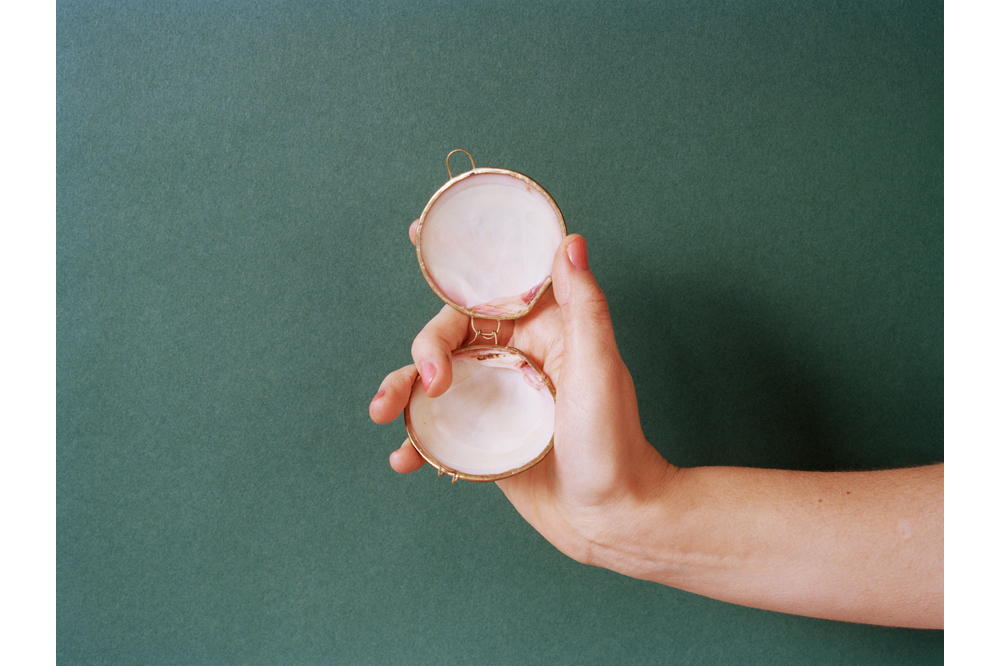
Works made years apart spoke to one another across both exhibitions in a way that suggests de Haan’s art has become a living ecology. Humming recursions were visible in These were never tongues, mais plutôt des pieds pour crapahuter, at Foreman, an exhibition that grouped de Haan’s long-running humidifier sculptures (Free and Easy Wanderer, 2014-ongoing) with a suite of collages and a pair of embroidered denim jackets. These humidifiers, characterized by wonder and awkwardness, were installed on concrete pedestals around the gallery. Fossilized shells and turtle fragments perched atop ultrasonic humidifiers that bathed them in cool mist, reintroducing ancient matter to cycles of moisture and atmosphere. The mist is romantic—baroque, even—swirling in arabesques amid the visible cords, plastic reservoirs, and hardware-store pragmatism, grounding speculative ambitions. Geological time is rendered intimate, domestic, and then, as the vapors dispatched through plastics enter our very airways, we are implicated too.
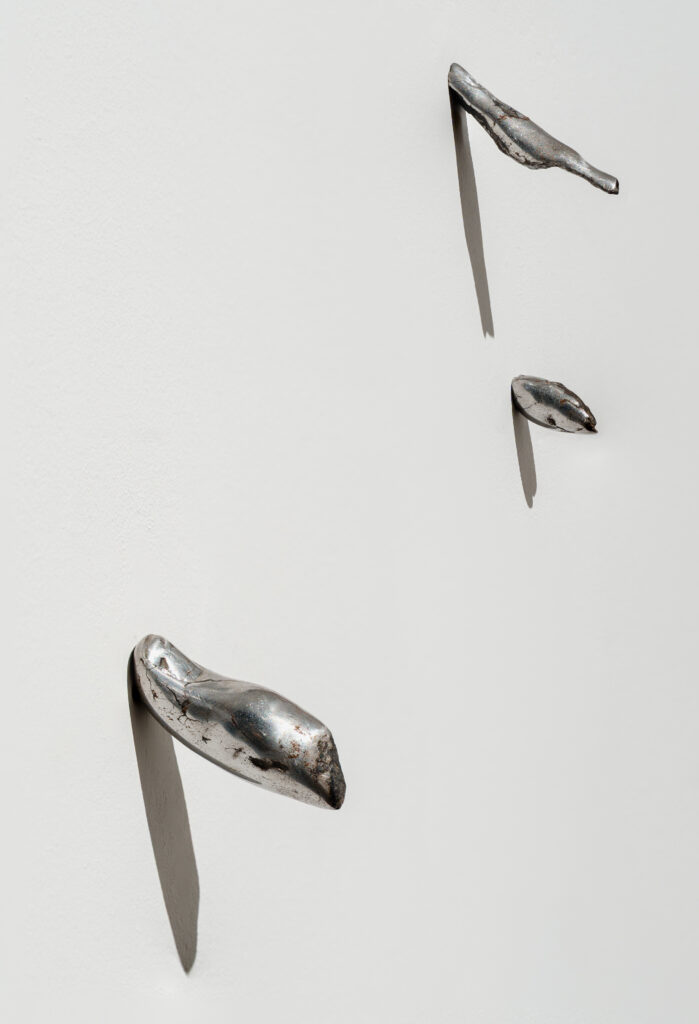
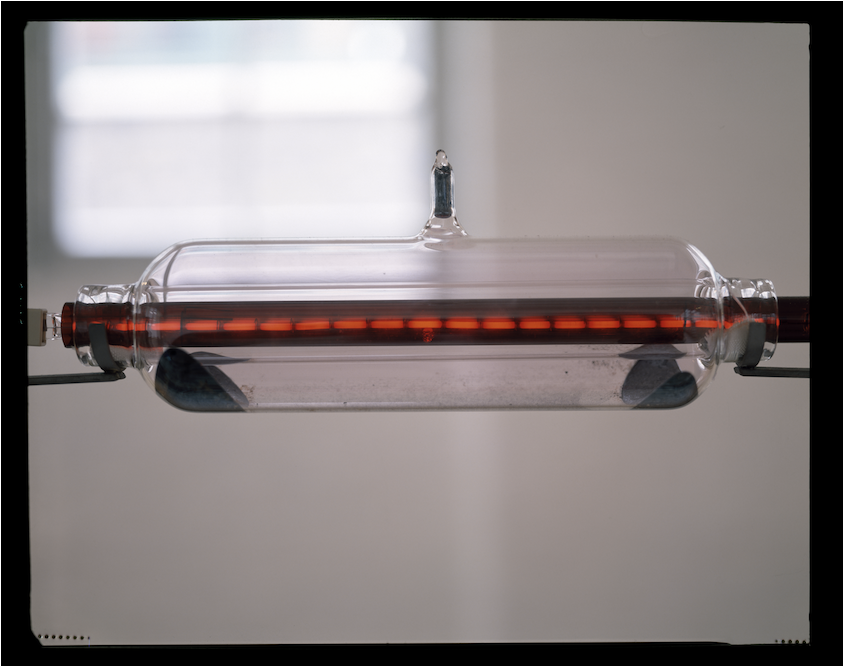
The embroidered jackets, hung alone on a wall, were newer and more figuratively descriptive than work I typically associate with de Haan. Created in response to a jacket made decades earlier by the artist’s father while he attended art school in Alberta—a garment that his father planned to be buried in—de Haan made a copy. The copy and prototype hung together, putting inheritance and iteration into close dialogue, and below the jackets were stacked posters of the garments, an attempt at presenting and circulating the image more directly. On an adjacent surface, a favorite work of mine came into view: de Haan’s Groper (2024–ongoing), a scattering of small sculptural forms affixed to the wall. Only upon approaching did you realize that they are pointing fingers, each pressing gently against the gallery’s surface as though testing its solidity. de Haan carves these forms from meteorite, transforming a material older than the earth itself into a gesture of tentative contact.
Two months later at Clint Roenisch, In the Garden of the Dentist expanded the themes of inheritance and recurrence—most prevalent at Foreman—into folklore. The exhibition’s title refers to an almost mythical figure: a dentist on Paros, a Greek island that de Haan and Drăgan frequent, who supposedly planted the extracted teeth of his patients in a garden. de Haan became fascinated by the story and asked around, only to discover that no one seemed able to confirm the dentist’s existence. In the Garden captured the strange lives that stories acquire as they are passed from person to person—or creature to creature—accumulating distortions as well as belief.
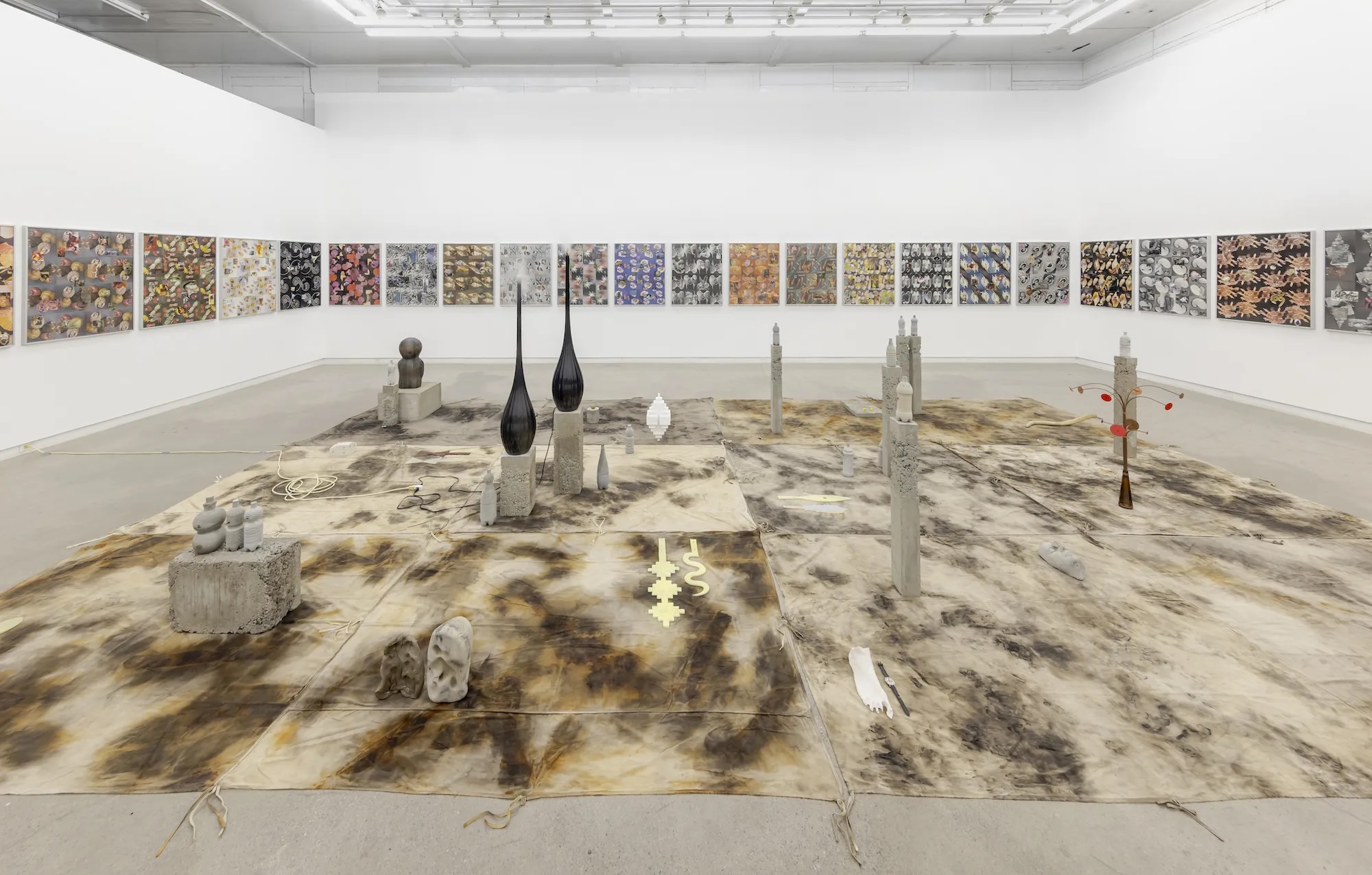
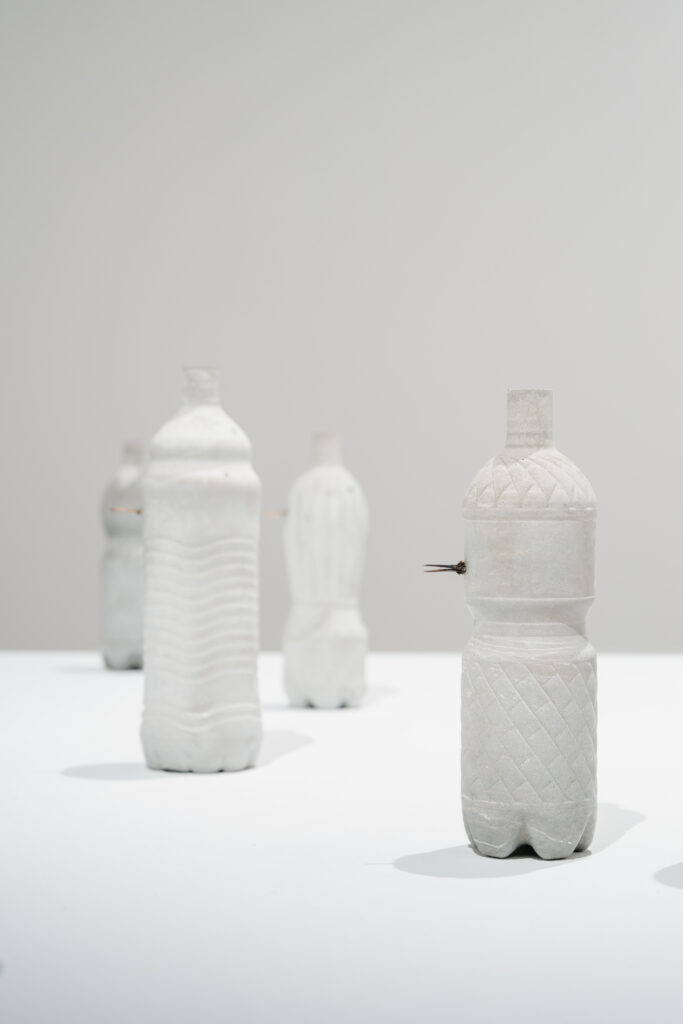
It always feels like a mise en abyme at Roenisch, a one-room gallery that excels at installing its artists, and this show was no exception: de Haan’s kaleidoscopic collages wrapped the space of Roenisch, to dizzying effect. Then at center, laid out across the gallery floor, sprawled a quadrant of large stretched and stained sheets—Drăgan’s Torper series, made with Corbin Union, a collective she and de Haan founded alongside Vancouver artist Warren McLachlan—wrung out with rust, salt, and metals, and exploding in their patterning as though billowing up from the floor. And yet they were pinned by a society of sculptural forms, including a recurring series of sculptures, Charm, Choir, Council, Chorus (2021). Migratory hummingbirds were entombed in an assortment of found bottles before being cast in concrete. Victorian-era taxidermy specimens sourced from a French antiquarian shop, the pairing of these delicate, near-mythic creatures lodged within the detritus of everyday life, was painful. Piercing through the containers and casts, their beaks stuck out heartbreakingly.
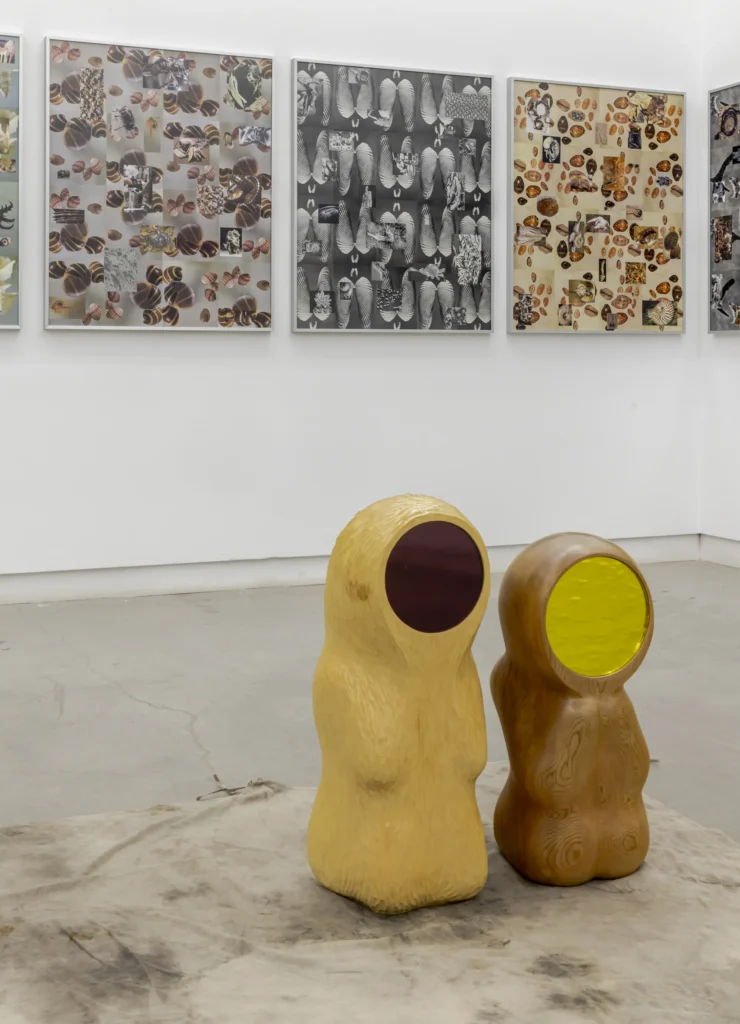
Elsewhere there were mementos, timepieces, sculptures of feet with missing toes, and creature-like rocks, each one transfixing its observer and yet setting her in rotation to the next. Augustly purveying their landscape was a pair of mirror-faced wooden statues, positioned at one corner, part of an ongoing series of carvings by de Haan, always with reflective surfaces where the face would be. Titled Biblionauts (2023), the forms originated from an object that Drăgan and de Haan both remember encountering separately in an Amsterdam bookshop—though later their searches for it yielded nothing, as even the bookstore had completely vanished. In this show, the carved figures appear benevolent, unknowable, and self-contained.
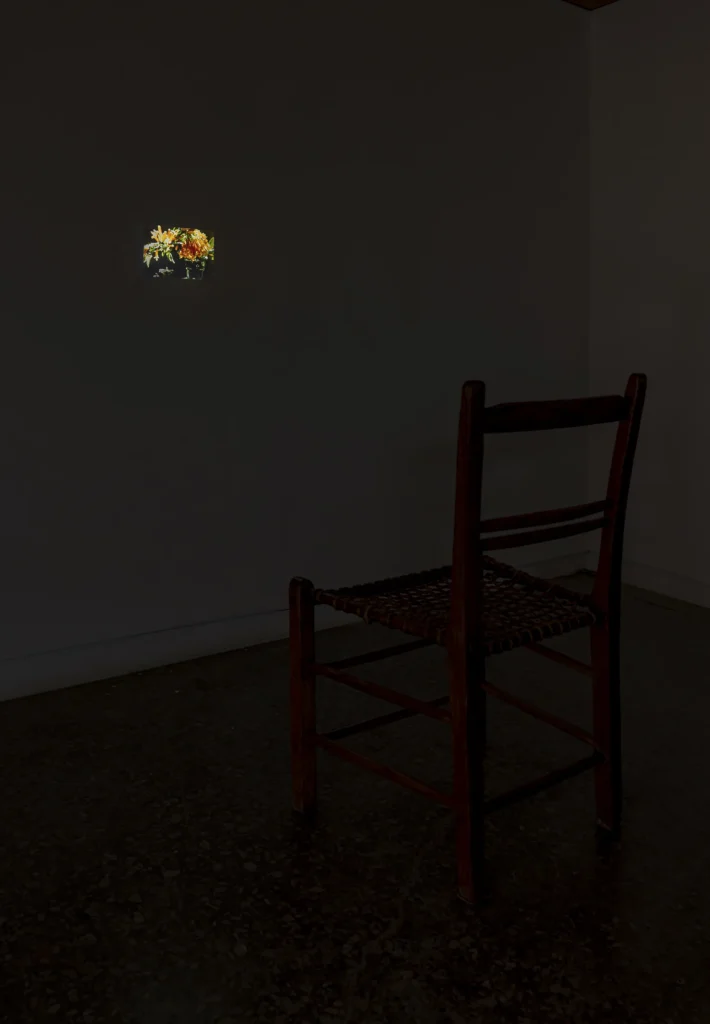
Drăgan’s tender Hummingbird Guided Meditation (2021) was sheltered within a darkened alcove gallery that you pass en route to the main space. Through slowed Super 8 footage, a script voiced from the perspective of a hummingbird, and a soundtrack composed by Maggie Tiesenhausen from field recordings gathered along the bird’s migratory path, the film assembles an interspecies imaginary. Yet rather than claiming access to another consciousness, it dwells in the attempt, extending the exhibition’s broader exercise in approaching a world that remains just beyond reach.
How do we survive time? Through fossils, family heirlooms, watches, remembered objects, rumours, shells, teeth, and stories. The works in these two shows repeatedly proposed that endurance is about changing shape and shimmering at the edges of memory, out of description’s grasp. That’s where eternity lies, and our ever-rushing present.
My visit to their place last fall came at a time of summer ending—and, for them, a time of still-beginning. The summer grasses were at their height, and de Haan and Drǎgan were walking me through, pointing out all the indigenous species—needle and thread, June grass, blue grama—that they’re encouraging to grow back.
I watched de Haan scan with his head perpetually lowered, his hands clasped behind his back, sweeping the ground for traces: sun-blanched bones, fossilized shells, fragments of antler. The landscape there encourages that particular posture. And when I think of de Haan and Drǎgan moving through the Badlands with their gazes fixed on the ground, scanning for traces of former lives, I think of the title de Haan gave to the ongoing fossil-humidifier works, Free and Easy Wanderer. For him, wandering is a mode of attention. It is the slow discipline of following traces: a fossil shell, a family story, a vanished bookstore, a hummingbird’s route across a continent. In his work, the return of things is never miraculous. It is simply the reward for looking long enough.









Contribute your thoughts by leaving a reply