









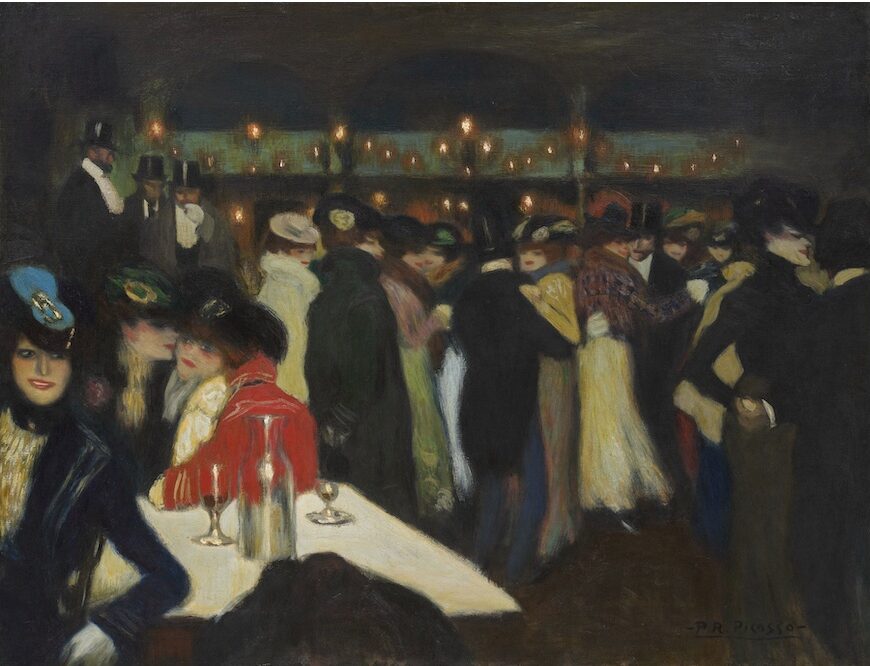
Of the five figures depicted in Pablo Picasso’s enduringly outrageous Las Chicas de Avignon (the title he supposedly preferred over Les Demoiselles d’Avignon, 1907), one is more appalling than the rest. Positioned quite hideously—squatting lewdly, with her back turned to the painter and viewer—her face is a corruption of a traditional African mask, degraded from its ritual purpose, and her head is manipulated to skew toward the front (the physics of which were made iconic by the possessed youth in The Exorcist). The image, considered to be among the earliest of Cubist renderings, sees a gathering of courtesans assembled in a French brothel. It is an image of horror painted by a voyeur, with all the fetish and intrigue this perspective implies. We are looking at a portrait of the artist, or rather, his worldview and imagination; what we encounter is a fantasy of a man who relishes the taboo and the “exotic,” and who finds female sexuality shocking and provocative.
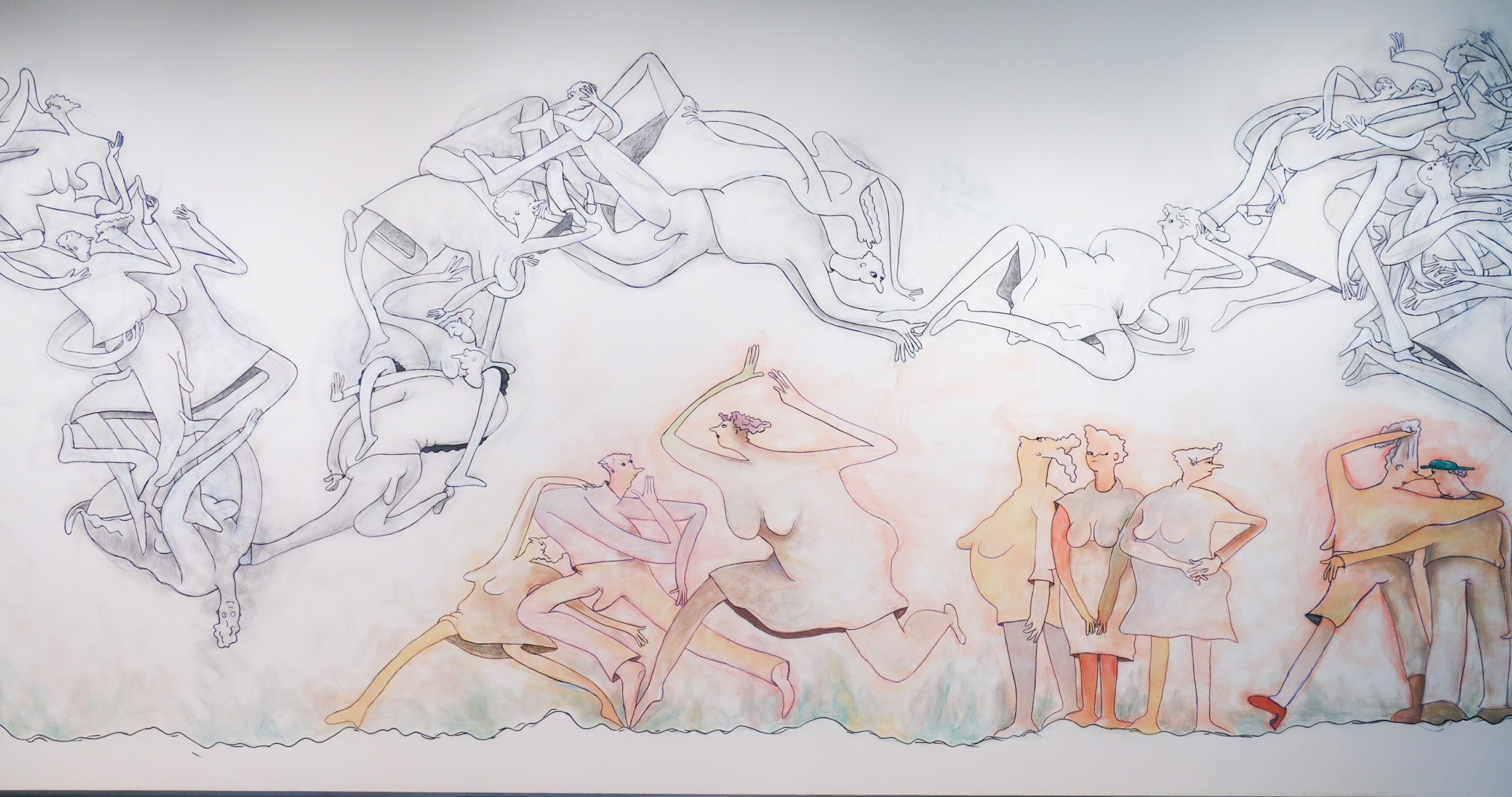
I am thinking of Picasso because his prurience usefully counters the critical modalities typically brought to the work of Gladys Nilsson, a Chicago-based artist who began painting in the wake of second-wave feminism and is still all-too-often expected to address the “woman question.” Because her female figures take on unruly proportions—are fleshy and voluptuous, or otherwise unconventionally attractive—critics have framed their sensuality as a disruption of misogynist art-historical norms (though the works also resuscitate classical ideals of beauty, perhaps returning to those embodied by the Venuses of the Upper Paleolithic or the voluptuous muses of the Renaissance). With her typical flair, Nilsson responded to such a framework by advancing it, further undermining the canonical fetishization of women by privileging the quotidian build of the mall-walker. Her contribution to the Menil Drawing Institute’s Wall Drawing Series, Drawing (2025), features a cast of lubberly figures engaged in clumsy gymnastics—a charming sequence of pratfalls that becomes a (seriously sexy!) flirtation, with elders lingering, looming, lusting, and loving.
Imagining women, at times, we size them up to unruly proportions and fantastic scale. Looking at women as Nilsson does, we notice any number of features: the length of a hem, the cut of their hair, the fullness of their lips and bellies, the lift of their breasts, and the progression of the folds that scaffold their necks; how far they are from birth, how close they are to death. We might gift our attention to an individual’s peculiarities: an embossing of moles and freckles, the odd hair spiraling outward, cakey residue remaining from unblended cosmetics.
Nilsson’s figures are unmasked—plain-faced and vulnerable, sinking beings basted together with fat, blood, flesh, tissue, and bone, angular at times and uncomely, hardly the muses of marble. As such, the work unmakes the ageism that characterizes historical renderings of human flesh. The figures are also modestly dressed—not spectacles, and certainly not nude. They both resemble and age alongside the artist, who herself turned eighty-five last May (the central figure in Drawing bears an uncanny resemblance to Nilsson, though, as with most of her work, Nilsson has denied it is a self-portrait). Defying American cultural prejudices about maturity, Nilsson’s figures fully retain a vigor and liveliness that is enhanced by the artist’s wit and fascination with the youthful gestures of desire.
Nilsson is best known for her watercolors and came to prominence in Chicago in the 1960s as a member of Chicago’s Hairy Who group, renowned for its mod psychedelic affect. The cartoonish character of the work produced by the group’s six artists—including Jim Falconer, Art Green, Jim Nutt (Nilsson’s husband), Suellen Rocca, and Karl Wirsum—underwrites the wry humor and playfulness inherent to the group’s guiding ethos, a zany free-for-all that has remained consistent since its founding.
Of the bunch, Nilsson has been called the most feminine, a term she is said to dislike—understandably, given its pejorative connotations at the outset of her career. The term is nevertheless convenient and well applied: her pragmatism and humor aptly counter the bravado and machismo characteristic of work by her contemporaries and predecessors (think Picasso’s Chicas, or Rube Goldberg’s benign Not Miss Any Feminine Beauty). The critic Jan Avgikos, writing for Artforum, has similarly noted that while Nilsson’s work comprises “playful femmes of all shapes and sizes,” the work of her “colleagues . . . bristl[es] with aggressive energy” aimed at passive submissives stylized as “pinups or glamour girls.” Nilsson’s muses are instead “libertines . . . who radiate creativity and … joy”—not unlike the artist herself. In her hand, brush and canvas facilitate a meeting of equals, unmaking the historically lopsided power imbalance between maker and muse.
The large scale of the work at the Menil represents a compositional challenge for the artist, considering Nilsson’s penchant for works on paper and canvas. Drawing is impermanent, to be painted over in August of this year, and made with acrylic marker pens, water-soluble crayons, graphite in varied colors, heavy-duty soft 6B and 2B lead pencils, and acrylic paint, which Nilsson has smudged and rubbed by applying dry rags to the surface. The resultant work achieves the washiness of her beloved watercolors, remaining visually congruent with the rest of her oeuvre and embodying a precisely Nilssonian flamboyance and irreverence.
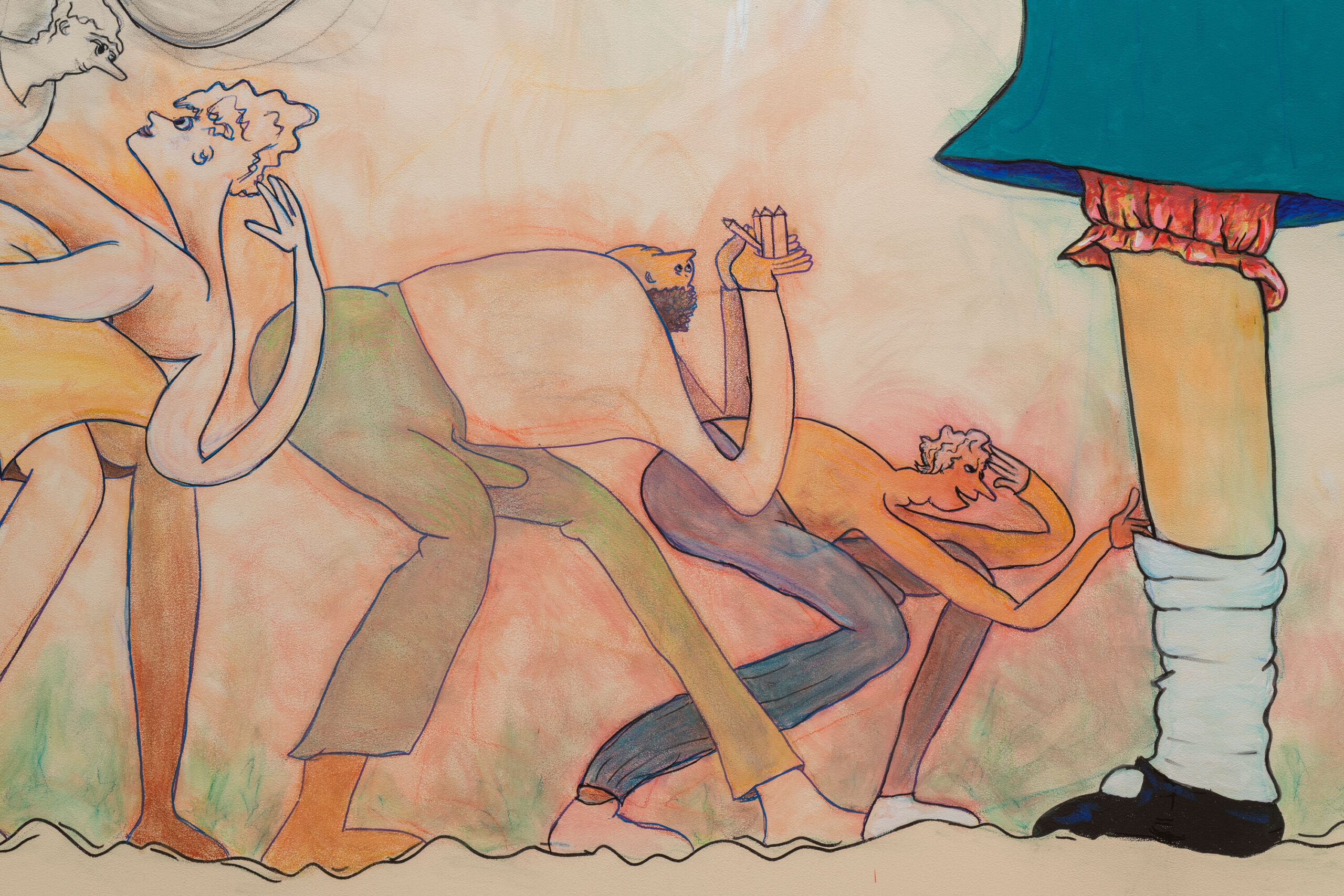
The central figure of Drawing, a character Nilsson has referred to as Big Girl, is blue-eyed and white-faced, like an old dog, and holds a bundle of colored pencils in both hands. She is fully clothed, and yet her shape is clearly distinguishable beneath her garments (much like that of the figures surrounding her). She gazes perpendicularly from the image onto the Menil Drawing Institute’s vinyl floor and is rendered in full color, while others tangling above and beside her are depicted in a markedly reduced palette. Big Girl neither appears to be drawing them nor directly involved in their lovemaking—and yet the figures engage her anyway: a man, erect, offers her additional pencils (at which she glances out of the corner of her eye); another brushes her nose, attempts to gaze into her eyes, and reaches for her left hand as if to grab it; another, slack-jawed, gapes at her leg while he fingers the white slouchy sock that dresses it.

Women are the focus of Drawing. The men depicted fortify them, structurally and relationally (men bend over backward to look at women, or kneel forward to lift their weight), and figures eddy across the width of the drawing, buoying the base on rocky ground. Feet flit in front of one another’s faces; panties and pantaloons peek out from beneath otherwise unostentatious dress; cocks emerge cartoonishly from pulled up trousers, pointed toward their love interests. We observe a figure sucking her own fingers; we catch another smelling another’s toes. And yet, no matter how amatively the figures behave, this is not a typical bacchanal. Nilsson’s mural instead represents a safe, sensual sexuality, without much incivility to be mitigated. The group’s easy companionship overshadows any gamy hankering for sex.
A word that comes to mind when I think about Nilsson’s work is the French jouissance, which refers to both philosophical and embodied enjoyment, or, more leisurely, to fruition. The term suggests a fulfillment that unfolds over the course of a lifetime, not just in fleeting, youthful instants. In bending and swinging to fill the white space of the Drawing Institute’s entrance hall, Nilsson’s women, and their adult bodies, are depicted with sincerity—not as images of romantic ideals but as something more innocent and humane. Lust is not a salacious detour but something natural that courses through and around aging somas, atrophied postures, pillowy rolls of flesh, and sagging breasts. It is rare to see elderly women treated pragmatically, with both hope and ease, in a work of this scale. And it is rarer still to see female figures engaged in the act of parthenogenesis. Nilsson’s figures are positioned in mutual service to one another, ensuring pleasure.







Contribute your thoughts by leaving a reply