







In Arch Connelly: Art in Drag, a short video directed by Lisa Rovner, Arch Connelly references Pink Manifesto (1980), a statement he wrote for his first New York solo show at Artists Space. Printed in two sections on pink paper with an excess of capitalization and repetition, the manifesto consists of a list of things Connelly loves—lampshades, rococo, mink, muscle men—followed by a declaration of what Connelly’s work is about: “MY WORK / is MANNERED, is HOMOSEXUAL, is EFFETE, is BASE, is SNOBBISH …” In Rovner’s documentary, the camera zooms in on the page while Connelly, speaking years later, asserts that the statement was a way of articulating “what [he] wanted to do”: make “gay art for gay people.”
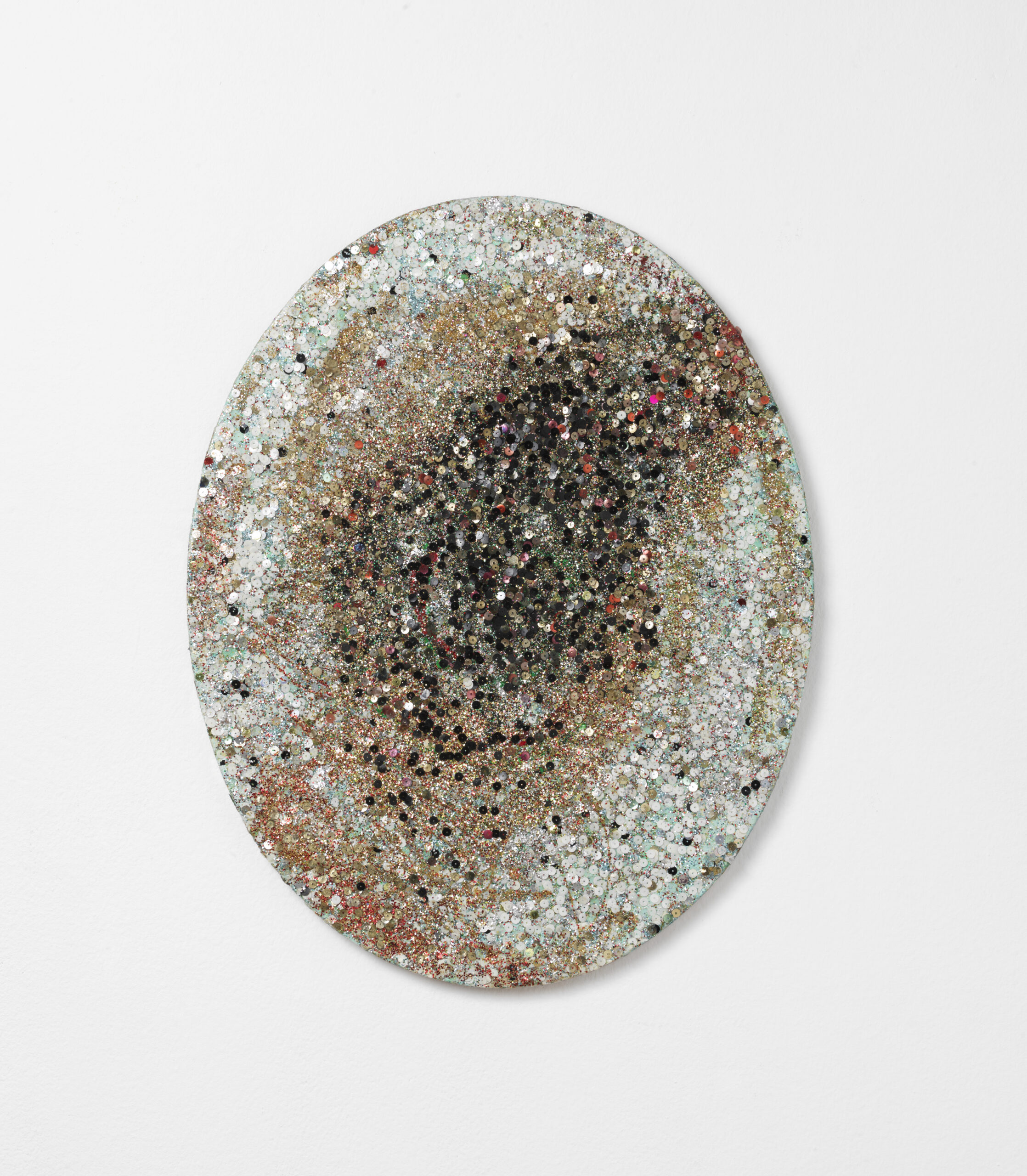
Rovner’s film—whose audio is drawn from an interview Connelly did with writer and Visuals AIDS Archive cofounder David Hirsh in the early 1990s that offers something like an oral manifesto—was commissioned by the Aspen Art Museum in Colorado for Straighten Your Wig and Pray, which brings a suite of Connelly’s paintings and sculpture together with materials from his substantial print and correspondence output in the first museum survey of the artist’s work. The show tracks Connelly’s creative output from 1980 until his death from complications from AIDS in 1993. Connelly was known for his incorporation of faux pearls, glitter, and other thrifted materials that he used to make fantastical, semi-abstract work that blurred the lines between high art and queer craft, and his admixture of the material body with Christian iconography. Compared with the overtly political work being made by many of his peers, the thematic indulgences of Connelly’s art may have made it harder to locate a politics in his practice. But the show interrogates such interpretations by gently positing that making gay art for gay people actually amounts to a politics unto itself.
Connelly began his career in San Francisco in the 1970s making costumes and sets for performance groups, including the Cockettes. In Rovner’s film, Connelly brags that he and his collaborators “knew all the best garbage,” that costumes were “taken out of a dumpster,” and that set cardboard was “pilfered.” But he left San Francisco for New York in 1980 to get away from a surge in drug use and overdoses. Connelly quickly became part of the vibrant and complex East Village scene and fell in with a group that included David Wojnarowicz and Greer Lankton, which was dubbed the “New Irascibles” by Arts magazine in 1985. He started showing at the Fun Gallery alongside Keith Haring and Jean-Michel Basquiat. Within a few years, all the major themes that would persist in his practice until his death, including the subversion of fine art and correspondence as theater, had emerged.
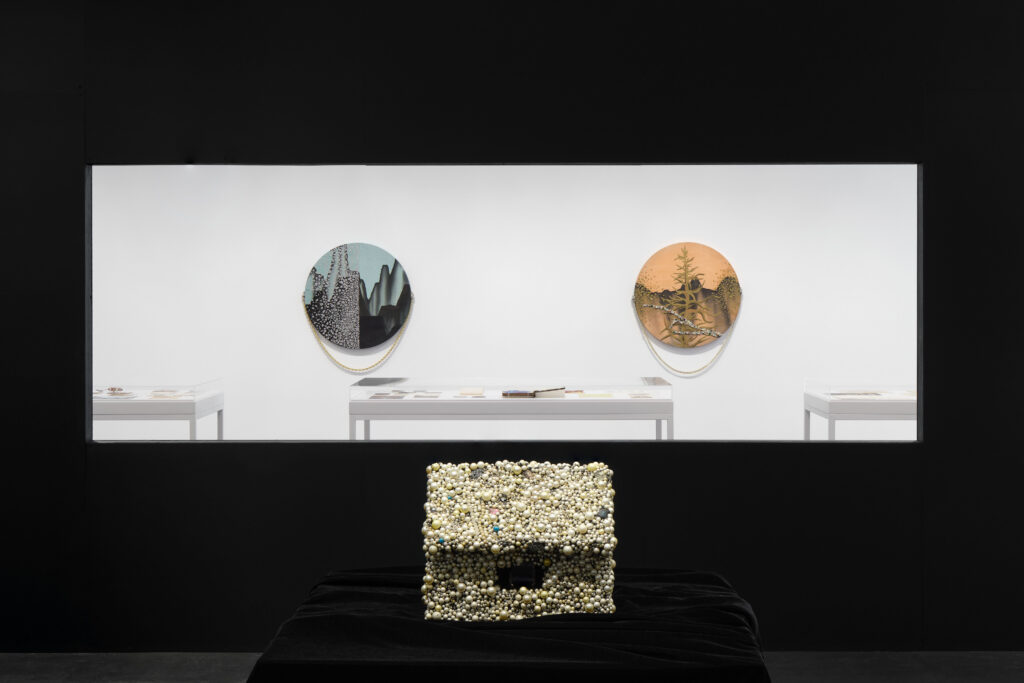
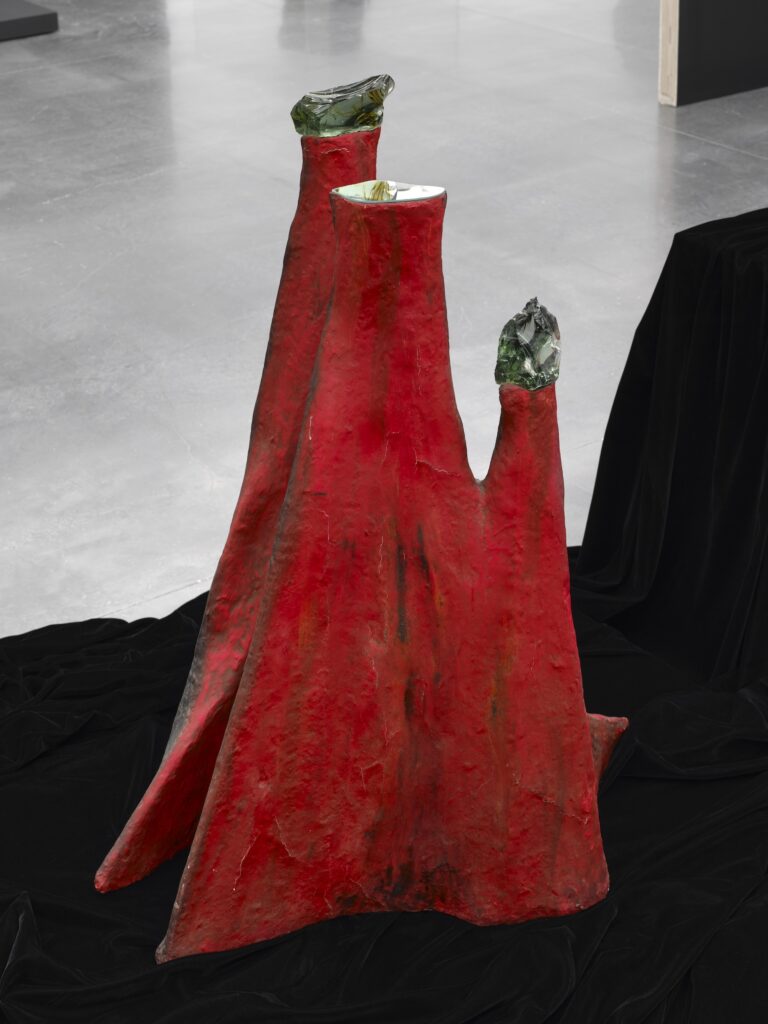
Straighten Your Wig and Pray offers a coherent perspective on Connelly’s intentionally untidy aesthetic. By beginning in 1980, the show gives the effect of Connelly’s as a fully formed creative vision birthed from nothing more than ephemera, film clips, and art historical citations, like a camp Venus landed on the shores of the east side of Manhattan with a practice all ready to go. A series of abstract acrylic paintings adorned with eggshells, costume jewelry, and tuille; small sculptures completely covered in faux pearls; and a series of webs—also made of pearls—ring the exterior of the gallery. The space is given a quasi-domestic feel through the inclusion of several furniture-like objects that double as plinths, such as in Cocaine Mesa (1980), three glossy red stalagmites whose tips are severed to create a platform that supports transparent crystals. The curation, by Stella Bottai and Daniel Merritt in collaboration with theater director and set designer Fabio Cherstich, reflects Connelly’s investment in performance—Connelly told Hirsh he believed that “paintings are sets”—while emphasizing gestures in the work toward coherence and domesticity by making heavy use of draped fabrics, high color contrasts, and suspended walls with cutouts that provide strong sight lines across the gallery.
Created during a moment of censorship, state-sanctioned homophobia, and the HIV/AIDS crisis, Connelly’s theatrics contrasted the stark reality of the place and time in which he worked. The same year, 1987, that Andres Serrano made Piss Christ and Larry Kramer called participation in mourning rituals such as the AIDS Quilt “ghoulish,” Connelly made an abstract tondo in pearls called Blurry Self-Portrait and the pearl-covered cross whose title gives this show its name. Even the publication of Connelly’s Local Boy (1990)—a collage featuring a model in a jockstrap and football pads surrounded by jewels, pearls, and images of flowers—on the cover of Artforum’s November 1991 issue contributed to a misunderstanding of his work as apolitical. Though done with Connelly’s consent, this use of Local Boy was a decision taken not by the artist, but by the magazine’s editor, Ida Panicelli, in response to a conservative push for censorship of the arts spearheaded by US Senator Jesse Helms.
To establish Connelly’s aesthetics in a tradition of political art, Straighten Your Wig and Pray relies on archival materials to underscore his commitment to developing a distinctly gay aesthetic. The curators also assert that Connelly’s work evokes the “entrapping nature of desire.” Oft repeated and conveniently vague, the word desire has come to stand in for the presence of a political framework in queer art regardless of historical context. But desire that deviates from normative convention is not inherently political, and queer desire is not negative or inherently limiting. Despite some lush moments, Connelly’s work, feels rather void of longing. In Luxury Web (1991), webbed strands of pearls dangle past the bottom edge of the frame meant to contain them, caricaturing Minimalism’s austerity and exactitude by disrupting its geometries. Connelly even explicitly linked his webs to the work of Eva Hesse, whose corporeal riffs on the grid framed connectivity—adjacent but not identical to longing—as a path to liberation. Connelly also challenges expectations related to desire in his Icons series. By recontextualizing pornographic source imagery in the tradition of religious objects whose very purpose is displacement, Connelly describes the relationship between the body or object and the cultural expectations inscribed onto it as a function of desire.
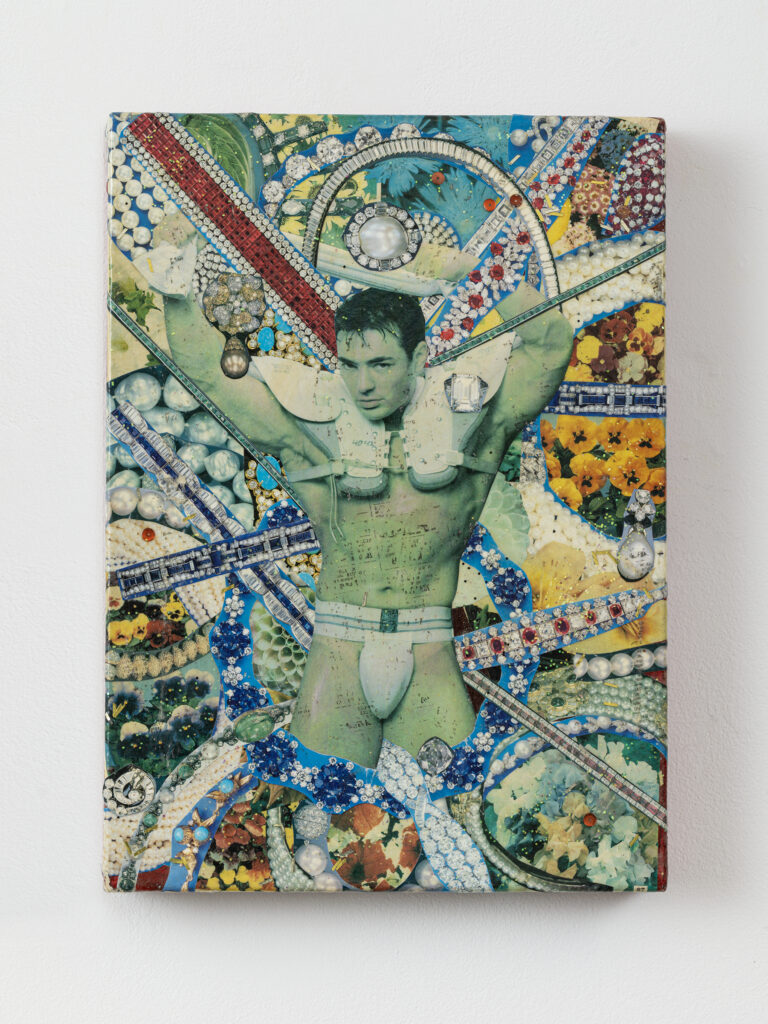
The show achieves its goal, if not perhaps in the way it intends, by presenting a coherent set of works that map cleanly onto the extant queer aesthetic genealogies. Contextualized as expressly queer, Connelly becomes legible as positioned as part of a tradition of artists, stretching from Jess in the 1950s to Wardell Milan today, who use pornographic imagery and collage to make arch, camp, and ironized critiques of dominant culture. By emphasizing Connelly’s time in New York, the show also invites his low-brow material twists to be placed in conversation with the work of some of his slightly younger and better-known contemporaries, including Lankton and Jerome Caja.
Despite the show’s emphasis on coherence, it is the fragments of Connelly’s correspondence practice, on view in conventional vitrines, that feel like a revelation, in part because they evidence the ways in which Connelly’s fragmentary grammar—both linguistic and aesthetic—fundamentally enliven his oeuvre. A show announcement from 1974 on paper with feathers sprouting up from behind it, an autobiographical artist statement addressed to the curator Dan Cameron, letters written using a different color ink for each line, and a xeroxed collage on the occasion of a new year that Connelly called a “correspondence poster”—the latter two addressed to the artist Jimmy Wright—showcase a commitment to extending his practice beyond the confines of the gallery, studio, or stage.
Connelly’s correspondence practice also recalls that of Ray Johnson, another gay artist whose aesthetic approach to correspondence Connelly likely would have been aware of. Like archness, camp, and excess, correspondence works only when both parties have a shared vocabulary, address, or language, a connection that constitutes its own kind of intimacy. Where Johnson approached mail art as a practice unto itself that defied interpretability, Connelly seems to have mailed art that explicated his conceptual and cultural references to those who might serve as interpreters. Nevertheless, Connelly’s correspondence shares with Johnson’s a refusal to make readily available meaning—one that may ultimately extend to immediate identification as political. As opportunities for public expression of queerness, art, and their intersection came increasingly under threat, Connelly may have faced that moment of senselessness with nonsense, nurturing an aesthetic that pointed away from coherent meaning in ridiculous defiance of what was going on around him. What it may have meant to Connelly to make gay art for gay people was to create decadent moments composed from just enough of the stuff of life to be familiar to it, but which exceeded or evaded its constraints to offer those surviving, despite efforts both overt and covert to restrict or extinguish queer life, to get lost in the chaos and excess of camp. Connelly’s work may not accrue to conventional subversion; but refusal of convention may have been his politics.








Contribute your thoughts by leaving a reply