





Before looking up, first look down. Or, before looking to Na Kim’s beguiling portraits of clouds, take a moment and look back.
In her 1993 reading of Cindy Sherman’s Centerfolds, Rosalind Krauss notes the camera hovering above a certain Miss Lonelyhearts splayed across the kitchen floor in despair, clutching a letter in her hand. Krauss makes it very clear that narrative doesn’t really matter; rather, the point is the formal “production of the signified /horizontal/, a production achieved by concentrating on a point of view in which the camera looks downward.” The peering lens reorients “the horizon line” as a “function of the floor.” This production of horizontality is, Krauss maintains, “concentrated equally in the domain of baseness and of an attack on form.” Its atmosphere of pervading abjection precedes any character or narrative, “[eroding] … form from within” and unmooring any organizing logic that coheres the visual world itself.
For Krauss, the production of the horizon illustrates how constructions of form flirt with myth. But other artists, especially landscape painters, have long contended with the horizon to structure composition and produce meaning. For example, take the British painter John Constable, whose art I have come to know through my position at the Yale Center for British Art, which holds an abundant collection of his work. Among the most intriguing are his Cloud Studies. Drawn from direct observation of his surroundings, these smaller oil sketches, on paper affixed to canvas, index the celestial shapes, colors, and tones of singular moments in the changing skies over Hampstead Heath. Some are framed by fields and trees, while others are completely untethered from the ground, filling the frame with meteorological splendor. Of the latter, the horizon is entirely absent. Existing only in the viewer’s imagination, it is virtual and provisional, its relationship to the composition entirely mutable. Unlike Sherman’s photograph, these paintings invite a point of view that is oriented not downward but heavenward, the horizon not a function of the floor, but of belief. Constable’s interest in the natural sciences notwithstanding, he was a man of strong Anglican convictions at a time when religion was just beginning to lose its hold over society. This formal orientation of his Cloud Studies as analogous to the transcendent and immaterial drives of the artist’s Christian faith pushes the work further into the territory of myth. At the same time, Constable’s unseen horizon, which could exist in innumerable spatial relations to the impossibly still cloudscapes, exposes not only the uncertainty inherent to faith but also the manmade constructed-ness of such a belief system, regardless of an artist’s biography or intent (itself another speculative myth).
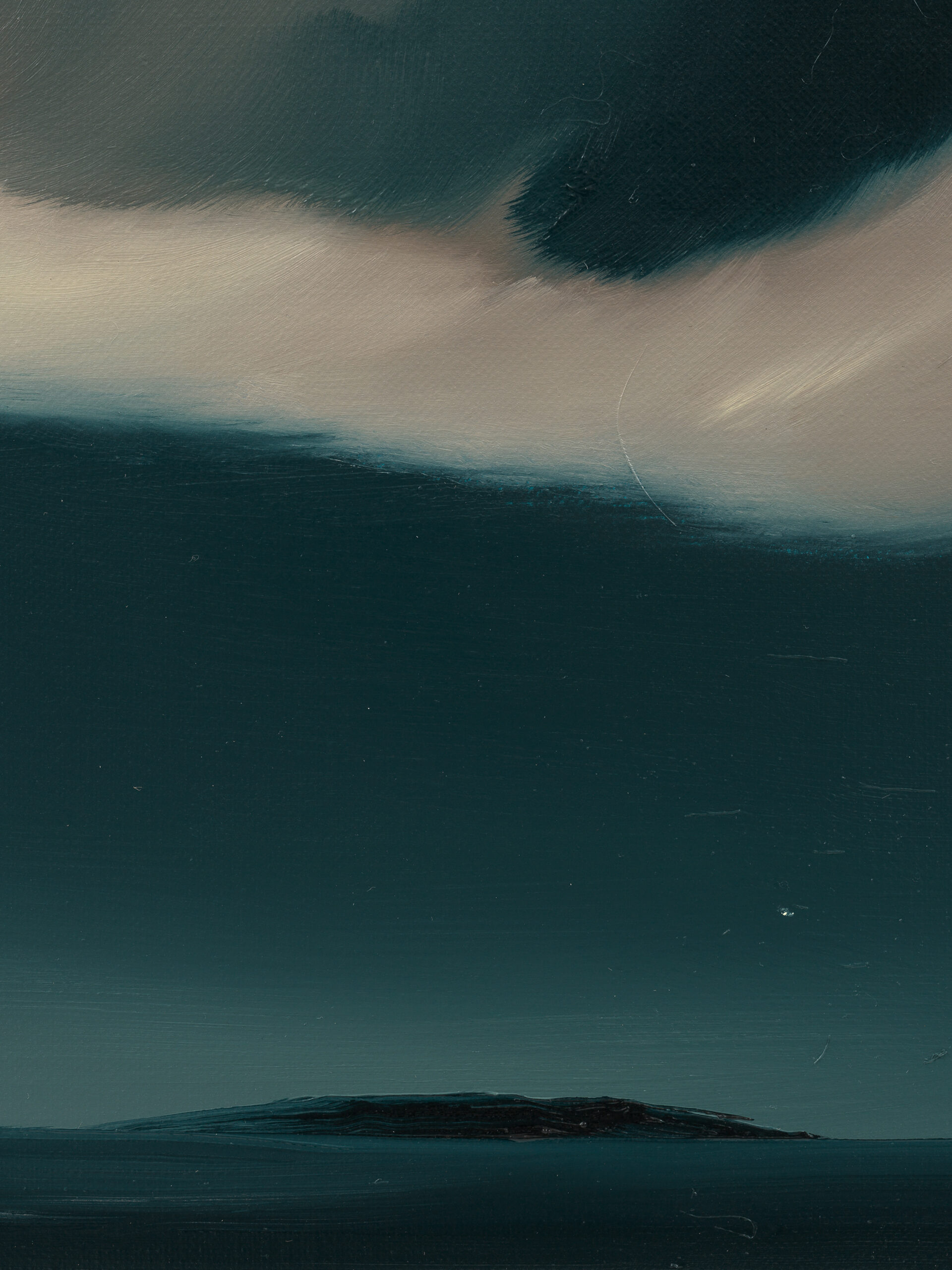
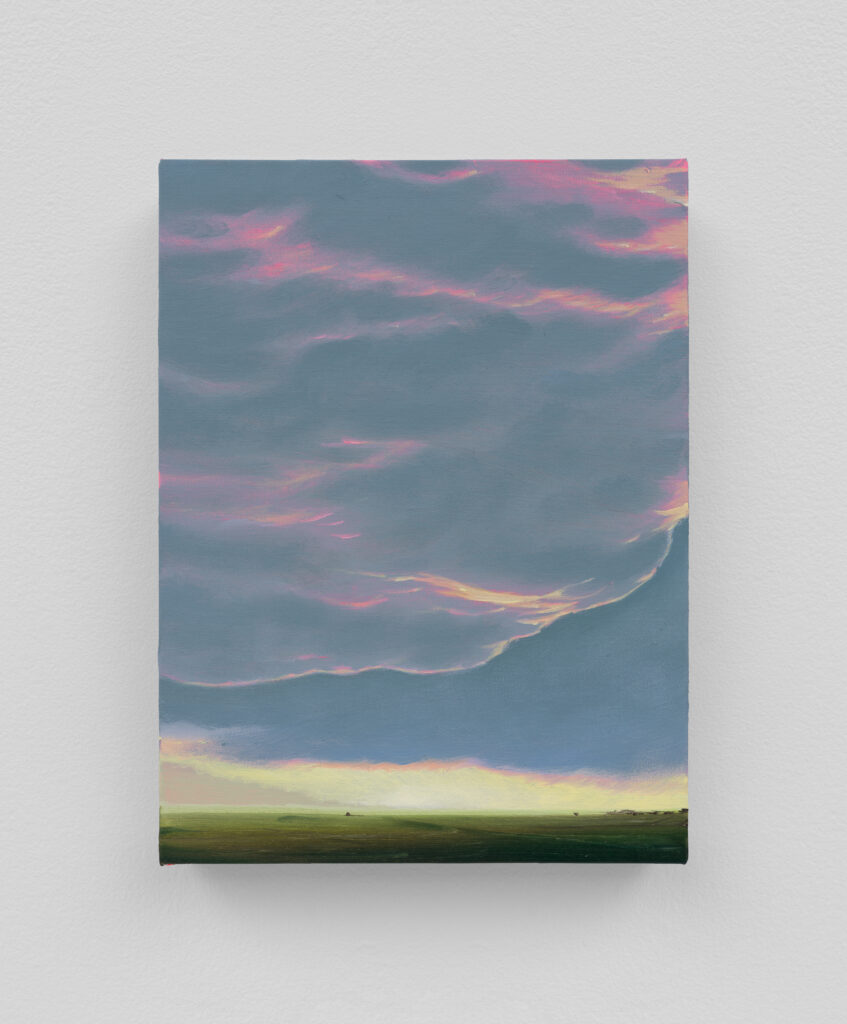
The paintings that featured in Kim’s Blue at Nicola Vassell in New York, all 2026, are canny variations on the theme of clouds as subjects. In her paintings, they exist in various states from dark and stormy to light and fluffy, from realist to fanciful, dominating the thin strips of miniature landscape, replete with tiny buildings, that run along the bottom like windowsills. In many instances, sky, land, and sea blur into indistinction, troubling the boundaries that hold the world together, until a brushstroke here or there announces itself and the paintings become paintings. Each work is assigned a person’s name, the appearance of the cloud formations perhaps alluding to the titular characters of Dierdre, Mona, or Fred. (Ironically, for the most part, the handful of portraits of people included in the exhibition go untitled.) Just as children scry the sky for familiars, figures and faces hide within the compositions: In August, a dark mouth blows mist like breath on a cold day, or in Ariel, a stoic profile on the edge of a storm front faces the clearer skies ahead with contempt.
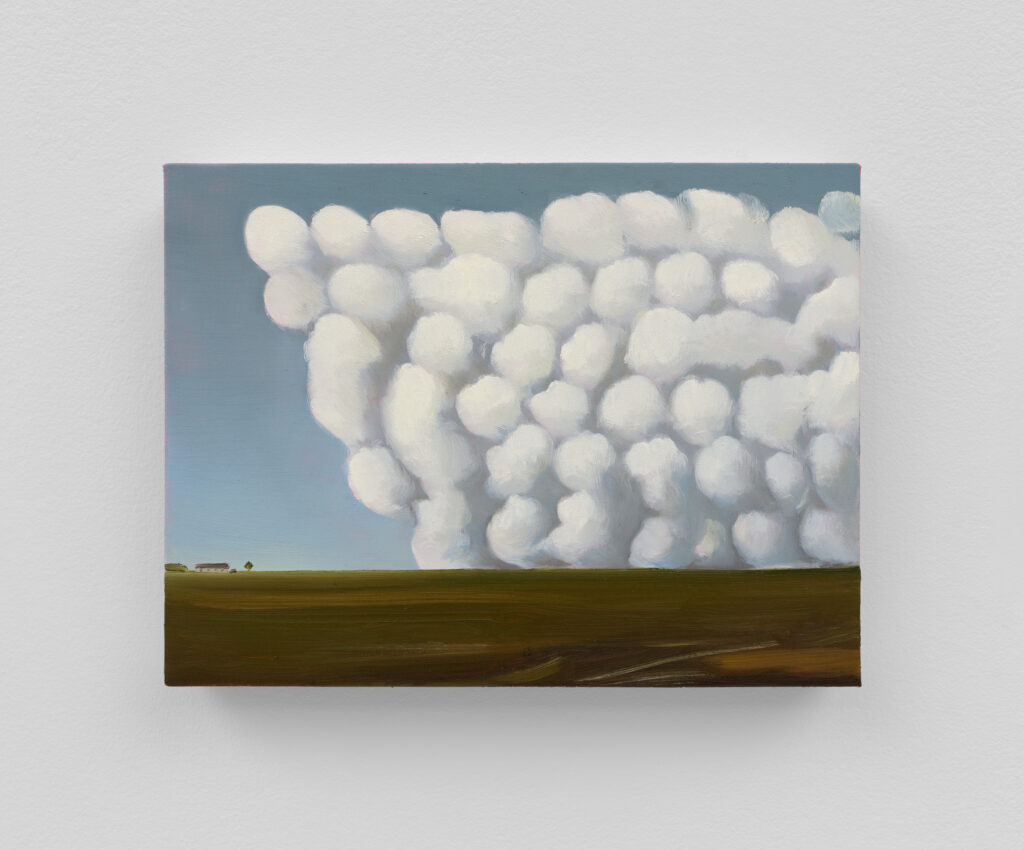
The edges of Kim’s canvases reveal the colored underpaint, often an energetic neon pink, which contrasts the calmer palette of the eventual painting. Sometimes, though, this bold hue peeks through elsewhere, adding dimension and tonal variation, much in the same way that Constable’s unexpected maroon grounds add richness to his Cloud Studies. Kim’s paintings knowingly wink at their art historical antecedents, engaging in playful conversation with the Romantic sublime of Caspar David Friedrich, the ethereal veils of American Fritz Henry Lane, Salvo, or the gestural grace of Maureen Gallace.
Unlike the pure Cloud Studies of Constable (or even Sherman’s Centerfolds), Kim’s paintings act as windows, correcting the horizon by placing it in a more realistic relationship to the audience. Her images face the audience head-on, resulting in a form that, as Krauss would say, “coheres for the human viewer … hover[ing] in a plane parallel to the upright body.” In returning the horizon to this position, Kim restores form to terrestrial stability, retrieving it from the uncertainty of both the abyss and the heavens. She gives the human viewer a central subject position that is only reinforced by anthropomorphizing the cloudscapes. As “portraits,” these paintings traffic in the common phenomenon of pareidolia, the tendency to see faces or other pictures within inanimate forms. They subtly question the primacy of an assumed anthroposcenic gaze, a myth of human control over the surrounding world. That we possess any sort of command over nature, especially the increasingly unpredictable weather—more drastic because of our damage to the environment—feels all the more hollow and false.
However, with the rhetorical aplomb of saying two things at once, Kim uses charmingly surreal landscapes that exaggerate humans’ outsize conception of their own agency to convey her own urgent warning of catastrophe. While her work seems to exist outside these battered myths of human primacy, she has skillfully placed them at the center in ways viewers may not initially notice. Sitting between the external world and interior life, these works meditate on a question the theorist Leo Bersani once asked: Does the subject live in the world, or does the world live in the subject? For Kim, the answer still hangs in the air.








Contribute your thoughts by leaving a reply