


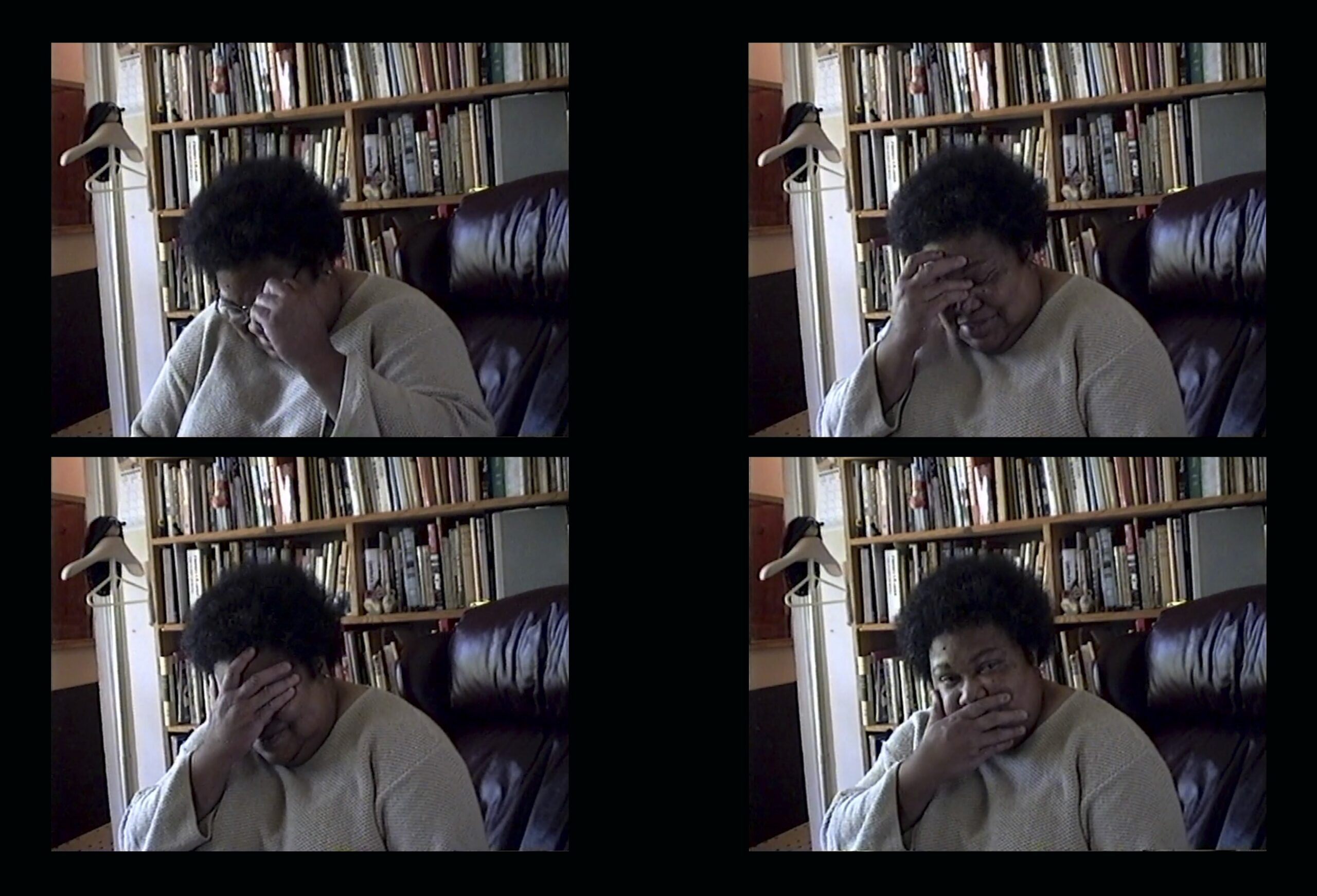




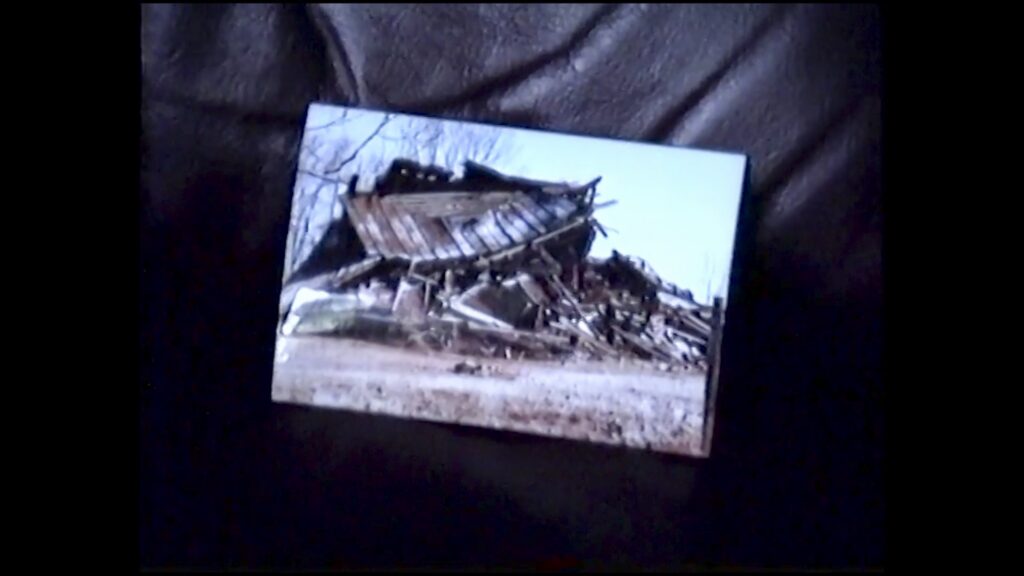
On a summer afternoon in 1995, artist and writer Judith McWillie brought her Sony camcorder to the home and studio of Beverly Buchanan. Throughout much of her practice, McWillie (1946–) has visited the living/working spaces of Black artists in the US South, recording hours-long conversations that, together, document the legacies of vernacular art. Eight years before her interview with Buchanan (1940–2015), McWillie made one such recording with Mary Lou Furcron, a then 76-year-old architect and maker. Furcron designed and built her own home in Vesta, an unincorporated community about 45 minutes east of Athens, Georgia, where Buchanan lived from 1987 to 2010. Buchanan photographed Furcron’s home in 1989, showing the architect standing on her front porch tending to her garden, as the tilted house, assembled entirely out of brush wood, appears to sway like a living being. Shortly after this meeting, Furcron suffered a stroke, and her home was later destroyed. Buchanan’s photos became some of the only visual remnants of the residence. On that summer afternoon in 1995, Buchanan and McWillie reminisced about Furcron, who they always reverently refer to by her full name. Speaking about McWillie’s video, Buchanan tells her interviewer, “Your eye did what my eye would like to do—focus on exactly what you focused on.”
Soberscove Press’s Beverly Buchanan, Athens, GA, 8 July 1995 documents the two-hour exchange between Buchanan and McWillie. The book—edited by Mo Costello and Katz Tepper—elaborates on their discussion with annotations, alt text, images, and footnotes, while maintaining a relative “fly on the wall” approach to the artists’ encounter.
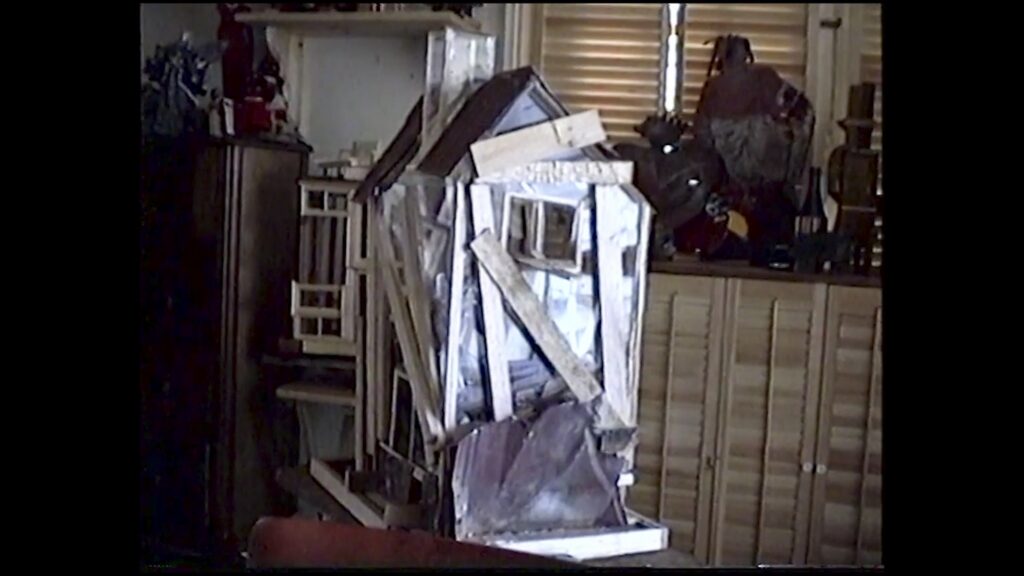
The book is broken down into ten sections, “mimicking the structure of a playscript,” as Tepper explains in the introduction. Each “scene” is punctuated by action lines and video stills moving from the outside in, beginning with Buchanan’s garden and transitioning into her studio. After a few frames of blue static, the video opens on an establishing shot of one of Buchanan’s famous “shacks,” a body of work comprising intimate sculptures, brightly colored drawings, and photographs of dwellings in the South. Birds chirp in the background as McWillie’s camera pans around Buchanan’s expansive garden. Our eyes settle as her lens comes into focus on a bird bath, a peach tree, potted plants, stones, and overgrowth. The scene ends, and we move to the driveway. McWillie props up her camera as Buchanan approaches in her dark green Toyota Tacoma truck.
BB: [opens the truck door.] I apologize.
JM: [walks toward the truck.] Hey.
BB: I was out at Jimmie Daniels Road, and I said, “What time is it?” …
Said “It’s ten to” … And I said, “I’ve got ten minutes to get home!”
Buchanan does most of the talking, energetic and, perhaps at times, subtly performing for McWillie. They finish each other’s sentences and seamlessly shift between topics—the light in Buchanan’s studio, her move from New York, her garden and collection of miniature cars, and some of her recent exhibitions, often returning to her 1994 retrospective and the traveling show House and Home: Spirits of the South (1994–96), which grouped her work with artists Max Belcher and William Christenberry.
Buchanan moved to Georgia in 1977, initially settling in Macon after nearly 15 years living in New York. Born in North Carolina, Buchanan studied in New York, earning master’s degrees in parasitology and public health from Columbia University. While working full-time as a medical technologist and educator in the Bronx and New Jersey, she studied at the Art Students League under Norman Lewis and Romare Bearden, exhibiting with the artists’ Spiral Group in downtown Manhattan. The year Buchanan moved to Macon, she turned her career entirely to art making. In Beverly Buchanan, Athens, GA, she sheds light on this pivotal moment: “I had to find my own relationship to what I was, what I thought I wanted to do. And it wasn’t working. And it didn’t work until I came South. … I could call it something once I got back home.”
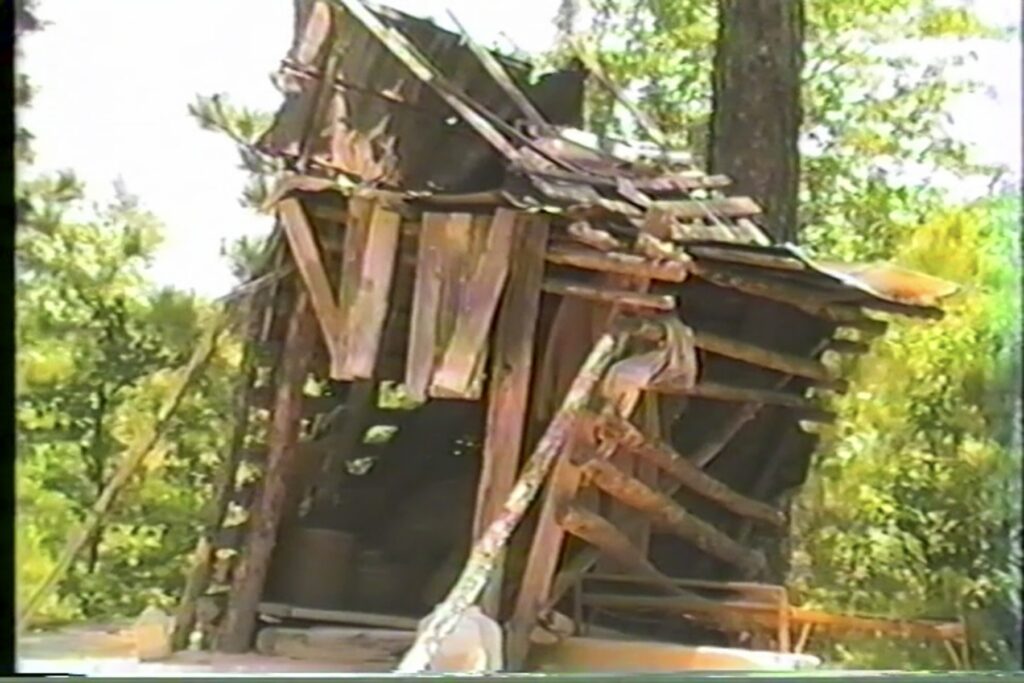
While Buchanan’s photographs of Furcron’s home in 1989 were among her earliest shack works, she first came across these vernacular structures as a child, when she would travel with her father, Walter Buchanan, an agriculturalist, to advise farmers across the Southeast US. The book carefully marks the through line between Buchanan’s shacks, her early career in public health, and her later artistic practice that, as Tepper writes, reanimated “her memories of rural Black life as a continued source of study.”
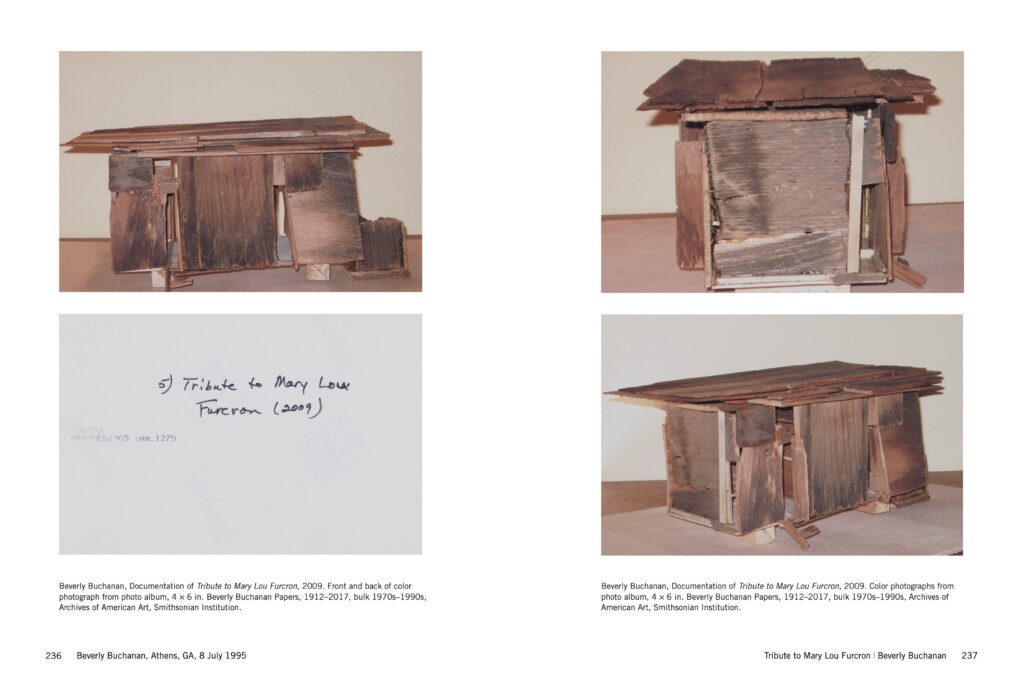
The third section of the book, “Tribute to Mary Lou Furcron,” includes Buchanan’s photographs of Furcron’s home alongside reproductions of a 1994 artist book inspired by their initial encounter, in which the artist writes:
The first sight of the house was like a bolt of lightning had hit me and I could only sit and stare. Then I noticed her in part of the garden. … She wasn’t hostile, but reserved: I am familiar with the reserve of old black women who live alone with no visible means of protection. … This woman was proud of her gardens and whether you were there for long or not, she had things to do around there and you felt intrusive.
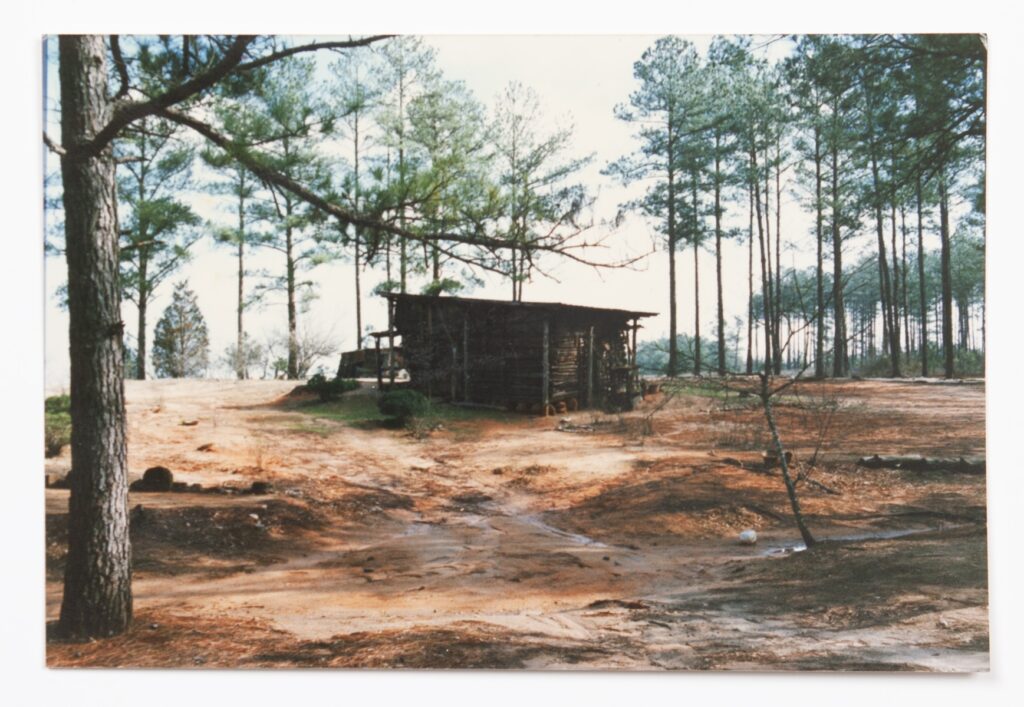
Buchanan returned to Furcron’s home in the years after it fell into a state of semi-ruin, grappling with the complicated image of “‘enclosed’ black women,” where the feeling of settlement and belonging can quickly transition into confinement or socioeconomic immobility. The inclusion of the artist book reveals just how complex Buchanan’s feelings about rootedness were, and how intertwined they were with her own physical mobility. She began making the small shacks as she navigated disability, sometimes trading works with friends for health care support. As McWillie periodically trains her camera out the window above Buchanan’s desk, we see some of these works living semi-permanently in the artist’s backyard. But the necessary anti-monumentality of her sculptures also points toward an intimate portrait of interiority. If a home tells a story of the one who inhabits it, for Buchanan—and many artists and makers working in this Black southern tradition—the process of making home was a creative practice unto itself.
As McWillie and Buchanan’s dialogue unfolds, they often return to structures that no longer exist, or that persist in a state of ruin.
JM: You went to the Palmyra church.
BB: —and talked to some of the people in that area. And what was disheartening for me was one young man… It was like, it wasn’t quite a trailer park.
JM: Yes. A trailer behind a tiny shotgun house, do you remember that?
[Beverly takes a seat at the desk, facing Judy]
BB: I don’t remember the house. I remember following this young man, and Patti was driving. I was just so excited to be in the area! I followed him… It was like a circular drive or something. And I stopped at this one house that had these incredible, uh, painted white rocks in a—in a straight line, and in a circle formation. And the house! [exhales]
I hesitated. I thought, “I wanna know what happened to this stuff, if I’m in the right area.” So I walked on up to the house and knocked on the door, and didn’t get a response. I stayed there, like, two seconds. And something said to me, “Go next door.” Okay. And, I could see people next door. This young man walked in the house, so I started talking to him to ask him about these pieces. He had no idea. Not only did he not know what I was talking about, he could have cared less. And that attitude just, it-it-it shook me. Really, standing there talking to him, I could hardly…
And he said, “I don’t know anything about it. Maybe some of the women inside may know.”
JM: Well there’s a lot of changes that have gone on just in the last ten years.
BB: I’m sure, I’m sure.
This vacillation between the there and not there gets to something at the heart of Buchanan’s practice. Creating the shacks, which she referred to as “portraits,” was as much about documenting their makers as the Black aesthetics and spatial practices they embody. This practice is deeply entwined with the legacy of redlining (and its progeny, gentrification). Illustrating this, the 2026 exhibition Beverly’s Athens (also organized by Costello and Tepper) at the University of Georgia’s Athenaeum presented a series of Buchanan’s undated photographs of shotgun houses on Rocksprings Street in Athens, now a protected historical district. Built in 1925, the houses’ paneled siding, covered porches, galvanized metal roofs, and brick chimneys were a mainstay of this kind of early-twentieth-century housing for Black working-class families. Conversely, the nearby historically Black neighborhood Linnentown was demolished in the 1960s by the University of Georgia and the city government as part of an urban renewal project. Buchanan’s photographs of both sites, along with her shacks, stand as obstinate records of systemic precarity.
The material conditions of impermanence and upheaval are often associated with Black life in the US, but, as Buchanan’s interventions attest, these conditions do not mean total erasure. The term “ruin” takes on a particular meaning in Buchanan’s work, not as a perpetual condition of disrepair, but as something that endures in spite of an environment that would have otherwise. In her own words, “a lot of my pieces have the word ‘ruins’ in their titles because I think that tells you this object has been through a lot and survived …it’s like, ‘Here I am; I’m still here!’”
The dialogues that Beverly Buchanan, Athens, GA brings together create a deep and intricate chorus. Reading Costello and Tepper listening to Buchanan and McWillie speaking about their mutual admiration for Furcron becomes a relational act, a way of communing between generations. Ultimately, the book makes the ineffable aspects of the conversation more accessible, rooting it in a disability framework that also foregrounds the ecologies of care that Buchanan and McWillie cultivated throughout their lives and friendship.
Watching Buchanan through McWillie’s eyes, I find myself trying to understand something more about the artist—to read her facial expressions, cadence, vocal tics, and sense of humor. I wonder, in turn, what more she wanted to know about the people her artworks embodied. I’m reminded of Buchanan’s loosely dated Self-Portrait (1990–2005), a photograph of a shack in the artist’s backyard. The shack appears in McWillie’s video, but in the photograph, it’s surrounded by overgrowth. Many of the spaces and structures Buchanan documented no longer exist in a material way, either damaged, bulldozed, or unkept. But Buchanan’s work accounts for absenting both natural and manmade. Even her site-specific sculptures don’t insist on a permanence of place, not necessarily. Instead, they were created to return to the earth and seed new ecologies. To take root or tread soil for life to emerge, or simply to exist in the enduring adaptability of Black vernacular space.









Contribute your thoughts by leaving a reply