


In the end, it almost seems like it was always meant to be this way. Khaled Sabsabi sat quietly beside his friend Michael Dagostino in the little kitchen beneath the Australian pavilion at the Venice Biennale as Dagostino told him, “It’s who you are.” It was early May, and Sabsabi had just debuted two artworks: conference of one’s self upstairs and khalil over in the Biennale’s international exhibition, In Minor Keys. That Sabsabi and Dagostino, his curator, would make it here was no sure thing a year earlier, when Sabsabi became the center of a political controversy in Australia that saw him appointed, sacked, and eventually reinstated to the pavilion. “Everybody said, ‘You did it with such grace; you didn’t lash out,’” continued Dagostino. “But we don’t. It was strange that people felt like it was a strategy or something.”
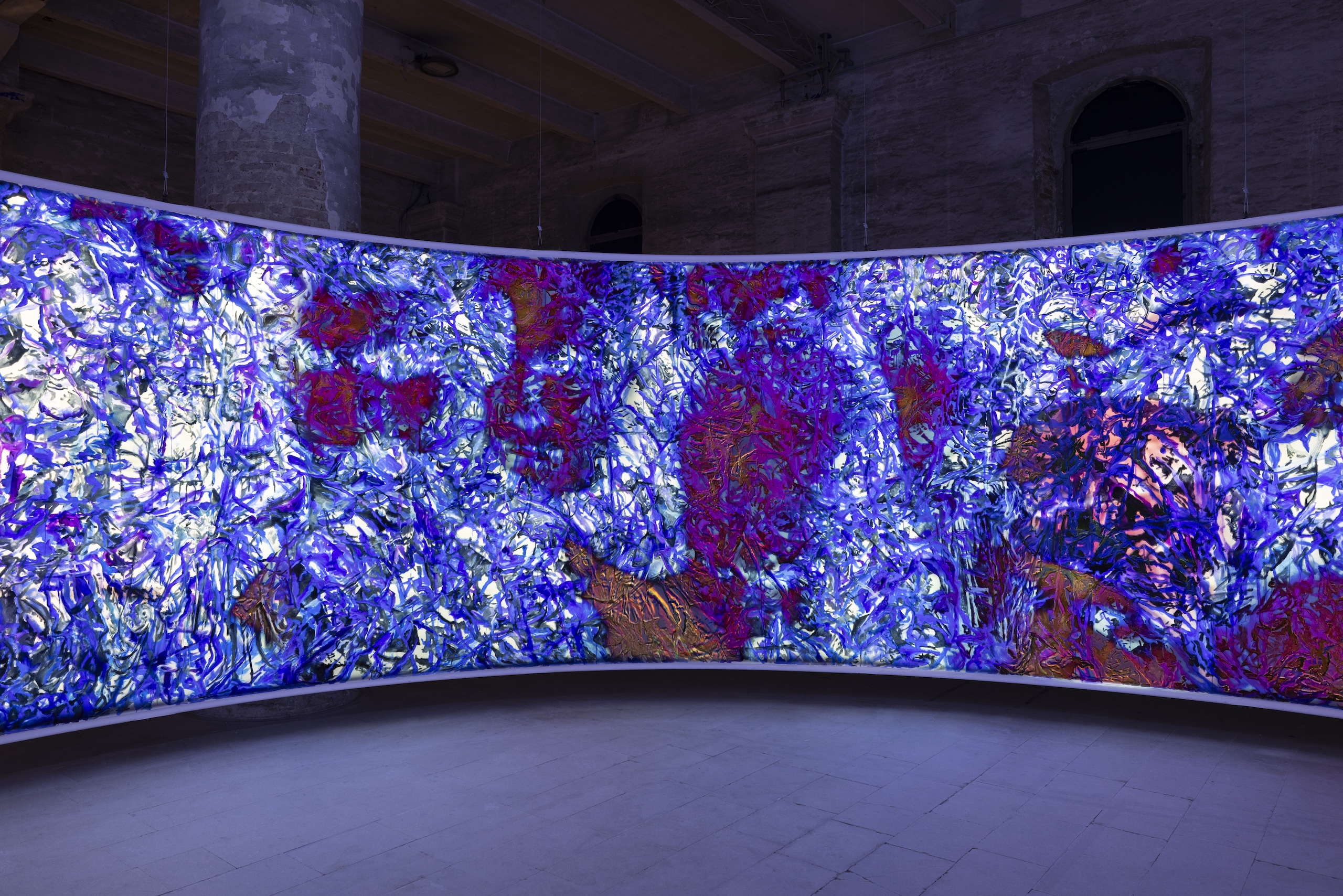
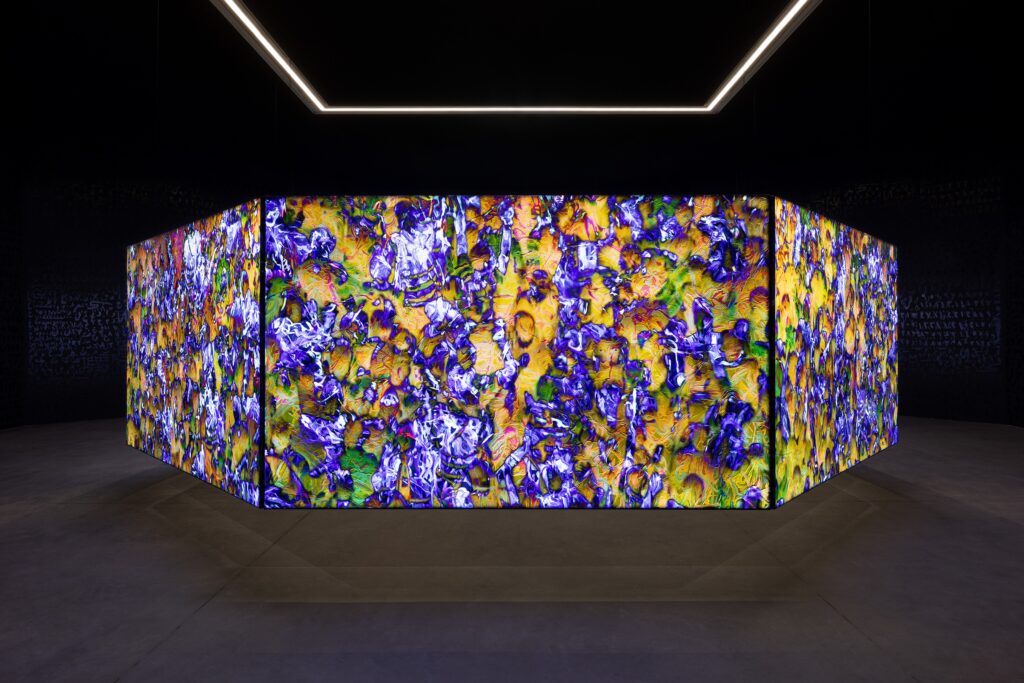
conference of one’s self hangs in the Australian pavilion, a smooth black construction that was built in 2015, the newest addition to the Biennale’s Giardini. The artwork consists of an octagon of large painted panels, facing outward, with a digitized version of the painting projected back onto itself, using gentle variations in color and shape to make the abstract patterns morph and sway. A few minutes’ walk away, Sabsabi’s single 40-meter canvas opens the exhibition at the Arsenale—the Biennale’s other, denser venue, housed in an old military barracks—hanging in a loose spiral in the middle of its own room. khalil is the inverse of conference of one’s self, inviting visitors into its embrace to view the painting and projection on its inside.
Sabsabi’s two works are a linked meditation on Sufism, the spiritual philosophy of Islam that the artist has been exploring over the past two decades. While the works are in part a result of his bumpy path to Venice, they are also the culmination of a much longer journey of exploration across Sabsabi’s career.
On February 7, 2025, Creative Australia announced that Sabsabi would produce the Australian pavilion at the 2026 Venice Biennale, along with Dagostino. Four days later, a column by Yoni Bashan ran in The Australian, a conservative newspaper, attacking Sabsabi’s appointment. Bashan had dug up a 2007 work from Sabsabi’s catalogue called You, which features images of then-Hezbollah leader Hassan Nasrallah, and claimed that it glorified the terrorist organization. The Australian government classified Hezbollah as a terrorist organization only in 2021, and the work was produced at a time when Sabsabi was exploring ambiguities in his own Lebanese heritage and how cultural identity is weaponized in wartime propaganda.
Bashan’s allegation was taken up on February 13 by conservative Senator Claire Chandler, who, in parliament, demanded to know why Sabsabi had been appointed. Panic spread across the government, and that night Creative Australia’s board held an emergency meeting, deciding to mitigate the perceived risk of divisive discourse by withdrawing Sabsabi and Dagostino’s appointment. Bashan and Chandler, unconcerned with the nuances of Sabsabi’s work, got the media frenzy they wanted by exploiting the artist’s identity as a Muslim Arabic Australian.
Almost immediately, the arts community rallied to Sabsabi’s side. The remaining artists on Creative Australia’s Venice short list signed a statement condemning the decision and calling for Sabsabi’s reinstatement, ensuring that none of them could be called upon to replace him. The magazine Artist Profile published ten defenses of Sabsabi by Australian and international curators. The artist Lindy Lee resigned from her position on Creative Australia’s board, saying in an interview with ABC Radio that “the sense I had was that we were being hemmed in by press and by government.”
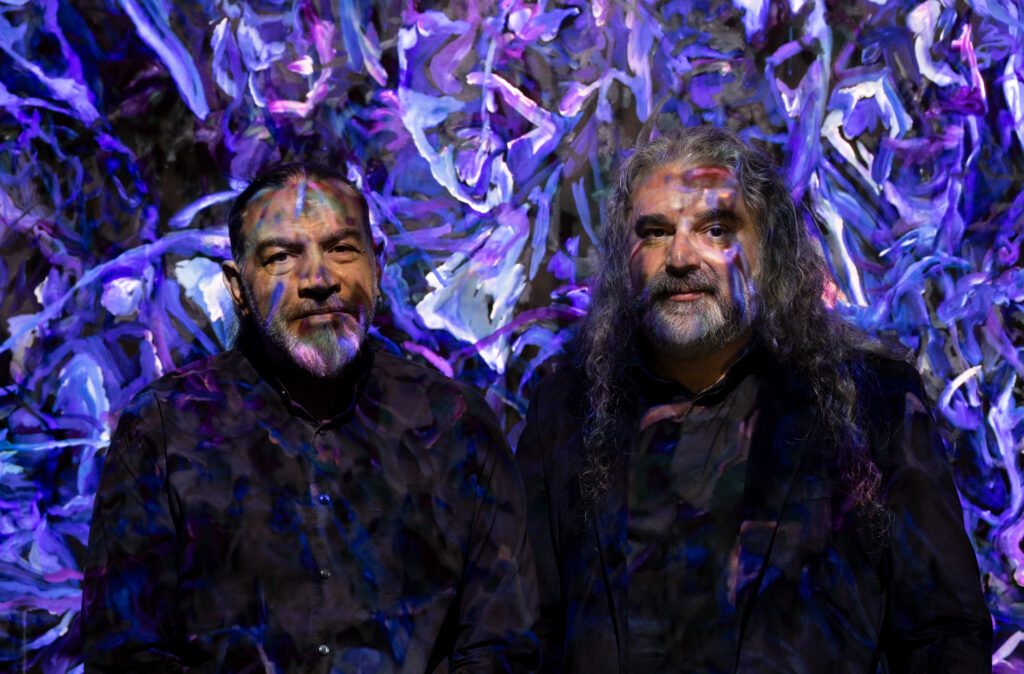
For his part, Sabsabi blocked out the noise and began work on a new painting in his makeshift garage studio, hoping still to complete the work he’d originally planned for Venice. Dagostino began organizing support from their communities in Western Sydney, across Australia, and internationally, eventually starting a fundraiser to help them produce the proposed exhibition. From the beginning, they wanted the work to make it to Venice in some form, even if it had to be shown in a space unaffiliated with the Biennale. When it became clear that Sabsabi’s garage wasn’t big enough to complete the work, the artist Abdul Abdullah gifted Sabsabi his studio and staff in Bangkok.
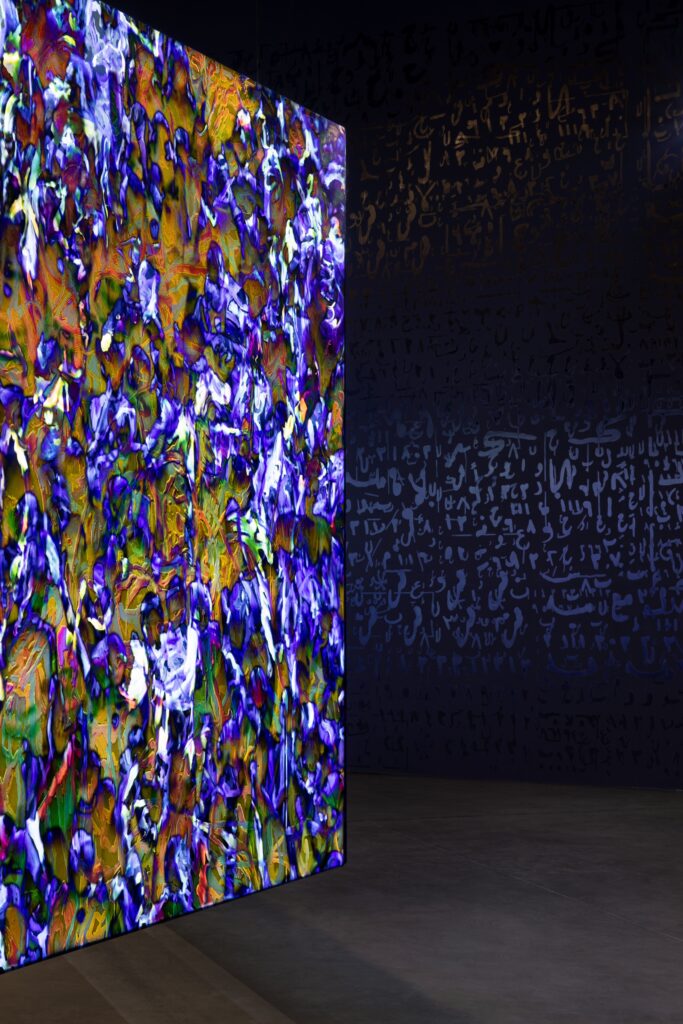
In Bangkok, Sabsabi layered swirls of paint onto the canvas that would go on to become khalil. He digitally merged the painted forms with other footage to create a video version of the painting in which various figures, faces, and forms emerge out of the nest of swirls. He suspended and circled the canvas in the middle of the room with the paint on the inside and then projected the video version back onto its source, bringing the paint to life.
Sabsabi finished khalil two weeks earlier than planned. “I had a dream that I needed to make more work,” said Sabsabi in a conversation with Dagostino for ArtReview ahead of the Biennale’s opening. “So I decided to stay on. And it wasn’t until much later in the process that the reasoning … made itself visible.” Over those two weeks, Sabsabi made the eight panels that became conference of one’s self.
He had just finished both works when he was contacted by Koyo Kouoh, the curator of In Minor Keys, who wanted to include him in her show. (Kouoh died shortly after, in May 2025, while she was still organizing the exhibition.) Then, in July, after an external review of the sacking scandal, Creative Australia announced Sabsabi and Dagostino’s reinstatement, meaning Sabsabi would be in the unique position of showing two works in Venice. He is the first Australian artist to do so.
Radically accepting events bigger than himself is something of a guiding principle for Sabsabi. “My practice has always been about making,” he said in the kitchen. “Where it’s exhibited becomes secondary.” He was undeterred by the political storms brewing around him and put his head down to make these works with a calm determination. Showing in both the national pavilion and the international exhibition only amplifies the message of his works, their emphasis on shared humanity going beyond the usual silos of the Biennale, where reductive national identities and the debates they spark often drown out the art itself.
Khaled Sabsabi was born in Lebanon in 1965. His parents moved to Australia in the early 1970s looking for short-term work, leaving Sabsabi with his grandmother and aunt. After the Lebanese civil war broke out in 1975, they sent for him and eventually settled together in Western Sydney, to this day one of the most culturally diverse parts of Australia. “The majority of people in our community are first-generation migrants,” Sabsabi explained.
His parents opened an Arabic music and video store, “an encyclopedia,” Sabsabi said, “that, hand in hand with hip-hop, was an important school for me.” His artistic potential was spotted and nurtured by art teachers at his high school, where he excelled in drawing. He developed a tinkering practice as a hip-hop performer under the name Peacefender in the 1980s and would bring that approach into his art in the 1990s. He began mixing his painting and large-scale installations with a video editing technique inspired by sampling.
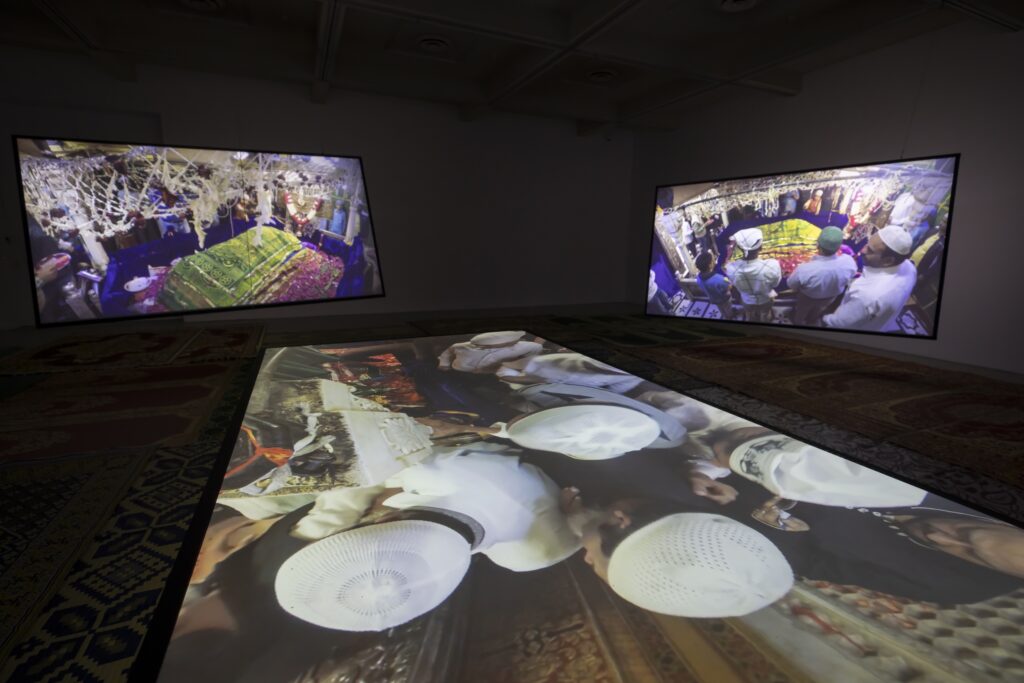
In 2002, Sabsabi returned to Lebanon for the first time since he’d fled as a child. “It was about reconnecting with language, geography, and culture,” said Sabsabi. On that trip, he also met his Sufi teacher, who remains an important guide through the spiritual and philosophical teachings of Islam. “That was the first time that I started to look at the nuances of spirituality,” said Sabsabi. Faith became a leading part of his art, influencing him to embrace the unknown in his search for identity and meaning and bringing a new level of ambiguity into his work. Asked to sum up Sufism, he said that “it’d take us years to be able to capture what it means,” and his accumulation of knowledge over time is palpable in his work, through the overlaying patterns and the invitation to viewers to find their own meanings.
Sabsabi and Dagostino, friends and collaborators since the 1990s, were a softly spoken inseparable duo in Venice. They both have long, curly hair; they both dress in all black; and their calm poise contrasted the hectic energy of the Biennale’s preview week. Just like Sabsabi’s art, they focused on sharing their work instead of playing a loud role in the many protests, controversies, and strikes that dominate the week. “The Venice Biennale is an opportunity for artists to go as big as they possibly can,” said Dagostino, “and sometimes it works, and sometimes it doesn’t. I find the most interesting artists [here] are those who work in that quieter space.”
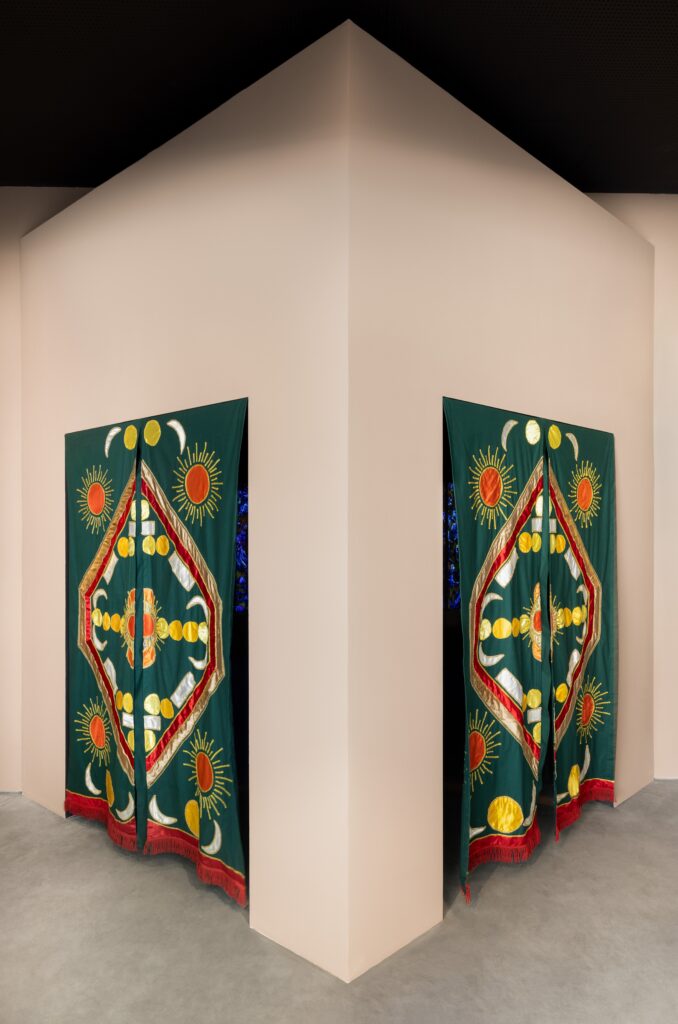
Visitors to the Australian pavilion come up a gravel pathway and encounter two doorways, each covered with handmade curtains commissioned by Sabsabi from the Multicultural Women’s Hub, part of the Arts and Cultural Exchange in Parramatta, Western Sydney, depicting colorful patterns of moons and suns. Either door could be an entrance or an exit, and the viewer chooses to navigate the pavilion clockwise or counterclockwise. “Each individual has their own experience, brings their own self,” said Sabsabi. “But whichever way they go, they come back to the beginning,” again reflecting the endless task of spiritual exploration.
Inside the dark internal space, the conference of one’s self glows gently under the projection. It uses the same technique as khalil but faces outward, appearing to float in the middle of the room. The painted swirls could almost be alive, as the projection changes the colors and causes new forms to emerge, even giving the illusion of three-dimensional depth at times. After a while it becomes difficult to tell what is fixed paint on the canvas or whether the whole thing is just a projection. “Everything is in flux,” repeated Sabsabi many times during our conversations.
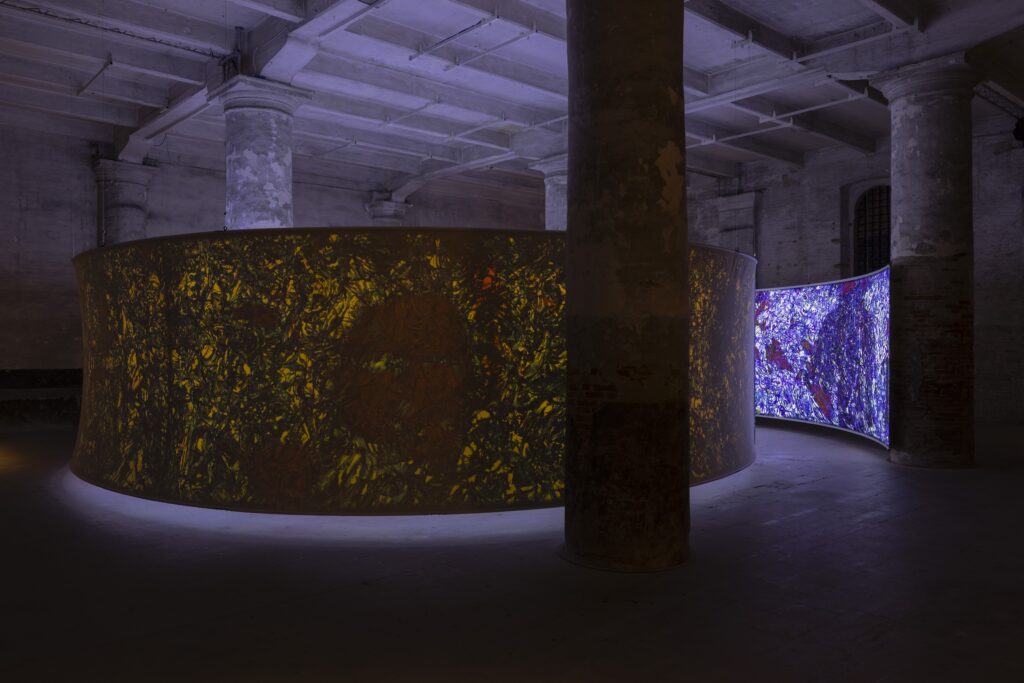
Khalil means “dear friend” in Arabic, and Sabsabi sees khalil as a much more nurturing work than conference of one’s self. The first work in the Arsenale exhibition, it welcomes people, surrounding them with the soft light coming off the canvas. khalil’s projections speak a little louder than its sibling’s. The faces that emerge from the abstract shapes feel like a crowd of people forming out of the endless churn of the universe, finding community across their differences or similarities.
The stories of khalil and conference of one’s self are stories of migration, and migration is always about chance. “They got an option to choose Canada, America, or Australia,” Sabsabi recalled of his parents. “They were the places taking people seeking refuge. How do you choose?” Since khalil was originally conceived for the walls of the Australian pavilion, its journey to the Arsenale leaves it floating in the much bigger space. It doesn’t feel out of place or without a home, but it isn’t tied down, either, like it’s a traveler passing through. “It’s quite poetic,” said Sabsabi. “It’s got its own life force, and it wanted to be there.”
This year’s Biennale had no shortage of controversies, in the artworks themselves and in the protests, strikes, cancellations, and resignations that accompanied them. But even though In Minor Keys is itself a crowded, at times overwhelming exhibition, it’s clear that Kouoh could source her vision of quiet continuance in Sabsabi’s work. khalil “sets the tone for the rest of the exhibition,” said Dagostino. More than that, khalil makes visible the qualities that carried Sabsabi through the past year: patience, openness, and an insistence on complexity over certainty.






Contribute your thoughts by leaving a reply