








In the spring of 2013, I made the first of many visits to the Brooklyn studio of Juan Sánchez, to begin research on a monograph about his work. Back then, Sánchez inhabited a cacophonous space between the Manhattan and Brooklyn bridges, where conversation was punctured by the insistent rattle of subways, and jazz and salsa drawn from Sánchez’s music collection filled the gaps in between. Like many artists’ studios, it was a window into his methods and his interests. On cluttered bookshelves were volumes by Caribbean philosophers and the Puerto Rican poet Juan Antonio Corretjer, a fierce independentista known for his wry wit. Here and there were in-progress canvases and the objects that ended up collaged to their surfaces: Catholic prayer cards, photographs, cowrie shells. But among the things that I most remember was an improvised shrine displayed on one wall that featured a cowbell, a Hamsa amulet, and a steel sculpture by Melvin Edwards.
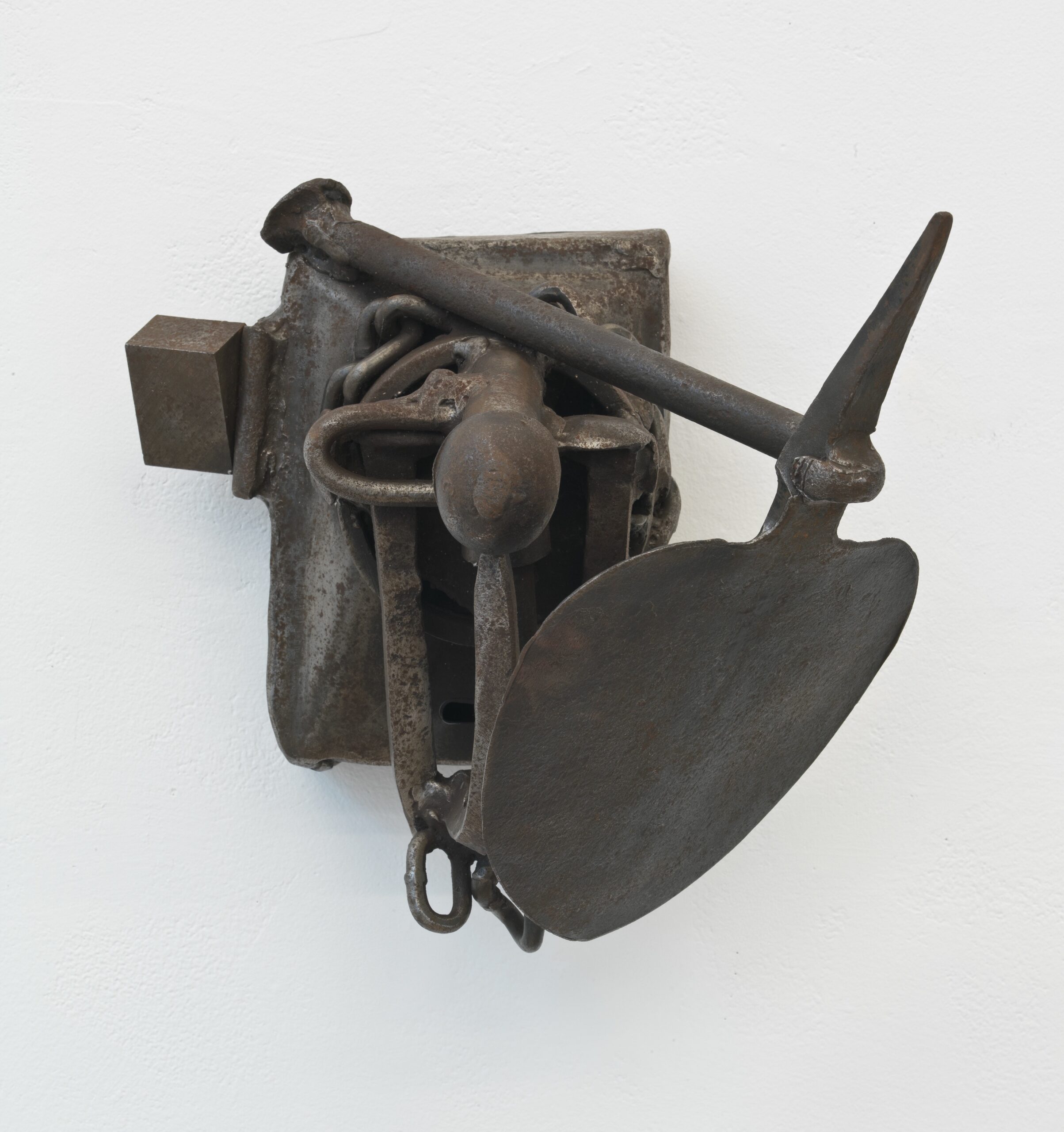
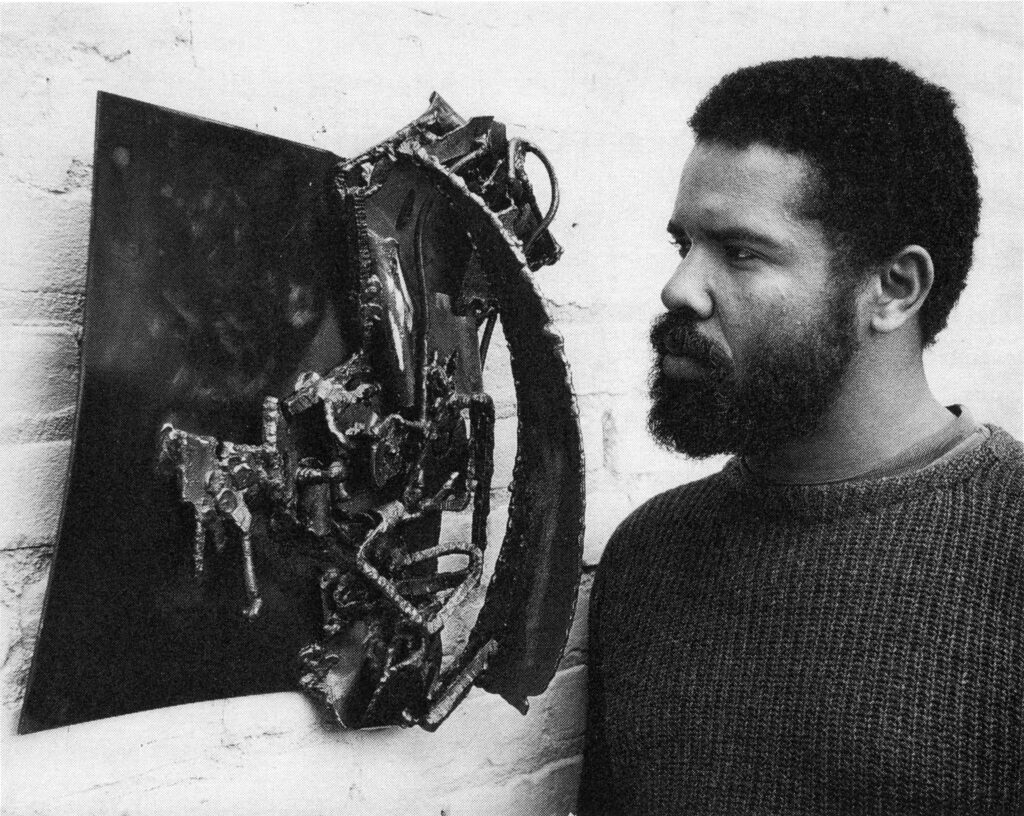
Edwards gave the piece to Sánchez at some point in the 1980s—it is one of his famous Lynch Fragments, the dense, welded reliefs that often sprout menacing forms such as knives and chains. The one in Sánchez’s studio was less ominous than most, evoking a small birdhouse that contained a chain, a hook, and a horseshoe. The sculpture by Edwards—for which I have neither a title nor a date—occupied a place of prominence, next to a wall where Sánchez presented his work to visitors. “Having it there, I saw it every day,” he told me recently. “I took it as something of his presence.”
Edwards, a sculptor of uncompromising steel forms that conveyed violent histories with grit and grace, died in March at the age of 88. Over his long career, he created powerful public works that wove together African American history and abstraction, and gave materials such as barbed wire, which he would drape from gallery ceilings, a textile quality. He was also a teacher, first at the Chouinard Art Institute (now the California Institute of the Arts) in Los Angeles and later at Rutgers University in New Jersey, where he influenced generations of students. It was at Rutgers where Sánchez and Edwards became acquainted.
Edwards was born in segregated Houston in 1937, later lived in Ohio, and spent formative years in Los Angeles, playing football for the University of Southern California, where he also learned to weld. In the late 1960s, he relocated to New York, where he became part of an important circle of Black artists that included painters Sam Gilliam and William T. Williams. Throughout his career, Edwards made drawings and prints, but the physicality of welding is what called to him most. “I always liked work that had dynamics to it,” he told Bomb in 2014, “that had or implied strength or aggressiveness.”
Sánchez was born in Brooklyn almost two decades later, in 1954, to Afro Puerto Rican parents from the island’s southern coast. He came to art via an interest in graphic design and illustration, but during his undergraduate years at Cooper Union in Manhattan he became intrigued by the ways he could explore the nuances of the Nuyorican condition via photography and painting. In 1978, he embarked on his graduate studies at Rutgers, where he began to create the works for which he has become known: deeply layered paintings and prints that link constellations of events, including intimate family scenes, Puerto Rico’s struggle for autonomy, and liberation struggles around the world.
Sánchez never studied under Edwards—Edwards taught sculpture, and Sánchez, in those days, was focused on painting. But Sánchez gravitated to the elder artist for his wisdom and his lighthearted nature—when asked about how and when he conceived the titles of his works, Edwards would reply, “Making experimental art is like making a baby: everybody’s busy enjoying themselves, nobody’s thinking about what the baby’s name will be.” The two often discussed their shared interest in music, as well as what it meant to navigate the art world as Black men. Sánchez says that Edwards advised him not to depend on the fickle tastes of art’s gatekeepers to validate his ideas: “He would tell me, you’re not making money? You find money to make the work. If you’re not getting recognized, you still have to make the work, because the work is important. It will have an impact. It will live beyond. … The art world has its own apartheid. You create your own situation.”
After Sánchez concluded his graduate studies, a friendship bloomed. In 1981, Edwards invited the young painter to join him in an exhibition at the New Museum of Contemporary Art titled Events: Artists Invite Artists; seven years later, Sánchez featured work by his mentor in the group show, Affinities: Idioms/Aesthetics/Intents, that he organized at the Jamaica Art Center (now the Jamaica Center for Arts and Learning) in Queens. It was Edwards who stood by Sánchez’s side when the latter married theater scholar Alma Villegas. And Sánchez was with Edwards in 1985 when their mutual friend Ana Mendieta failed to arrive for a lunch date at a West Village Mexican restaurant. They later found out she had died, possibly at the hands of her husband, Carl Andre, the previous night. (He was later acquitted by the State Supreme Court in Manhattan, but many in Mendieta’s circle continue to suspect that he had a hand in her death.)
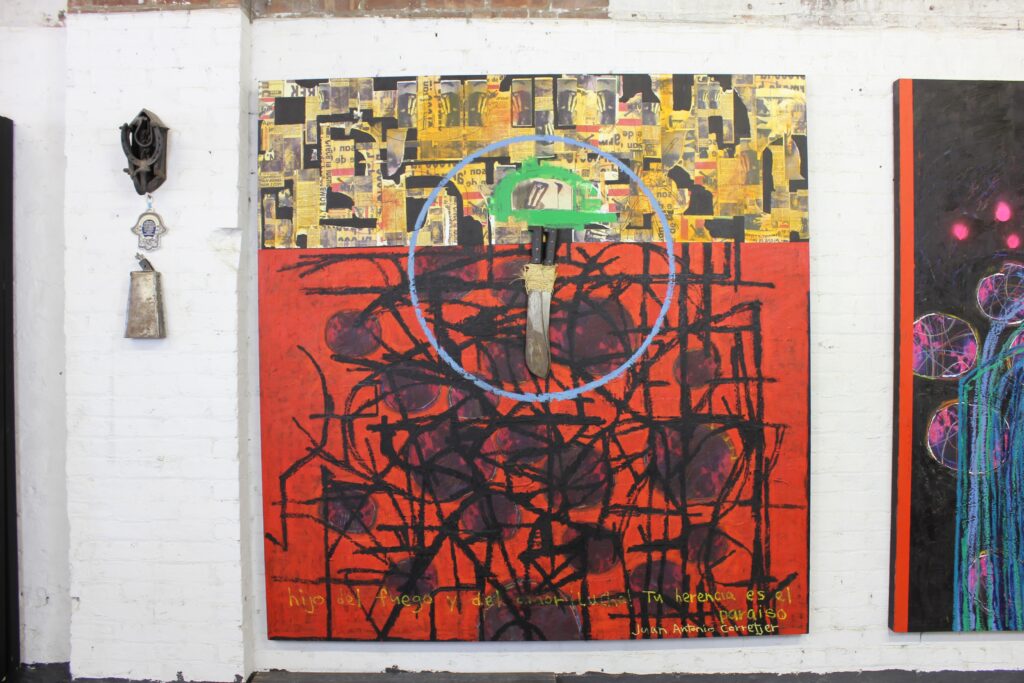
Over the years, as I have reviewed the material from my sessions with Sánchez, I’ve been struck by the frequency with which Edwards’s sculpture appears in my photographs—as if he’d been watching over us throughout. One of my favorite images shows the Lynch Fragment next to a 2002 painting by Sánchez titled The Unknown Soldier, which features a collage of news clips related to a Puerto Rican independence fighter above a geometric pattern that rises over a background of fiery red. Two small machetes adhere to the painting’s surface, the metal of their blades rhyming with the steel of Edwards’s sculpture to the left.
To me, Edwards’s small but weighty work has always been a marker of the ways artists—especially Black artists, whose ideas and aesthetics have historically been marginalized—support each other: in joy, in grief, in accomplishment, but also in the fallow times in between. They are the lineages that perhaps don’t register formally, but that nonetheless give shape to a worldview. I knew Edwards only through his work and the words of others. But through my encounters with Sánchez, he remains ever present.








Contribute your thoughts by leaving a reply