







Prior to Nour Bishouty’s first exhibition in Mexico, I had never encountered her work in person. Everything I had read about her practice led me to expect an investigation of archives and documentary forms: works concerned with the gaps and omissions of historical records, skeptical of archival images presented as transparent evidence. Walking through the ground-floor galleries of Museo Universitario del Chopo in Mexico City, however, I was surprised to encounter a constellation of works that appeared almost childlike. The artist draws on deeply researched family history, contending with gaps in the archive and exploring how they relate to the wider omissions of Western knowledge. But bright colors and naive, even awkward, figures populated drawings and sculptures whose visual language seemed, at first, far removed from the sober aesthetics often associated with archival practice. As I spent more time with this language, I came to see it as a proposition for a different model, one that approaches memory obliquely—through errant objects, speculative narration, and unstable bodily forms.
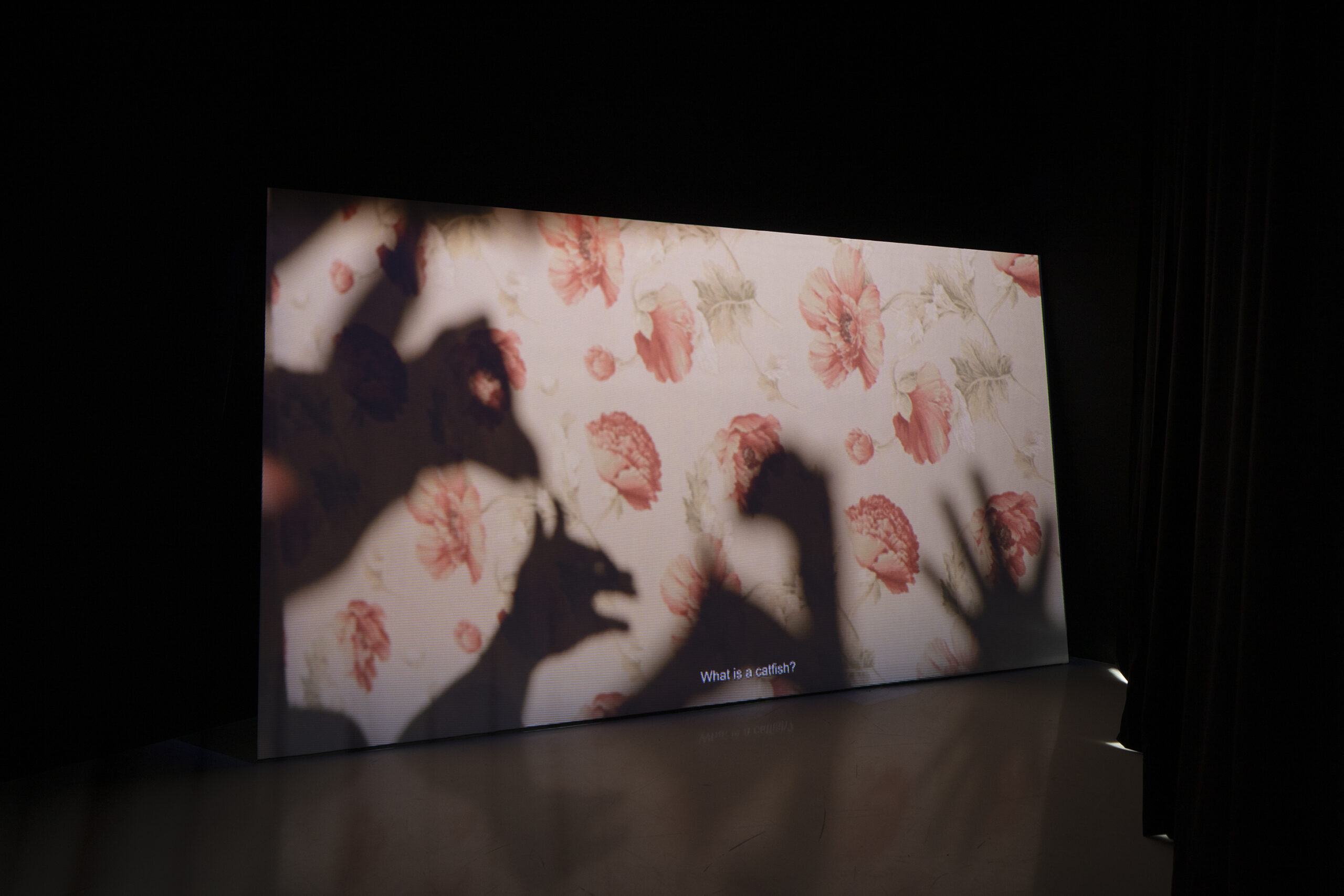
Throughout Bishouty’s sparse show, titled Unlikely Mother, hands emerged as a structuring presence. Displayed across two monitors resting on the floor, the video This is the forest primeval (2025) presents spectral figures—plants and animals—that drift across an imaginary landscape, all created by shadows of gesturing hands. Although several Indigenous cultures have employed shadow play as a form of storytelling—including the transmission of cosmologies and creation myths—within a contemporary Western framework, such practices are often dismissed as infantile amusements, despite their long, complex, and political histories. In other works, three pairs of long-sleeved dark gray spandex gloves oscillate between recognizable and unfamiliar forms. For instance, in Palms (2025), the glove takes on unexpected orientations: Rotated ninety degrees, the spandex fingers evoke another kind of palm, the tropical tree.
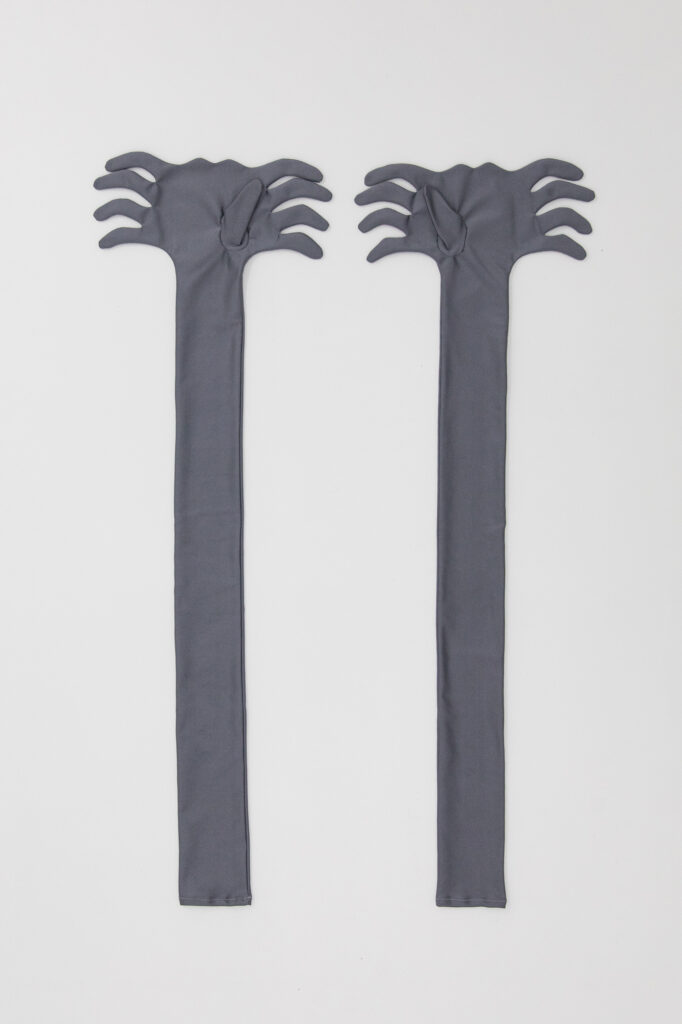
Bishouty’s sustained attention to hands—prompted by her mother’s atypically configured hands—anchors much of the exhibition. Her mother’s hands become less a biographical subject than an archival fragment: a partial trace from which multiple formal and narrative variations emerge. Though they never appear directly, her mother’s hands are repeatedly evoked by others: hands with only two short fingers emerging from the metacarpus, forming a pincer-like silhouette. In Papercuts (2025), paired hands made from subtle, delicate tracings on die-cut black paper assume unexpected forms, which resemble the fauces of an animal or the pincers of a claw. Though hands recur throughout the exhibition, Bishouty never allows them to become a fixed visual language or a pattern (a term rooted in the Latin pater, or father, an authoritarian figure). Each iteration alters their form and meaning, refusing the stability that patterns ordinarily promise.
The hand mutates from animal to vegetal form—as in the spandex sculpture Maybe a dog and could be a tree (2025)—or becomes alternately a metaphorical figure (Papercuts) or dreamlike apparition (This is the forest primeval). Or it becomes a rhetorical gesture, as in Presenter’s Hands (2025), a miniature video that dryly gives cues for hand gestures and depicts them against a stark black background devoid of any context. Shown behind a rectangular slit on the wall, it more closely recalls contained politicians’ speeches than the oneiric spirit of the other works. Across these contrasts, repetition produces distortion.
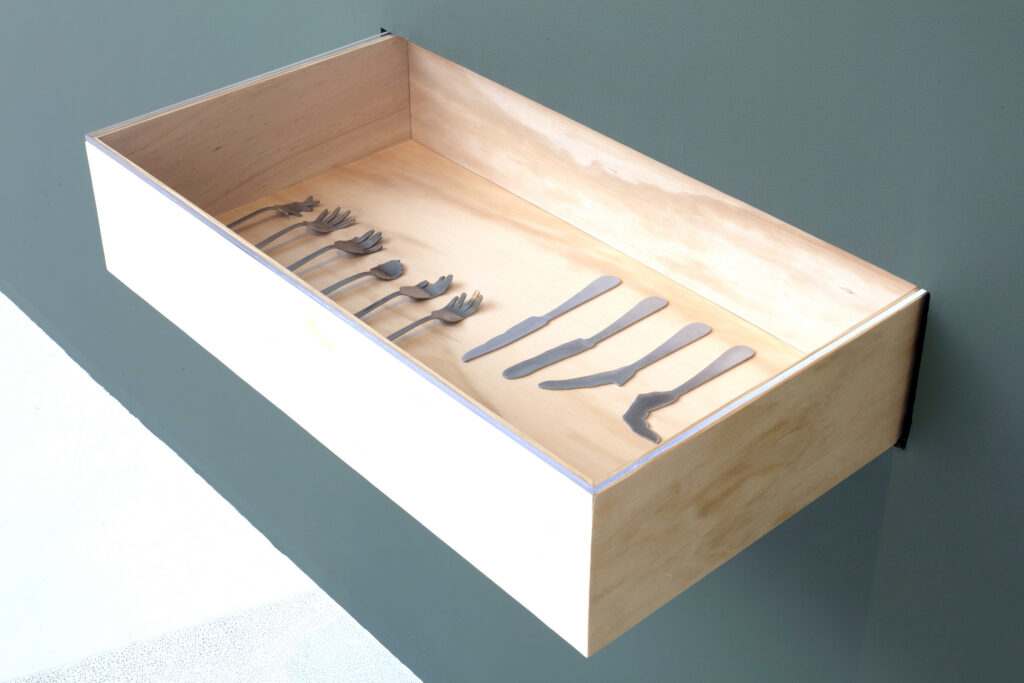
This logic extends beyond the body. Across the exhibition, everyday objects are similarly estranged, their familiar forms bent just enough to frustrate recognition and use. Table Manners (2026)—a set of six stainless steel knives and forks—embodies this distorted, derailed sensation. The forks’ tines are irregular, or absent altogether; the knives’ blades warp into uneven and erratic contours, several of them bent, folding as if they aimed to clasp something, much like a finger. The utensils, not fully functional, appear almost gestural, as though attempting to narrate something. This tactic rises to an absurd level in Spouts (2025), an aluminum teapot with a vaguely Ganesh-like body and five protruding spouts—its playful resistance against serving a utilitarian purpose recalls Meret Oppenheim’s surrealist Luncheon in Fur (1936).
The exhibition’s austere layout revolves around a central boxlike structure, a room inside the massive gallery. The imposing surrounding walls are painted in muted greens that complement the museographic elements—robust plinths, oversize frames, thick shelves—made of bare wood. That combination eases the viewer into the structure’s interior, where the film Catfish Mother Puddle of Juice (2026) is projected. Moving among a natural history collection’s storage room, a verdant landscape, and scenes of domestic intimacy, the film tells a fragmentary story of a little girl and her mother through scenes of mutual care: They draw together, comb their hair, caress each other. A catfish—a highly adaptable and scaleless freshwater fish with prominent whiskers—is the unlikely narrator, speaking in Spanish through a feminine voice-over. Rather than treating motherhood as an innate condition, the catfish repeatedly describes imitation, adaptation, and separation as its defining processes. For instance, it asks whether mimicry—imitation—requires awareness, later reflecting that “it’s hard to say where imitation stops and something like evolution begins. A child adores their mother; a mother rejects her child. Her body rehearses separation long before it happens.” However ludicrous, the catfish becomes a stand-in for a form of motherhood shaped by adaptation, contingency, and mutable relations between bodies and environments. On a small screen inside a circular cutout in the adjacent wall, also inside the video cabin, is another video, a looped interview with a scientist specializing in catfish research. Scientific discourse and speculative narration coexist here without resolving each other. Bishouty places scientific knowledge alongside fiction, suggesting that archives are assembled through competing modes of narration rather than singular truths.
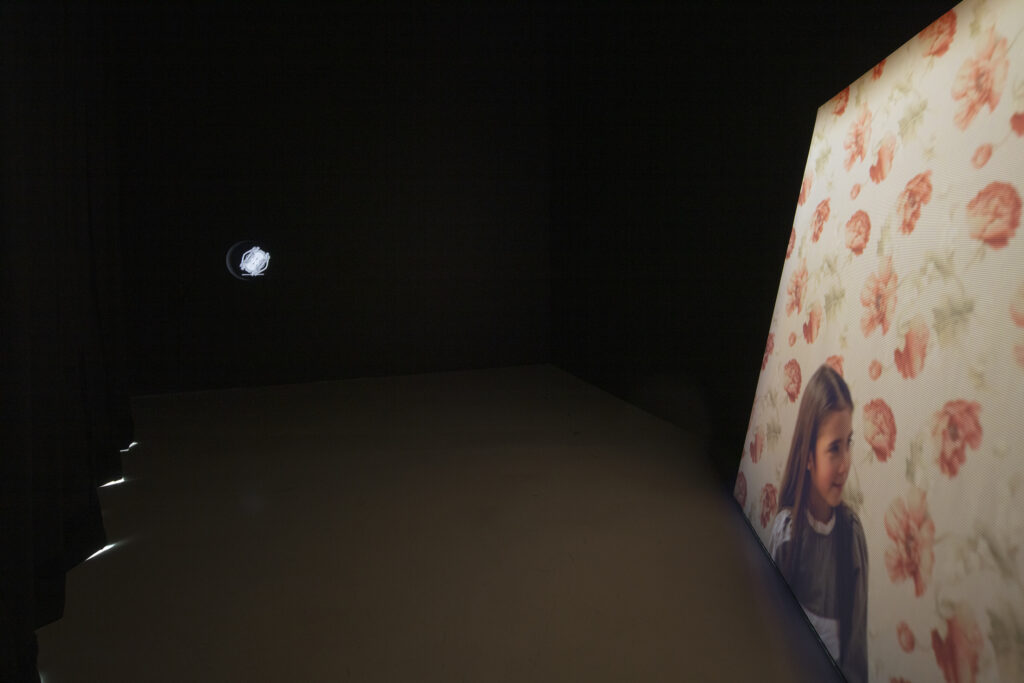
Even though the artist’s own mother has a palpable presence in this work, it is difficult to attribute the titular “unlikely mother” to a singular figure. Rather than naming a person, the term seems to designate a mode of disturbance through which objects and images are birthed or come into being. The “unlikely mother” stands in sharp contrast to the likely father (pater): the authoritative model through which forms, narratives, and identities become stabilized—and reproducible. The archive, in this sense, is never abandoned but continuously reshaped through repetition, mutation, and speculation. Bishouty’s refusal of fixed patterns in favor of malformed utensils, adaptive creatures, and gestural drawings unsettles the expectation that diasporic artists render their histories immediately legible through documentary clarity, explicit testimony, or recognizable political symbols. The exhibition’s playful approach to archival form begins to resemble what Gil Hochberg calls a “disturbance”: a speculative form of testimony oriented less toward the evidentiary demands of the present than toward futures the present still struggles to apprehend.







Contribute your thoughts by leaving a reply