







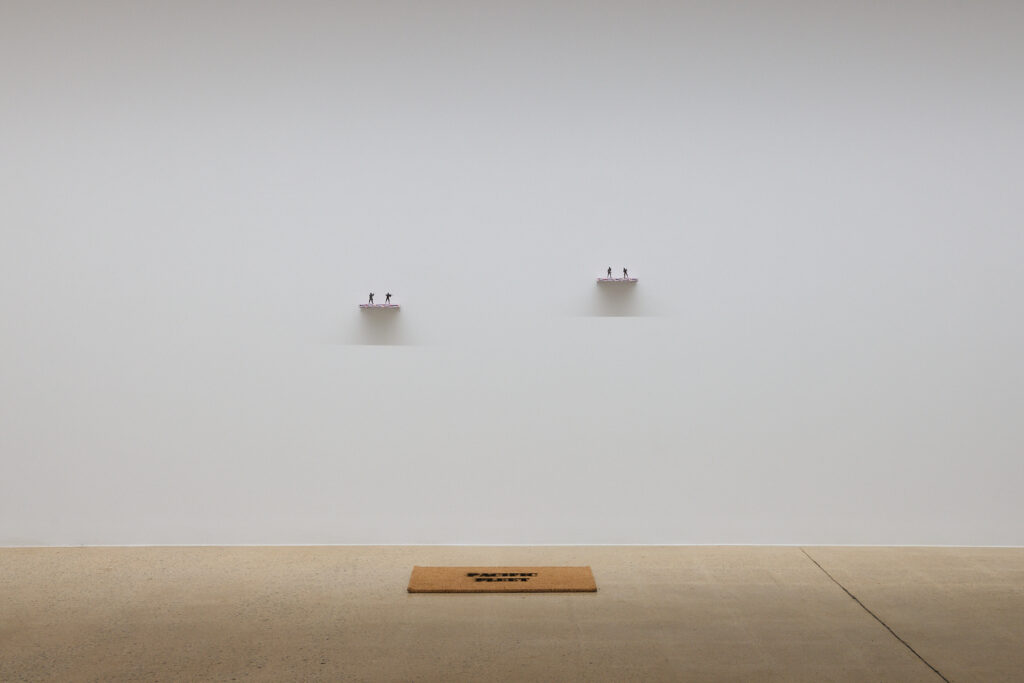
In Joyce Joumaa’s exhibition Prologue, music from the second, back gallery bled into the first: “اﻟﺑﺣر ﺑﻌﺷق اﻧﺎ – اﻟﺻﻐﯾرة ﻧﺟﺎة, I Love the Sea”(1979), a ballad sung by Nagat El Saghira. Small sculptures arranged across the room—military allusions everywhere—included miniature figurines of soldiers bearing, holding, and aiming firearms. They occupied small shelves made of Bazooka bubble gum. Doormats, spaced out across the floor, guided us through the gallery. Though typically used to greet guests in domestic spaces and clean off the dirt of the outside world before we settle inside, these doormats do not offer the warmth expected of the home. Rather, they display terms like “Internal Crisis,” “Pacific Fleet,” and “Compromise Cabinet,” military expressions for actions designed to keep out or, as is in many countries at war now, destroy the domestic. They convey a sense of trespass, of soldiers not wiping their feet before barging in. The melancholic voice of El Saghira stayed with us, nostalgic for a Lebanon before the intervention.
Prologue, recently on view at Galerie UQO at Université du Québec en Outaouais and curated by Heather Canlas-Rigg, explored this intervention through the lens of a nationalist cartography of the sea, where territorial control and geopolitical desire converge. It was here that the exhibition’s concerns began to resonate beyond Lebanon. In Haiti, my country of origin, the American occupation that began in 1915 reshaped the parliamentary system into a representational democracy designed to maintain an imperialist grip on governance. This restructuring enabled the violent dictatorship that ruled from the 1950s to the 1980s, ostensibly to contain the spread of Communist ideals in the Caribbean. To this day, American political meddling affects the lives of Haitians both locally and in the diaspora. Joumaa’s practice speaks to a comparable history of intervention in Lebanon. Many of her video works—Electoral Photogeny (2018), Merging, Dissecting, Collecting (2021), and To Remain in the No Longer (2023)—draw on archival material to foreground the cyclical nature of American colonialism and its enduring effects.
Entering the gallery, we found the generous text written by Canlas-Rigg, which laid out the exhibition in full. The terms were defined, the path through the space was implicitly mapped, and each work was prefigured in analysis. Yet the exhibition itself resisted this degree of prescription.
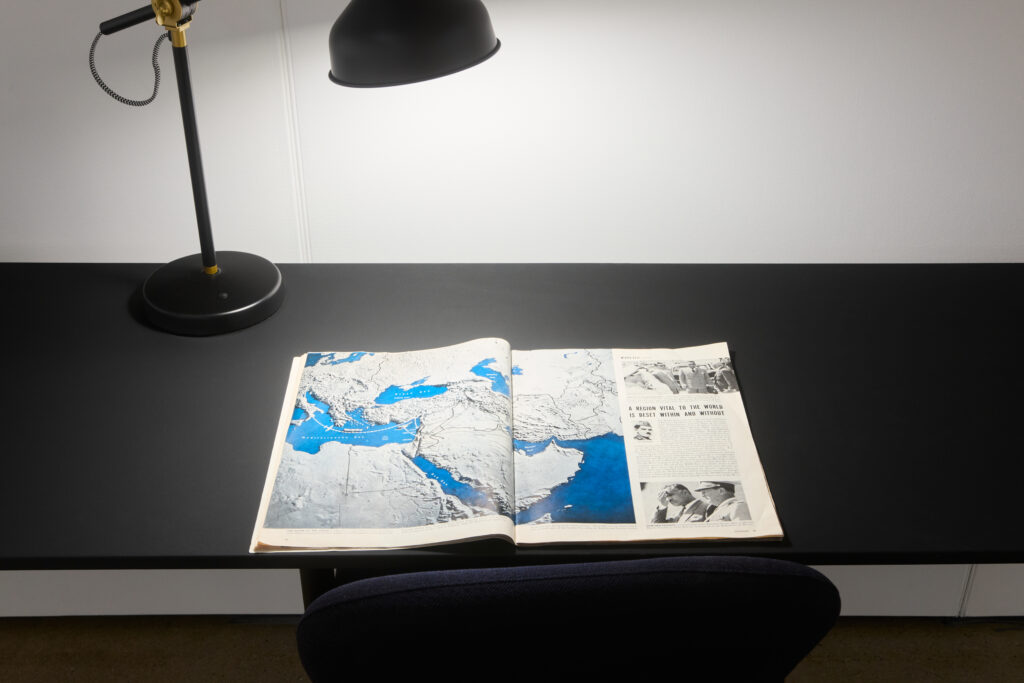
The first gallery was punctuated by a July 28, 1958, copy of Life magazine placed on a large black table with a single chair and a desk lamp, where visitors could sit and flip through it. I did so and was immediately seized by the headline “THE MARINES HAVE LANDED…” The article reads like a novel:
Again it was a week of crisis and showdown … This time the threat was the turbulent Middle East. On the streets of Beirut, Lebanese youngsters gathered to gawk at US Marines in full battle dress. The Marines, for their part, were asking, “What are we doing here?” From Washington, President Eisenhower radioed the answer, “You are helping the Lebanese people to remain free,” he said.
The article contains photos and stories of other Marine occupations around the world, presenting American intervention as a global project of “peace” in countries like China, Nicaragua, and Libya. All the while, the melancholic refrain of “اﻟﺑﺣر ﺑﻌﺷق اﻧﺎ – اﻟﺻﻐﯾرة ﻧﺟﺎة, I Love the Sea,” lamented the loss lurking in the magazine’s subtext. The seas the singer loves so intensely, from the Mediterranean and Aegean to the Black and Caribbean, aren’t sites of freedom but control, folded into the broader geography of American pacification.
One image in particular returned me to my own point of entry: Marines departing Haiti in a truck, passing beneath an arch bearing the name of President François C. Antoine Simon, with the caption recounting the US occupation from 1915 to 1934. The photograph collapses distance, drawing Haiti into the same visual and political field as Lebanon. In this way, Joumaa’s inclusion of the Life issue underscored the centrality of archival documents, with their ability to become instruments of imperial narrativizing, to her practice.
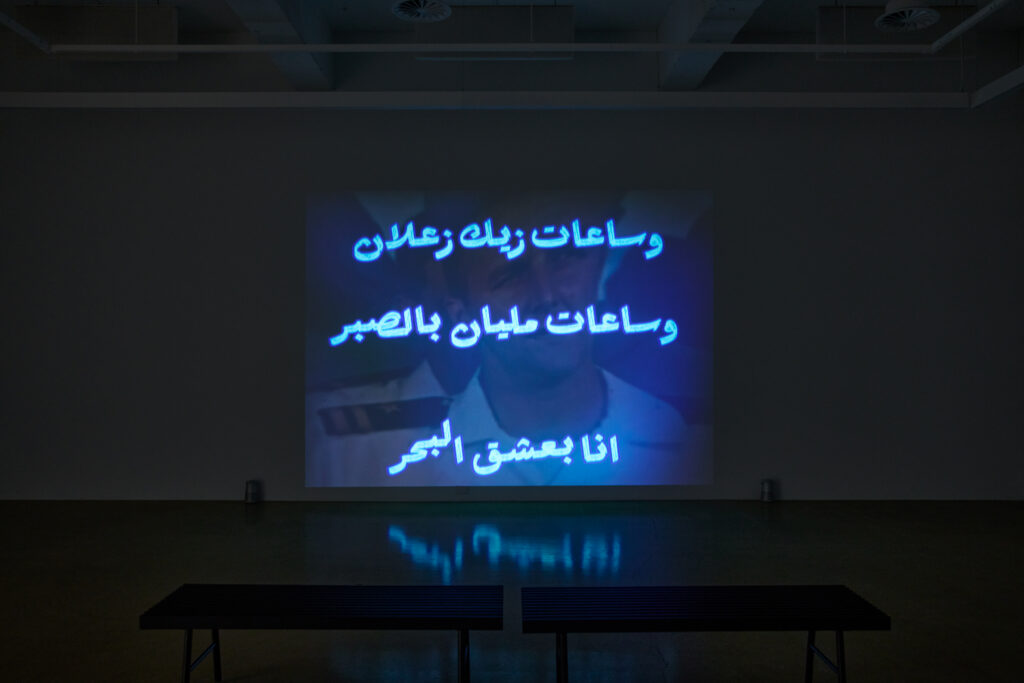
The video work Prologue comprises found television footage used by US officials to broadcast and promote the occupation. Distorted, blue-toned images of men preparing their float, saluting the flag, moving on the deck, lying in their quarters, and getting ready to “help Lebanese people remain free” appear in the background. In the foreground, the lyrics of “اﻟﺑﺣر ﺑﻌﺷق اﻧﺎ – اﻟﺻﻐﯾرة ﻧﺟﺎة, I Love the Sea,” typed in a large blue font, scroll upward. As with a karaoke video, we could sing along to El Saghira, whose voice had become overfamiliar during the time spent in the space, her song now an earworm. Its repetition ensured that the song stayed with us even beyond the exhibition. Although her voice was soothing—as she tells her beloved how she loves the sea because it is tender, it immigrates and travels like them—it also had an alienating effect, as the sound was imposed on us while we watched these men deploy across the sea without its consent. The consequences of their occupation persist for the Lebanese people, long after these men have departed from their land and sea—a persistence that feels especially acute in the present moment, as Lebanon once again faces US-funded violence and devastation.
Although Joumaa works with heavy subject matter, her practice retains a sense of poetry and subtlety. It makes us aware of Lebanon’s political histories while also expressing how dear the country is to her, and how central it remains to her artistic practice. Lebanon is on repeat, but never a broken record.






Contribute your thoughts by leaving a reply