






Artists exhibiting at Brussels’s Établissement d’en Face are faced with an unusual choice. The long-standing artist-run space is currently situated in a former law office across the street from the Palais de Justice, an enormous 19th-century Greco-Roman courthouse overlooking the northeast of the city. The Palais de Justice could be seen as a dichotomous symbol of Belgium, both a haunting spectacle (or specter) of the country’s colonial-carceral legacy and a joke about its disordered nonchalance; defunct scaffolding has flanked the courthouse’s gilded dome since 1984. I’ve seldom felt closer to the monstrousness of its architecture as from inside Établissement d’en Face. Artists must choose, then, whether or not to confront this imposing view. Brussels-based artist Fabrice Schneider has opted to obscure it.
For his solo exhibition Mars, Schneider has composed a psychodrama of interiors. In his treatment, the exhibition space is not a set, but a player alongside the objects that inhabit it. Together, they invite viewers to meditate on the passage of time through gestures of analysis, control, measurement, and mourning. Motifs of public and private, family and work life repeat across the exhibition, each instance revealing further indexical traces of affect. Windows in particular—or, more precisely, the obstruction of them—emerge as a kind of chorus, mediating the exhibition’s relationship to the paternalistic machinations of the outside world.

Schneider is unafraid to wade into ambiguity. He is perhaps best known for his photographic work, more recently of the rock climbing community, through which he makes cool observations on the capitalist desire for ascension. Sequencing is central to his process, extracting meaning from the values photographs produce when put in relation. It’s unsurprising, then, that for this arresting breakthrough exhibition, he would give equal attention to conducting the emotions of the space around the artworks. With Mars, Schneider reveals himself as an artist deeply attuned to the dramatic aura not just of things, but of the spaces that hold them, demonstrating that they are continuous, in a mutually reliant feedback loop.
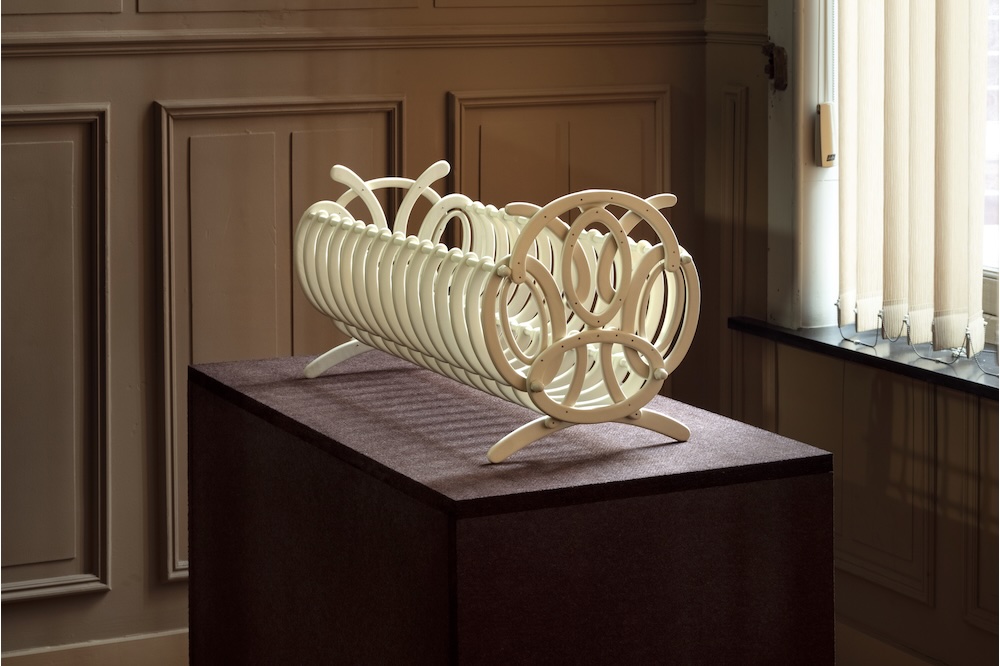
The exhibition opens onto a somber bel-étage room, its jalousie blinds closed in precise degrees. The largest window has been completely shuttered, while a second lets in just enough light to illuminate the room’s only contents: a crib resting on a table (Table Jardinière/Ivory Crib, all works 2026) in its farthest corner. The crib’s emptiness suggests a sudden loss more than anticipation. Its shape is so narrow that it’s functionally useless, but so stylistically bodily that it conjures a tight ribcage. Light pouring through adjacent window blinds mimics its skeletal motif, casting contemplative shadows across the room. The light begins to appear as an external threat, like the pitying look that so often accompanies grief from outside.
Upstairs, a bay window has been painted over, the courthouse conspicuously blocked from view. A Streisand effect is produced here: Masking the windows makes their presence grow more pronounced, imbuing the space with a hermetic tension further underscored by Schneider’s preoccupation with sequencing. In Untitled (Exercise), a fabric-topped table presents an array of hardware from Établissement d’en Face. Screws of various shapes and sizes are arranged in lilting horizontal rows, like a lorem ipsum of ineffable personal logic, the unvalidated unconscious at work. It’s a performatively futile, but nimble, way to make sense of the literal underpinnings of one’s surroundings and all the lives (and art) they have held.
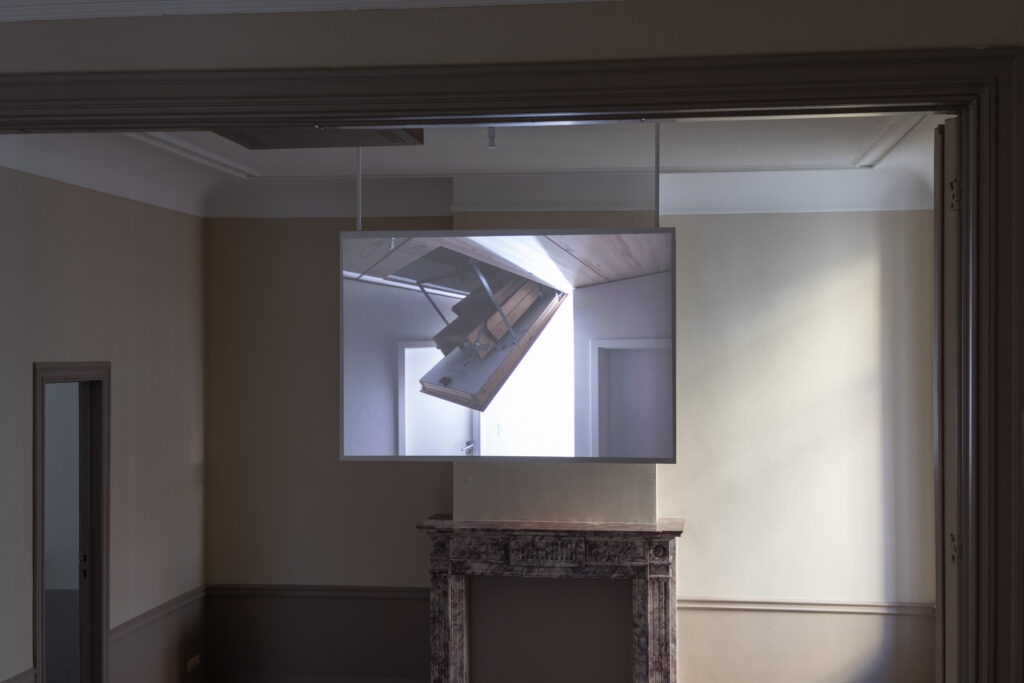
Two nearby films share this rhythmic meditation: First, a stop-motion slideshow that catalogs the mechanics of an attic trap door opening and closing, its descending ladder folding and unfolding (Untitled, Slideshow), is projected onto a screen suspended close to the ceiling. A fireplace—another kind of portal—is visible just behind the screen, within the film’s sight line. Schneider seems more interested here in conjuring an opening than in the slog of combing through the contents that lie beyond it. As the film’s central motion repeats, aberrance seeps in: Schneider has in fact photographed not one, but many attic trap doors, all operating within the nondescript aesthetic conditions of a middle-class northern European family home. Meticulously documented DIY design decisions—a slatted pine roof here, a special kind of hook there—reinforce the universality of seeking tidy solutions for stowing away emotions.
Motifs of repetition and difference carry into a second video (Untitled [Peter]), playing on a mobile phone left charging on a shabby little veneered shelf. Its placement is a sly provocation of audience agency: The impulse is to pick up the phone, but to do so might be an invasion of privacy (or a contravention of unspoken rules). On-screen, a man sits in a cinderblock hallway crowded with chairs, pointing and nodding to his surroundings. Here, again, meaning arises from the uncanny realization that his mundane gestures are caught in a perfect 20-second loop; the video succeeds in the structuralist prosody of its seamless repetition.
The final floor of the exhibition once again begins with an object perched alone in a darkened room. Untitled (Porte Bouteille) appears, ostensibly, as a retirement gift, and, as a memento of working life, it proves fantastically abstruse: Braided copper wires wrapped in linen line its bifurcated ribbed cylinder. A brass plaque reads: “Evocation de 35 ans de Mesures – Mesures et Analyses” (“Looking back on 35 years of measurements – Measures and Analyses”). It is a readymade in the Duchampian sense, but less a quip about authenticity in the age of reproduction than a commentary on the way time is contained by and within objects—an observation made all the more poignant by the artwork’s intimate orientation: Its inscription faces inward, so that a viewer must touch their head against the wall to read it.

In the exhibition’s final room, four tables, trimmed with prim skirting more often encountered at a catered corporate event, each display eight framed black-and-white magazine images (Untitled). They depict parents (mostly fathers) and children (mostly sons)—all of whom are affluent and white (they are, of course, hired models)—reenacting seminal moments. Who and what are these images for, and who is in control? Could I be the daddy taking my son to my corner office? Or the daughter playfully covering my mother’s eyes? With the adjacent windows completely painted over, the ceremonial display of bourgeois family life (presumably what the powers that undergird the Palais de Justice want) is cloistered away for private consumption. With jarring dramaturgy, the work is conspicuously lit by a bulb dangling overhead, its reflections intruding on the glass-topped images below. Light neither enters nor leaves the room, and so like in a shopping mall, time progresses not according to circadian rhythms, but to the canned beat of the aspirational nuclear family.
From across the street, Schneider’s window treatments resemble a milky void. This is all the more apt given that Établissement d’en Face, like so many independent cultural spaces in Europe and beyond, currently faces existential public funding cuts in the name of Neoliberal austerity. Schneider’s introspection begins to feel like a protective foil against the future’s uncertainty.
Mars reminds me of architectural theorist Beatriz Colomina’s reading of Adolf Loos’s modernist interiors, when she wrote that architecture is “not simply a platform that accommodates the viewing subject. It is a viewing mechanism that produces the subject.” Schneider’s greatest strength lies in is his ability to draw out the dramatic potential of negative space, revealing nested layers of affect between objects and time, time and its keeper, the keeper and its keeper. His psychodrama, though, ultimately transcends the interior.








Contribute your thoughts by leaving a reply