








Fatigue, unease, impotence, premature baldness: These are just some of the wide-ranging symptoms of Americanitis. First named around the 1870s and described by physicians of the time as an excess of nervous energy, the illness was believed to be caused by living too fast alongside the high demands of modern life.
Well over a century later, artist Alison Pebworth discovered this now long-forgotten disease and its ambiguous cures. She became fascinated, first by the history of the illness and then with how it might manifest in the twenty-first-century patient. Her show Cultural Apothecary, currently on display at MASS MoCA, transposes the 19th-century diagnosis onto the current moment, explores the root causes of a contemporary version of Americanitis, and invites us into the search for a cure. A painter, community artist, and researcher, Pebworth has been exhibiting across North America for over twenty-five years, and, for the past year, she has been based in nearby North Adams, Massachusetts, living and working on the town’s main thoroughfare, collaborating with passersby, and hosting pop-up events in a research residency that prepared her for and now complements this show. The exhibition itself recalls at once a small-town drugstore, science fair, and laboratory, charmingly familiar and still probing.
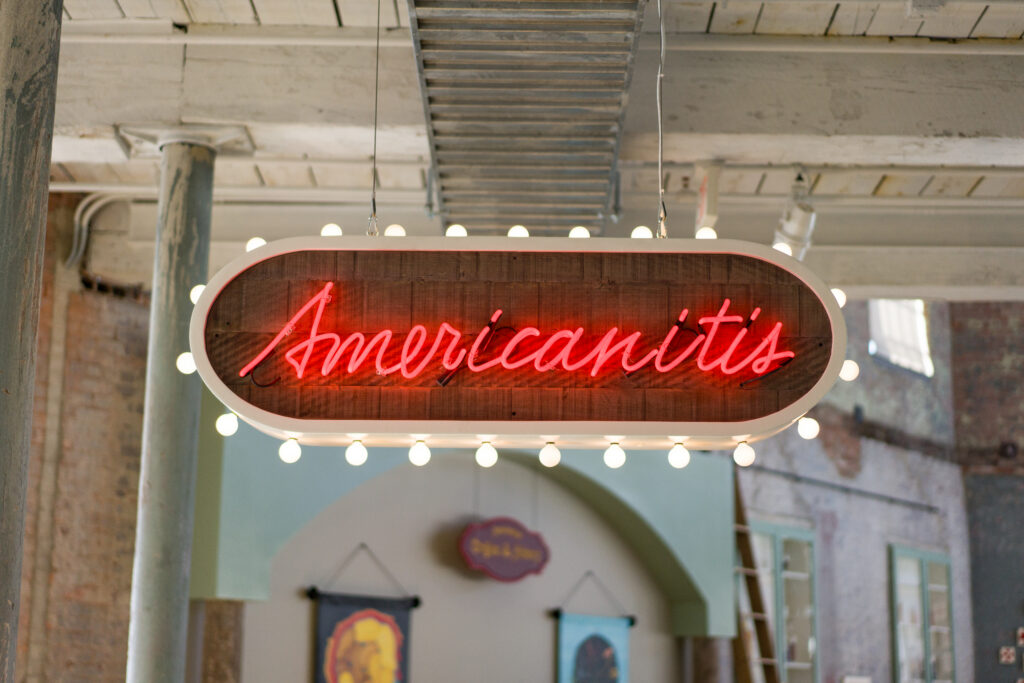
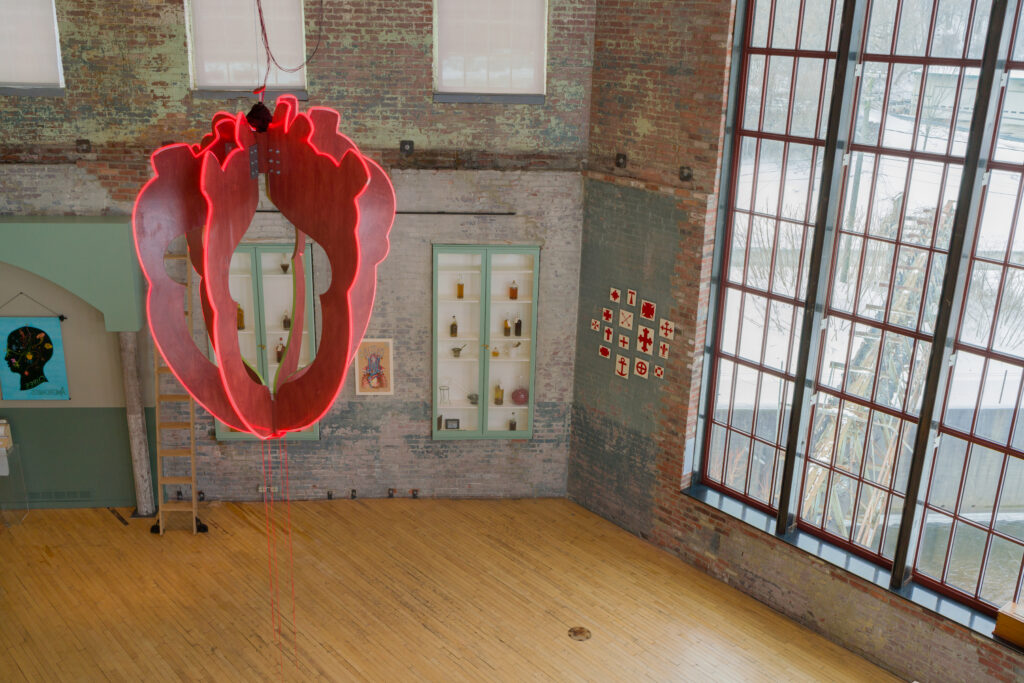
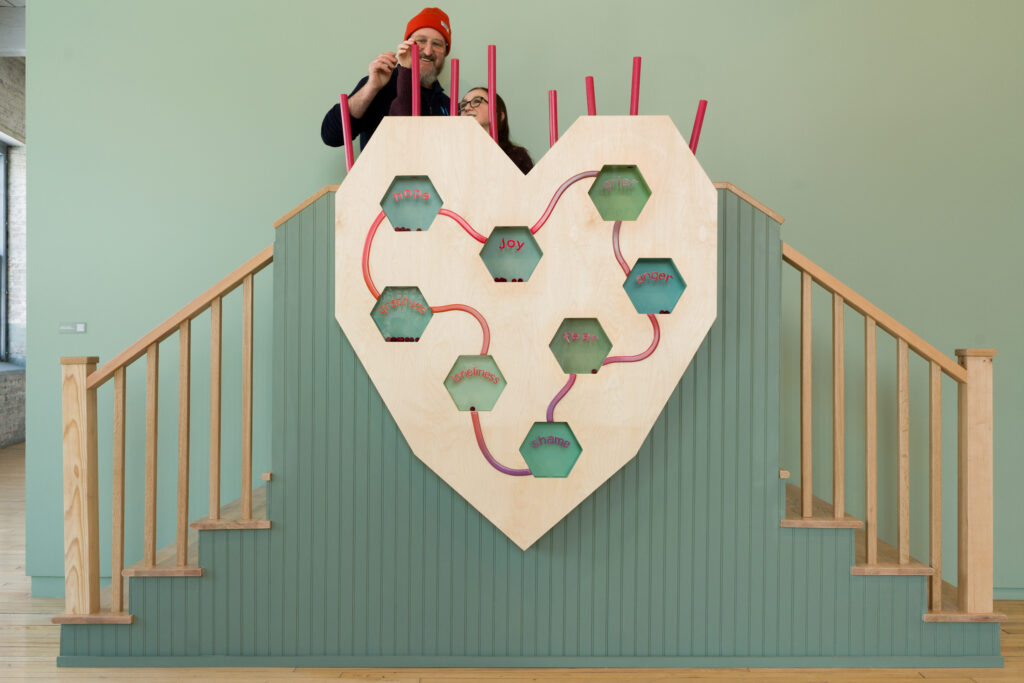
Beckoning visitors from across the gallery, a red neon roadside-style sign, a nostalgic take on classic Americana, spells out “Americanitis.” Every weekend at a bar along a far wall, Pebworth and gallery attendants serve a tea laced with locally sourced ingredients like birch and maple sugar. As they swivel on their barstools, visitors are offered a droplet-shaped piece of paper and invited to write down their hopes for the future. These drops are sewn with a red thread onto The Future Has an Ancient Heart (all works 2025), a large anatomical heart that hangs in the center of the gallery. Thousands of wishes from past visitors pour from the heart and pool on the floor. Visitors are also given a red bead and invited to vote for how they are feeling in the Heart Tally, a large wooden heart with slots for different emotions ranging from joy and gratitude to anger and loneliness.
This is Pebworth’s way of collecting data: Throughout the show visitors help shape the installation through their reflections. Every week, Pebworth counts the Heart Tally votes and adds the results to hand-drawn graphs on display nearby. Other data is collected through two long paper scrolls that sit atop plexiglass display cases, on which visitors may write their thoughts on the causes (“overconsumption,” “that damn cellphone!”) and cures (“connection with community,” “empathy,” “slowing down”) of Americanitis. As people record their ideas and wind the scrolls, the hundreds of feet of handwritten responses curl around inside the cases, and the answers become buried within the folds.
With the news cycle growing ever bleaker, it often seems like there is little hope, and my own nervous energy spikes. I’ve found myself asking, Am I suffering from Americanitis? Are we all?
How did you first learn about Americanitis?
In the 2010s, I was researching the traveling medicine show and I came across an ad for a cure for Americanitis. I hadn’t heard of it before, but my initial reaction was, Oh my gosh, I suffer from Americanitis! I found an old book on Americanitis and the elixir cure on eBay, and that was when my interest was really piqued.
At the time, I was traveling across the country from the West Coast to East Coast—kind of a reverse migration of manifest destiny—with my show Beautiful Possibility. As part of that show, I created a survey which listed the common symptoms, causes, and cures, and asked people whether they recognized Americanitis in themselves. Cultural Apothecary grew out of that.
It’s interesting that Americanitis was first discovered—or named, rather—between the 1870s and 1890s. At that time the country was still relatively young and was undergoing a huge amount of expansion and development. What do you think the similarities are between that time period and the one that we’re living in now?
During the Industrial Revolution there was this speeding up of life, and people were moving from an agrarian society into the cities. They were regulating themselves by the clock for the first time, and the railroad was connecting places that had previously been unconnected. There was all this creation and new technologies that were changing the way of life at a crazy pace, and people didn’t know how to deal with it. It’s actually very similar to what is happening today, with the rise of AI and the pressures of social media. We are having to constantly adjust to new technologies that none of us fully understand.
That was the robber baron era, when a small group of people were able to get incredibly wealthy through monopolizing industries, and [it] definitely bears a resemblance to society today, or some aspects of society! Everything is just faster, bigger, more, and maybe none of us are quite keeping up.
A show about Americanitis could be a bit doom and gloom, but one of the things that really struck me is how beautiful it is, and joyful and fun.
Thank you for saying that, because that’s really important to me.
How do you balance your aesthetic sensibility with the data collection, the more science-y aspect of the show?
I want people to come into it viscerally. The other important thing is accessibility: It has to resonate with people.
The science and the data collection were never meant to be the predominant thing. I mean, what do I know about science or data collection or anything?! I’m just kind of playing with our very American obsession with data and slowing it down into a visceral experience, and using play as its own critique of our dependence on consumer-driven analysis.
I am trying to find that balance. I mean, I think what set me on this whole journey in the first place, was, like, I fucking hate this world. But then I had this revelation that the only way to escape this world is to learn to love it. You know, we’re all expected to live, work, exist within these systems, and I don’t think many of us even understand them! I’m trying to find my comfort spot within the world.
How did you initially transition from painting into this much more multimedia, social way of working?
My early influences were alchemical, hermetic manuscripts. I understand the visual language of these processes, when depicted through images rather than words, to hide chemical secrets for turning base metals into gold. Looking at them deeply enough, you start to realize that there’s an internal correlation in these processes. Even forms of philosophy (like the philosopher’s stone) grew out of these correlations. When I went into painting I was like, OK, maybe I don’t have all these experiences, but I do have these visual tools to depict where I am now and try to make them relatable to other people.
I couldn’t stand that cloistered life of [making] paintings and then displaying them in a white box that only a handful of people will visit or can afford. So I built a cabinet for my paintings and took them out on the road. I built a tent that I could set up in different environments and invite people in for collaboration. That’s how I came into social practice. It’s been one long journey to understand how to make myself accessible. I was kind of refusing to join prescribed pathways, and I want to bring people along with me.
To that point, the whole time the show has been on at MASS MoCA, you’ve been living and working with the local community in North Adams, right? What have you learned from that?
I really credit the director of MASS MoCA, Kristy Edmunds, for the opportunity, because I just met her by chance, but she quickly recognized what my project was about. She saw that there needed to be a connection between the community and the museum, so she invited me for a research and development residency.
I found an empty storefront on Eagle Street, one of the oldest street in North Adams and right in the center of the downtown area. It has these big storefront windows, so it was the perfect place for me to get to know the community. It felt very aligned with my love of roadside attractions. It’s a total fishbowl. Even in group studios, I’ve never been one to keep my door open or anything. I’m a very private person. Here, I am totally on display, especially at night, which is when I do most of my work. This felt foreign to me at first, but now it just really feels like what I’m supposed to be doing. I love seeing people go by on the street. There are some people I’ve never spoken to, but we have a relationship through the window, you know?
That sounds amazing. I want to ask about the tea service part of the exhibition. Where did the idea for that come from? What is it about counter service that appealed to you?
That’s also part of the whole process of how to be accessible. I had a big painting show in San Francisco in 1999, and I purposely found a gallery that was also a bar. It’s important for me that people are able to sit with works. You’re never going to get much from a quick walk by. The bar stool, the fixed seat, that’s very important. You know, you can’t move away. All the years that I lived on the road, I found the counters in diners to be such a comfortable place for a single person to interact with whoever is sitting next to you.
Your family has a history with drugstores and drinks counters, right?
My mom’s family ran a drugstore, so she grew up there, working behind the soda fountain counter. I mean, I grew up in the woods, so it always seemed so romantic to me, the idea of sitting at a bar and just talking to people. My aunt met her husband over the counter.
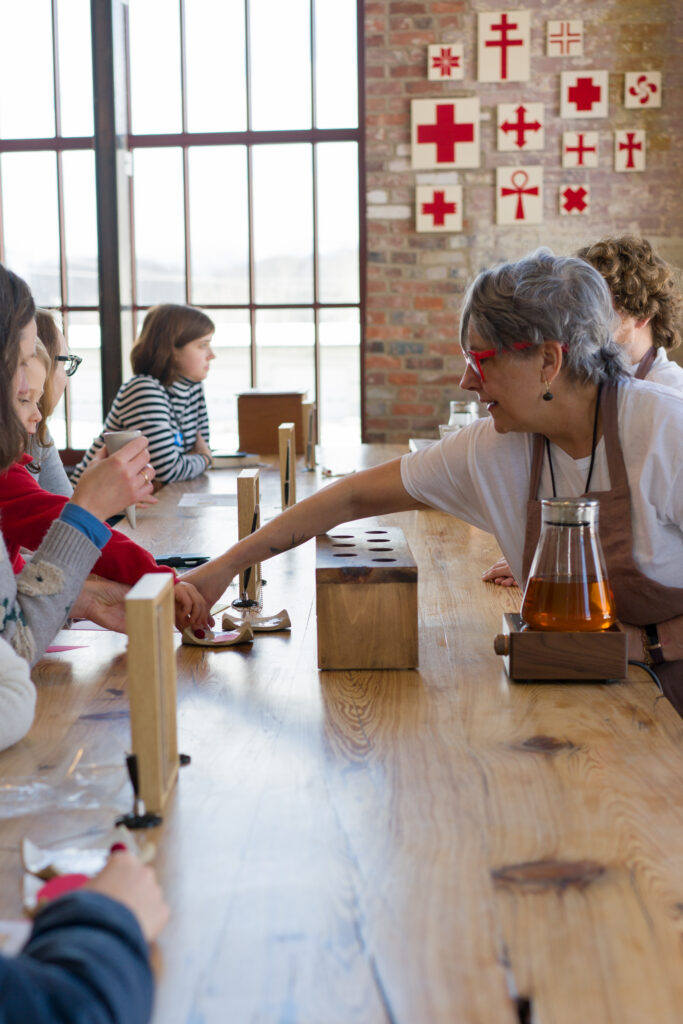
What about the tea that you’re serving in Cultural Apothecary?
The tea is made of turmeric, other herbs, and locally sourced plants, and has anti-inflammatory properties. I mean, -itis literally means inflammation. It’s an inflammation of the American. The tea is a kind of restorative cure. But really the [tea service] is about taking the time to sit, reflect, absorb. It’s a place that is comfortable for single people, isolated people, whoever!
The show’s been open for a little over a year at this point. Have you been able to glean any insights?
In the Heart Tally, where people record their emotions, I’ve been surprised how consistent responses are. I expected there to be more fluctuations. Hope and gratitude are consistently the top emotions that people pick. I have read that hope is the main human emotion, so maybe it is just showing how alike we all are. I can see subtle changes in how often people record feeling fear and grief, when certain things happen in the world. When the kids are off school and there are more of them visiting, I get spikes in joy.
The Future Has an Ancient Heart, where people write down their buried dreams, is definitely the most emotional. The default is for people to wish for peace. I find it really powerful how many people have taken the time to really sit with it, bare themselves a little bit.
I’m working through the causes and cures from the scrolls that people write on. I have maybe seven or eight hundred feet of data, which is crazy. It’s been fascinating to see how easily people respond to causes and cures, and how many people have really taken the time to go deep.
Is there any hope for us?
I’m uncertain about a human-centric Earth, but I feel like hope lies in the universe, and that’s what we have to cultivate.
There are a lot of references to nature throughout the show—for example, there is an acorn in the middle of the central heart. We’ve become aliens from the natural world. We need to find these correlations again. I think that disconnection from the natural world is at the root of our disease. On the scroll that asks for cures, people have written countless times things like “get outside” or “delete your TikTok.” I do think that we are starting to see a subtle trend towards reconnecting with our instincts, our intuition. I am hopeful that that can happen. I am putting my trust in the universe and connection. There are people out there trying—and that has to mean something.







Contribute your thoughts by leaving a reply